Following the recent U.S. military intervention in Venezuela, a new poll suggests almost a third of Canadians say the United States might attempt "direct action" to take control of Canada.
It suggests one-in-five Americans think the same.
The Leger poll, which was conducted online and can't be assigned a margin of error, surveyed 1,540 Canadians between Jan. 9 and Jan. 11.
The poll suggests many Canadians believe the U.S. likely will attempt to take control of other countries in the future, including Greenland, Cuba, Colombia, Panama, Iran and Canada.
When asked to rate the likelihood of a U.S. attempt at direct action to take control of various countries in the future, 31 per cent of Canadian respondents said the United States likely will attempt direct action to take over Canada.
Another 55 per cent said such action was likely in Greenland, 51 per cent said the U.S. will probably intervene in Cuba, 47 per cent said it would go after Colombia, 47 per cent cited Panama and 36 per cent predicted American intervention in Iran.
The poll, which also surveyed 1,011 American respondents, also suggests 20 per cent of Americans think the U.S. government might attempt direct action to take control of Canada in the future.
More than half of Canadians surveyed think the American intervention in Venezuela violated the country’s sovereignty and sets a bad precedent.
Asked whether they agreed with certain statements, 53 per cent of Canadian respondents said they felt the U.S. intervention "ultimately was a bad thing because it is a serious violation of a country’s sovereignty and sets a terrible precedent for other countries to do the same. International order is threatened."
The survey reports another 23 per cent of Canadian respondents said the U.S. operation "ultimately was a good thing as (Venezuelan President Nicolas) Maduro was a corrupt dictator and his government was hurting ordinary Venezuelans. With him gone there is a chance for a better government."
The poll suggests that almost two-thirds of Canadians have followed developments involving the U.S. and Venezuela closely, while 35 per cent have not.
Andrew Enns, Leger's executive vice-president for Central Canada, told The Canadian Press that the older generation is the most "caught up" in the situation.
The poll suggests 77 per cent of Canadians aged 55 and older are following the developments closely, compared with 55 per cent of people aged 35 to 54 and 60 per cent of people aged 18 to 34.
"It kind of keeps those embers of patriotism and that 'defend Canada' burning pretty strong, which I think is helpful for the prime minister and his government at this time," Enns said.
A majority of Canadians — 56 per cent — said the U.S. military operation in Venezuela has worsened their impression of the U.S. government.
Nine per cent of Canadian respondents said it has improved their impression of the government, while 21 per cent said their opinion hasn't changed.
Enns said in the current environment, Canadians' opinions of the American government are not "very high to begin with" so "it doesn't take much."
The poll suggests 37 per cent of respondents in the U.S. reported the military operation worsened their impression of their government, while 20 per cent said it improved their impression and 27 per cent said their impression of the government had not changed.
Just under 40 per cent of American respondents said the U.S. intervention was a bad thing because it violated Venezuela’s sovereignty, while 35 per cent said it was a good thing.
The poll suggests nearly two-thirds of Canadians believe the U.S. intervened primarily to gain control of Venezuela’s oil reserves, while 13 per cent said it was to bring Maduro before a court of law to account for his crimes and seven per cent said it was to restore democracy in Venezuela.
"It's interesting times for Canadians. They're not sure what to expect," Enns said.
The polling industry’s professional body, the Canadian Research Insights Council, says online surveys cannot be assigned a margin of error because they do not randomly sample the population.
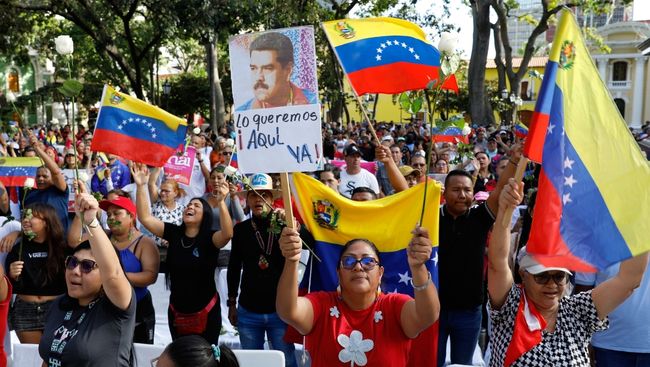
Picture Courtesy: AP Photo/Cristian Hernandez