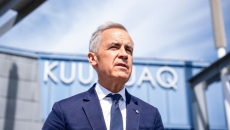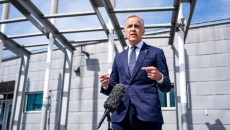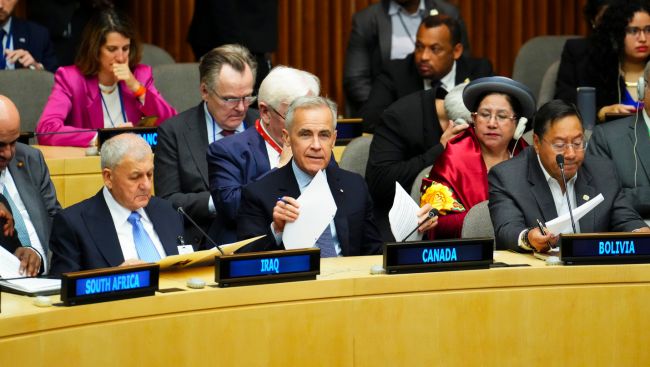
Prime Minister Mark Carney's vision of middle powers working with less traditional partners outside the superpower club is already taking shape at the United Nations, says Canada's ambassador.
"We have set up a number of different kinds of relationships that work for specific issues," said David Lametti, Canada's ambassador to the UN. "And that's precisely the manner in which I think Prime Minister Carney has envisaged this, for areas outside of the UN."
Carney attracted global attention this January with a speech to the World Economic Forum in Davos urging middle powers to band together to advance their interests and avoid being subjugated by superpowers.
The prime minister also has sought to shift Canadian foreign policy from one dependent on traditional allies to a new vision of what he has called "variable geometry." He described that approach last November as "dynamic, overlapping, pragmatic coalitions, built around shared interests, and occasionally shared values, rather than shared institutions."
Carney gave the example of tackling climate change through trade rules set by the European Union, technology standards drafted by China and India, and nature-based solutions supplied by Brazil.
"We've been practising variable geometry at the UN probably since the beginning," said Lametti.
Lametti said Canada has long sought to work at the UN with countries representing various regions and interests to seek consensus on important issues.
"At the UN, it happens all the time," he said.
Canada's foreign policy tends to be framed around the idea that an international rules-based order makes it easier for smaller countries to defend themselves and trade with others.
Lametti said a major part of his job is overseeing what he calls "the middle powers agenda" of like-minded countries working to preserve international law and resolve crises.
He pointed to a UN group of nations co-ordinating efforts to tackle Haiti's gang crisis. The group is co-led by Ottawa and Washington but also includes Central American governments threatened by uncontrolled migration and smuggling.
There's a bloc of UN nations advocating for human rights that calls itself the Mountains Group; member states Canada, Australia, Iceland, Liechtenstein, New Zealand, Norway and Switzerland all have large mountain ranges. Lametti said the work of the Mountains Group has become more prominent as Washington has stepped back from championing human rights at the UN.
Lametti said he has worked with his counterparts from Australia and New Zealand on matters ranging from the involvement of women in conflict and peacekeeping to the Israel-Palestine conflict.
"It's something that allows us to pool work. We're like-minded countries, we share values and we can work more efficiently," he said.
Another example Lametti cited is the JUSCANZ group — pronounced "juice cans" — which seeks to co-ordinate how multiple countries, including Canada, Japan, the U.S., Australia, New Zealand, Turkey and South Korea, share information on policies affecting developed countries outside the European Union.
Lametti said Canada is trying to advance issues "that are increasingly important to the prime minister and the direction of government" through these groups — issues ranging from the safe adoption of artificial intelligence to the protection of civilians in conflict zones.
He said Carney's work to link the Comprehensive and Progressive Agreement for Trans-Pacific Partnership trading bloc with the European Union is an example of efforts outside the UN to preserve rules-based trade. The move comes amid economic coercion by both the U.S. and China.
At a virtual panel held Monday by the NATO Association of Canada, Lametti also said "re-establishing" good relations with China and India is a vital Canadian interest.
"I don't think we're abandoning our traditional alliances so much as we are adding to them," he said. "All of this is part of, I would say, building onto relationships that we previously had."
Picture Courtesy: THE CANADIAN PRESS/Sean Kilpatrick