Tuesday, June 9, 2026
ADVT 
National

B.C. boosts rebate for electric vehicles

Darpan News Desk The Canadian Press, 03 Aug, 2022 03:45 PM
  • B.C. boosts rebate for electric vehicles

The British Columbia government says it is improving its rebate program for electric vehicles to make them more affordable and accessible. 

A statement from the Ministry of Energy, Mines and Low Carbon Innovation says the maximum provincial rebate for battery-electric, fuel-cell electric and long-range plug-in hybrid electric vehicles climbs from $3,000 to $4,000. 

The maximum rebate for lower-range plug-in hybrid electric vehicles increases to $2,000 from the previous high of $1,500.

The ministry says eligibility for a rebate will be based on income levels, with an individual making up to $80,000, or a household with an income up to $125,000, eligible for the maximum rebate.

As personal or household income climbs, rebate eligibility decreases on a sliding scale until those with a personal income above $100,000 or households with incomes above $165,000 are no longer entitled to the discount.

The statement says 2020 income tax returns show more than 90 per cent of B.C. residents are eligible for an EV rebate and can save as much as $9,000 on the purchase or lease of a new electric vehicle when combined with federal incentives.

The president of the New Car Dealers Association of B.C. says the revised rebates will make zero-emission vehicles more affordable for lower-income individuals.

Blair Qualey says the changes are "positive steps" and his association is anticipating more.

“While we can appreciate that government always faces the difficult position of trying to manage program spending and budgets, we will be watching how changes for higher-income participants may impact (zero-emission vehicle) uptake," Qualey says in a statement.

The price cap to determine eligibility for vehicle rebates in B.C. remains at a maximum of $55,000 for compact and full-sized cars, but the Energy Ministry statement says a second category is being added to support those requiring larger EVs, such as soon-to-arrive minivans, sport utility vehicles and pickup trucks.

 The cap for those vehicles has been set at a maximum retail price of $70,000, the statement says.
MORE National ARTICLES

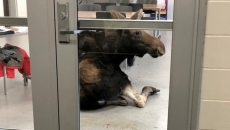
Moose crashes into Saskatoon classroom

Moose crashes into Saskatoon classroom
Veronica Baker, a spokeswoman for Saskatoon Public Schools, says a before-school program was taking place in the room when the unexpected visitor made its dramatic entrance.

Moose crashes into Saskatoon classroom

Champagne's D.C. takeaway: more meetings

Champagne's D.C. takeaway: more meetings
Champagne says the two sides talked about how to strengthen cross-border supply chains, the potential role of Canada's critical-minerals industry and meeting shared climate goals.

Champagne's D.C. takeaway: more meetings

BC Wildfire Service releases 2021 wildfire summary

BC Wildfire Service releases 2021 wildfire summary
A 2021 wildfire summary says about $565 million was spent in the "tremendously challenging" period between April 1 and Sept. 30, when 1,610 wildfires charred 8,682 square kilometres, mainly in southern and southeastern B.C.

BC Wildfire Service releases 2021 wildfire summary

Growth was cancerous in B.C. premier's throat

Growth was cancerous in B.C. premier's throat
British Columbia Premier John Horgan says a biopsy has shown a growth in his throat was cancerous. In a statement Thursday, he said his prognosis is good and he expects to make a full recovery.

Growth was cancerous in B.C. premier's throat

Apple CEO Tim Cook sends Diwali message to Indians

Apple CEO Tim Cook sends Diwali message to Indians
The year 2021 has been exceptionally good for Apple in India and despite supply constraints, the tech giant doubled its India market share in its fiscal year that ended on September 30, Cook had recently announced.

Apple CEO Tim Cook sends Diwali message to Indians

Growth in health spending tripled in 2020: CIHI

Growth in health spending tripled in 2020: CIHI
Health spending is projected to have increased 12.8 per cent between 2019 and 2020. That's more than triple the average annual growth rate seen from 2015 to 2019, which was approximately four per cent per year. Spending is estimated to have increased another 2.2 per cent between 2020 and 2021.    

Growth in health spending tripled in 2020: CIHI