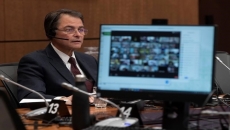
Bloc Québécois Leader Yves-François Blanchet is intensifying efforts to draw a line separating his party's values from those of the Trudeau Liberals, particularly on the fraught ground of free speech.
Blanchet said Monday that Justin Trudeau's response to attacks in France that authorities have attributed to Muslim extremists does not go far enough, and that the prime minister is "failing in his duty to denounce absolutely" the assault on secularism and freedom of expression.
Trudeau is harming Quebec's friendship with France, Blanchet said, calling for solidarity "without nuance." In a tweet posted Sunday, he sought to align his province with that country's cherished "republican and secular" principles in contrast to an "Anglo-Saxon multiculturalist doctrine."
"I’m ashamed that some French people could believe that what Mr. Trudeau has said is what Quebecers think," Blanchet said at a news conference Monday.
The stern words add to Blanchet's criticism of the prime minister's reaction to a University of Ottawa professor's use of a notoriously derogatory word for Black people in class.
They also preceded a House vote on another divisive issue: a Bloc motion demanding an apology from the government for having invoked controversial legislation during the October Crisis in Quebec 50 years ago.
The motion, tabled by Blanchet last week, was defeated Monday with the Liberals and Conservatives opposed and the Bloc, NDP and Greens in favour.
Last week, Trudeau condemned the attacks in France as "heinous" acts of terrorism that fly in the face of Canadian values and said Ottawa "would always defend freedom of expression, but freedom of expression is not without limits."
"In a pluralistic, diverse and respectful society like ours, we must be aware of the impact of our words, of our actions on others, particularly these communities and populations who still experience enormous discrimination," Trudeau told reporters in French on Friday.
The debate continued in the House of Commons on Monday afternoon, with the Conservatives joining Bloc MPs in demanding harsher denunciations while Foreign Affairs Minister François-Philippe Champagne replied that Canada will continue "to be one of the great champions of freedom of expression."
Quebec Premier François Legault weighed in on Monday, saying he disagrees with the prime minister's stance on free speech — despite the Charter of Rights and Freedoms' assertion that all rights and freedoms are subject to "reasonable limits."
"I agree with (French President) Emmanuel Macron. Accusing people who draw cartoons cannot be used to justify violence," Legault said in French. "Freedom of expression must be protected.
France has suffered multiple acts of violence amid a growing furor over caricatures of the Prophet Muhammad that were republished by the satirical newspaper Charlie Hebdo.
Extremists attacked the Charlie Hebdo newsroom in January 2015, after the caricatures were first published, and killed 12 people.
Since the cartoons' reprinting in September at the start of the ongoing Paris trial over the killings, the country has endured three attacks blamed on Muslim extremists.
One saw two people injured outside the newspaper's old headquarters, allegedly by a teenage refugee from Pakistan.
On Oct. 16, a teacher was beheaded outside his school in suburban Paris for opening a class debate on free speech by showing students the caricatures.
And on Thursday came a deadly knife attack in a church in the Mediterranean city of Nice.
Blanchet noted that Trudeau did not acknowledge the gruesome killing of teacher Samuel Paty by an 18-year-old refugee of Chechen origin until 11 days after the incident, when the Bloc Québécois brought forward a House of Commons motion condemning it.
Freedom of expression and cultural sensitivity have stirred up heated debate in a Canadian context as well.
Last month, the Bloc pushed the government on a racial slur uttered in a university classroom, demanding the Liberals state unequivocally whether they supported the professor at the heart of the controversy.
Blanchet said those subjected to hateful words deserve compassion and support, but using the term in an educational context isn't bigoted.
Trudeau had told the House of Commons that "we all need to be conscious of the power of our words."
On Monday, the Bloc motion calling for an apology for the government's response to a crisis in Quebec five decades ago marked another point of division.
In October 1970, the Liberal government under then-prime minister Pierre Trudeau decided to suspend civil liberties by invoking the statute then known as the War Measures Act in response to the kidnapping of a Quebec cabinet minister and a British diplomat by members of the militant FLQ separatist group.
The move, which came at the request of the Quebec premier and Montreal's mayor, led to soldiers patrolling the streets as authorities rounded up hundreds of residents under suspicion of involvement in the abductions.