Eight fewer departments and agencies are being asked to slash their budgets at least 15 per cent over the next three years, a move one economist says shows Ottawa's cost cutting exercise was not "thought through."
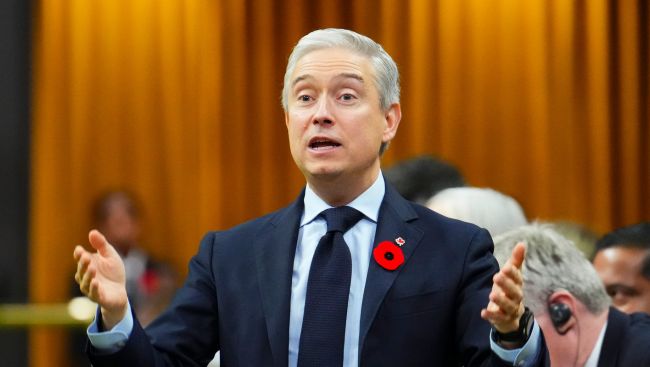
Earlier this year, Finance Minister François-Philippe Champagne directed most ministers to find ways to cut their departments' program spending by 15 per cent over the next three years.
At the time, the government said National Defence, the RCMP and the Canada Border Services Agency would have lower savings targets of two per cent.
The federal budget proposes to add eight more departments to that list.
They include the Crown-Indigenous Relations and Northern Affairs Canada, Indigenous Services Canada and the Department for Women and Gender Equality.
The other government bodies facing two per cent cuts are the Natural Sciences and Engineering Research Council, the Social Sciences and Humanities Research Council, the Canadian Institutes of Health Research, the Canadian Security Intelligence Service and the Communications Security Establishment.
Benoit Mayrand, a spokesperson for the Department of Finance, said the government changed some of the savings targets for various reasons, citing the need to attract top research talent and to advance reconciliation and the rights of women and LGBTQ+ communities.
David Macdonald, a senior economist with the Canadian Centre for Policy Alternatives, said Crown-Indigenous Relations and Northern Affairs Canada, Indigenous Services Canada and the research granting councils likely were added to the two per cent list because they're largely transfer departments — meaning they don't operate a lot of programs but they move money around in the form of grants.
"You couldn't avoid cuts to those end users. It's not something you could absorb through efficiency or through federal public sector worker cuts," Macdonald said. "You would end up with very perverse outcomes like elementary school funding on First Nations being cut."
The decision to reduce the savings target for Women and Gender Equality, Macdonald said, was likely a political one made in response to an outcry over funding cuts. He said the government may want to be seen as supporting the gender equity work done under the government of former prime minister Justin Trudeau.
LGBTQ+ and women's groups said in September they were bracing for funding cuts. Sen. Marilou McPhedran attacked the prospect of cuts to programs for women and pointed out that the Liberals were re-elected in the spring in part due to support from women.
Macdonald said it's "odd" that CSIS and CSE weren't already on the two per cent list, given that defence and security agencies were on the initial list. He said that may have been an "oversight."
Macdonald said it's possible that more departments and agencies will see their savings targets reduced, since the spending review seems to be a "moving target."
"I don't think it was well thought through," he said. "I don't think any of this is a particularly good idea."
The federal budget outlined a plan to lower program spending and administration costs by about $60 billion over the next five years.
It said savings will be achieved by "restructuring operations and consolidating internal services and rightsizing programs to realize efficiencies." It also said the spending review will involve workforce adjustment and attrition to return the size of the public service to a more "sustainable level."
Macdonald said it's not clear which programs are going to be cut to meet the targets.
An annex at the back of the budget provided some hints. It says Agriculture and Agri-Food Canada, for example, plans to wind down "some programs outside its core mandate," like the Agricultural Climate Solution Living Labs.
The annex says the Canada Revenue Agency plans to wind down business units that are "no longer connected to government priorities," including units supporting the Digital Services Tax, the Federal Fuel Charge and the Canada Carbon Rebate.
The Canada Border Services Agency said it plans to reduce the frequency of fleet vehicle replacement, extending its fleet life cycle from seven to 10 years.
Former clerk of the Privy Council Michael Wernick said in an email that some of the organizations on the two per cent list have "nothing to spend on except their salary budgets and a little bit of IT."
He said he doesn't understand why the intelligence agencies face any cuts at all.
"I am guessing they didn’t want to exempt anyone entirely or there would (be) pressure to exempt more," Wernick said.
"The real crunch will come about halfway through the fiscal year next fall, when organizations see if they are on track to stay within those smaller budget caps. It may get uncomfortable for some the closer they get to year end."
Picture Courtesy: THE CANADIAN PRESS/Sean Kilpatrick