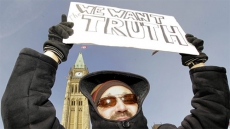
A gunman killed a soldier at the National War Memorial on Wednesday before being shot in Parliament Hill's Center Block. Prime Minister Stephen Harper said the attack will harden Canada's resolve to crack down on terrorists at home and abroad. Here are some past terrorism cases and terrorism allegations, as well as cases in which politicians or legislatures were attacked or such attacks were allegedly plotted:
2014: Two days prior to the latest incident, two Canadian soldiers were run over — one of them later died — in Quebec by a man authorities believed had jihadist sympathies. Martin Couture-Rouleau, 25, was shot and killed by police.
2013: Two people were arrested and charged with conspiring to blow up the British Columbia legislative building in the midst of Canada Day festivities. John Nuttall and Amanda Korody are each charged with knowingly facilitating a terrorist activity, making or possessing an explosive device, and conspiracy to place an explosive device with the intent to cause death or injury. None of the charges have been proven in court. The couple is scheduled to stand trial in January 2015.
2013: Chiheb Esseghaier and Raed Jaser were charged in connection with a plot — allegedly guided by al-Qaida in Iran — to attack a Via Rail/Amtrak passenger train that runs between Toronto and New York City. None of the charges have been proven in court. The pair are expected to stand trial in 2015.
2010: Police made three arrests in an alleged plot to commit acts of terror on Canadian soil. Misbahuddin Ahmed of Ottawa was convicted of two terrorism-related offences in July 2014. Hiva Mohammad Alizadeh pleaded guilty in September to possessing explosives with an intent to do harm and was sentenced to 24 years in prison. The third man arrested was acquitted of conspiring to facilitate terrorism.
2009: Software engineer Momin Khawaja, the first person charged under the Anti-Terrorism Act, was convicted for his role in a plot to plant fertilizer bombs in the United Kingdom. Khawaja, who is serving a life sentence, has denied the charges.
2006: Police in Toronto arrested a large group of young men who later became known as the Toronto 18. They are accused of plotting to bomb targets including the Toronto Stock Exchange, CSIS headquarters and a military base. Eleven were ultimately convicted of terrorist offences. In January 2010, one of the men, Zakaria Amara of Mississauga, Ont., was sentenced to life in prison. Fellow suspect Saad Gaya from Oakville, Ont., was sentenced to 12 years.
1995: Quebec sovereignty supporter Andre Dallaire entered the prime minister's residence at 24 Sussex Drive while Jean Chretien and his wife were sleeping. He confronted Aline Chretien at the bedroom door. She summoned Mounties while the prime minister snatched up an Inuit sculpture in case the intruder crashed the door. Dallaire was found guilty of attempted murder, but was found not be criminally responsible because of his mental state.
1985: An Air India flight that departed from the Vancouver airport exploded in the skies over the Atlantic Ocean, killing all 329 people on board. Two Canadians were tried for the bombing, but were ultimately acquitted of mass murder. Only one conviction has been obtained in the case. Inderjit Singh Reyat, who pleaded guilty to manslaughter in the case, was convicted of perjury in 2010.
1984: Three people were killed when Canadian army supply clerk Denis Lortie opened fire inside the National Assembly in Quebec City in a bid to "destroy" Premier Rene Levesque. Lortie was convicted of first-degree murder after his first trial in 1985 but a new trial was ordered because of errors by the judge. In 1987, he pleaded guilty to reduced charges of second-degree murder, allowing him to be eligible for parole after 10 years.
1970: The October Crisis begins as the Front de Liberation du Quebec kidnaps British diplomat James Cross and, later, Labour Minister Pierre Laporte. Prime Minister Pierre Trudeau invokes the War Measures Act, which allows government to temporarily suspend civil liberties. Cross is released 60 days later but Laporte is found dead.
1966: Paul Joseph Chartier, an unemployed Toronto security guard with emotional problems, blew himself up with a bomb in a washroom down the hall from the public gallery of the House of Commons. His notes suggested he planned to throw his bomb onto the floor of the chamber.