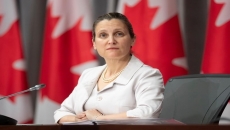
Foreign Affairs Minister François-Philippe Champagne was recently pondering Canada's place in the world from his home in Shawinigan, Que., "the command centre of foreign policy, these days," as he called it.
"Pax Americana is probably behind us," Champagne said in the interview. "Now, we need to see what's our interests, our values and our principles. We can advance them with our traditional partners, and also with new alliances around the world."
Champagne never mentioned Donald Trump by name, nor did he specifically mention the wrecking ball the U.S. president has taken to the international institutions created out of the devastation of the Second World War — the United Nations, the World Bank, NATO and others — that were devoted to ensuring a sustainable global peace.
But he was clearly noting how part of that postwar deal, the notion of the superpower America leading that new multilateral order by supporting and enforcing "American Peace" had clearly devolved toward "America First" over the last four years.
Canada had to adapt to that primarily because its economic fate is inextricably tied to its top trading partner south of the 49th parallel.
So Canada's foreign policy morphed, drawing on the playbook of gridiron football played on this continent — Canada did an end run around the United States. Here are five ways that played out:
End running the White House on NAFTA
Trump repeatedly called the North American Free Trade Agreement the worst trade deal ever and threatened many times to rip it up. Canada responded to his existential economic threat with a "Team Canada" approach that eventually helped forge a new trilateral trade deal in 2019. This saw cabinet ministers, provincial premiers, business and union leaders target individual members of the U.S. Congress, state governors, local politicians and business counterparts. The Canadians were armed with data that showed exactly where in the U.S. Canadian products were going, and sought to show in dollar terms that trade with Canada was essential to the U.S. It was distilled into this talking point: Canada is the chief export market of 35 U.S. states, and nine million U.S. jobs depends directly on that. "I think that has to be a permanent campaign because … our (COVID-19) recovery is going to depend, once again, on the United States," said retired diplomat Colin Robertson, who held several postings throughout the U.S.
Fixing the World Trade Organization without the U.S.
Canada led more than a dozen countries — minus the U.S. and China — in an effort to reform the World Trade Organization, which Trump calls "horrible." Trade Minister Mary Ng convened the Ottawa Group virtually this past week, following the work started by her predecessor Jim Carr, to find ways to make the world's trade referee work more effectively and then try to win over the U.S. with solid proposals. The U.S. has essentially crippled WTO's Appellate Body, one of its dispute-settlement arms, because it declined late last year to appoint new judges. Canadian trade lawyer Lawrence Herman said the U.S. has valid criticism of the WTO but is doing nothing to fix it. "They are being unilaterally obstructionist," he said. "They are basically saying, 'We don't like what's happening, and we are prepared to put a freeze on a lot of WTO processes.'"
Reaching out to Europe
Trump has defunded the UN World Health Organization because, he says, it conspired with China to downplay the threat of COVID-19 in January. Canada continues to support the WHO and joined with the European Union in May to support its anti-pandemic efforts. Before that, Canada joined France and Germany to be part of a new group called the Alliance for Multilateralism. The U.S. wasn't invited. Its goal: defend the global institutions fighting for their survival. In April, the alliance issued a statement supporting the WHO and saying the pandemic fight "requires more and enhanced international co-operation and worldwide solidarity." Bessma Momani, an international affairs expert at the University of Waterloo, said the new alliance represents a "symbolic" broadside against populist political movements in Poland, Hungary, Italy and within France itself. "The signalling there is really, really interesting," she said. "I don't think there's a lot of substantive outcome one should expect from the France-Germany-Canada alliance."
Stoking the fire with the old British BFF
Champagne made a special point of stopping in Britain to meet personally with his British counterpart, Dominic Raab, on his late summer four-country trip. Since then, Canada and Britain taken joint action on some high-profile international security issues, levelling sanctions against the autocratic leaders of Belarus and calling for a ceasefire in the fighting between Azerbaijan and Armenia. Raab and Champagne also joined forces with Germany to condemn Russia for its poisoning of opposition leader Alexei Navalny. While Canada may appreciate the newly rekindled camaraderie, Momani said British Prime Minister Boris Johnson likely feels the same, given his country's decision to stage a Brexit and leave the European Union, because it shows "they still have friends in the world."
Building a coalition to counter China
The U.S. request to extradite Chinese executive Meng Wanzhou has made Canada, and its two imprisoned citizens, Michael Kovrig and Michael Spavor, collateral damage in Trump's trade war with China. Trump's Secretary of State Mike Pompeo has spoken out forcefully about the detention and the president told Prime Minister Justin Trudeau in June 2019 that he would see what he could do about the two Michaels in an upcoming conversation with Chinese President Xi Jinping. It's not clear what Trump did on that front. Meanwhile, Canada has built a coalition of support in the international community that has extended beyond the U.S. to several dozen countries, a move that has angered Beijing. David MacNaughton, Canada's former ambassador to the U.S., said this past week all help on China is welcomed, including from the Americans, because what lies ahead is a "decade-long struggle in terms of redefining the relationship between the West and China."