Donald Trump's key tool for deploying tariffs faced tough questions from the conservative-led U.S. Supreme Court on Wednesday as justices considered a decision that could upend the president's plans to rapidly realign global trade.
Neal Katyal, the attorney representing businesses pushing back on Trump's tariffs, told the hearing that Trump has "torn up the entire tariff architecture."
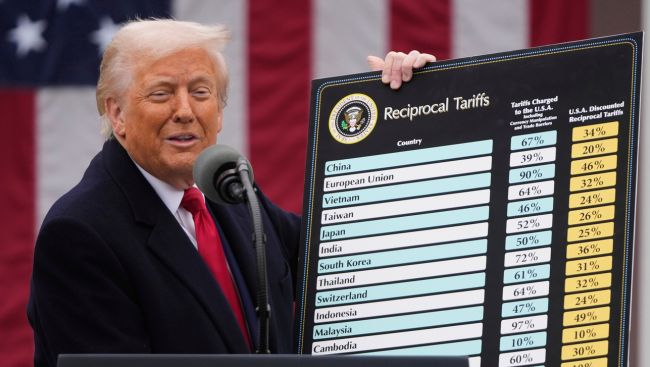
Trump used the International Emergency Economic Powers Act of 1977, known as IEEPA, for his "Liberation Day" tariffs and fentanyl-related duties on Canada, Mexico and China.
During a nearly three-hour hearing Wednesday, the Supreme Court justices parsed the language in IEEPA — particularly the wording about the president's "power to regulate importation" — to decide whether the law allows for tariffs.
The U.S. Constitution reserves power over taxation and tariffs for Congress.
Trump's top Supreme Court lawyer Solicitor General D. John Sauer faced pointed questions from the justices about the fact that the text of IEEPA does not mention tariffs.
Justices asked Sauer how the president could use the law to tax American citizens. Sauer replied that Trump's tariffs are regulatory and their main purpose is not to raise revenue — despite the president's repeated claim that the duties will make the United States rich again.
"You want to say tariffs are not taxes, but they are," said Justice Sonia Sotomayor, who was appointed under the Obama administration.
Republican-appointed justices also voiced skepticism about the Trump administration's claim that IEEPA allows the president to impose tariffs.
Chief Justice John Roberts noted that IEEPA "has never been used before to justify tariffs." Presidents have used IEEPA many times for things like sanctions, but Trump is the first to use it for tariffs.
Justices are also considering the major questions doctrine — a legal principle requiring clear congressional authorization on economically or politically significant issues — and the non-delegation doctrine, a principle that prohibits Congress from ceding its legislative power to other branches of government.
The president hit most of the world with what his administration has called "reciprocal" tariffs after declaring an emergency over trade deficits. Experts and economists have pushed back, saying trade deficits do not constitute an emergency.
Trump hit Canada with 25 per cent economywide tariffs in March by declaring an emergency at the northern border related to the flow of fentanyl. These tariffs don’t apply to goods compliant with the Canada-U.S.-Mexico Agreement on trade.
Despite Ottawa introducing border security measures to address Trump's concerns about the deadly drug, the president boosted those duties to 35 per cent in August as trade negotiations between the two countries deteriorated.
U.S. government data shows a minuscule volume of fentanyl is seized at the northern border compared to the volumes seized at the United States' border with Mexico.
Prime Minister Mark Carney seemed to steady bilateral relations during a White House visit last month — but Trump again suspended talks after Ontario sponsored a TV ad quoting former president Ronald Reagan criticizing tariffs.
Trump subsequently threatened an additional 10 per cent duty and claimed Canada was trying to influence the Supreme Court ahead of Wednesday's hearing.
Justice Sotomayor brought up the tariff threats linked to the Ontario ad during Wednesday's hearing.
"Does a statute that gives, without limit, the power to a president to impose this kind of tax, does it require more than the word 'regulate'?" Sotomayor said.
America's top court could have until June to issue a ruling but it's expected to come much sooner.
While Trump had suggested that he might show up for the hearing, he travelled to Florida on Wednesday. Treasury Secretary Scott Bessent, Commerce Secretary Howard Lutnick and Trade Representative Jamieson Greer were in attendance.
After the hearing, Bessent told reporters at the White House that Sauer made a powerful case for Trump to maintain IEEPA tariff powers and claimed the other side "fell flat on their face."
Clark Packard, a research fellow in trade policy at the Washington-based Cato Institute, said the hearing was like a "Super Bowl" for trade lawyers.
Cato submitted an amicus brief — a legal submission from a group that's not party to the action — arguing against the tariffs to the Supreme Court.
The fundamental question before the court, Packard said, is "can the president alone rewrite the U.S. tariff code under the guise of an emergency and strip that power away entirely from Congress?"
There are certainly economic harms at play in the case, Packard added, but Trump's tariff tactic could also "usurp Congress's clearly delegated powers in the Constitution."
Packard said some Republican-appointed justices were skeptical of the Trump administration's "expansive claims" but they were ultimately tough on both sides — including the lawyers arguing against the tariffs.
Some of the ever-shifting tariffs on Canada would diminish if the court rules against Trump's use of IEEPA, but White House Press Secretary Karoline Leavitt said Tuesday the Trump administration is "always preparing for plan B."
The Supreme Court’s decision will not affect Trump's expanding use of tariffs under Section 232 of the Trade Expansion Act of 1962 — tariffs that are already hammering Canada's steel, aluminum, automobile, lumber and copper industries.
Picture Courtesy: AP Photo/Mark Schiefelbein, File