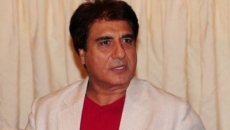
KARACHI, Pakistan (AP) — Two Pakistani women sit together on a couch, rehearsing their lines while a director scrutinizes them. Waiting off camera for his scene is the male lead, an actor blessed with “Bachelor” hair and fine bone structure.
Also out of sight: the Islamabad homeowners, who are holed up in a separate room and whose furniture and knick-knacks will be seen by millions of viewers — many from the society that has been their country's neighbor and uneasy sparring partner for much of the past century.
This is the set of the Pakistani drama “Adhi Bewafai,” or “Half Infidelity” — one of what some in other nations would call “soap operas." But these dramas, it turns out, are not just for Pakistanis.
Realistic settings, natural dialogue and almost workaday plots about families and marriages make Pakistani dramas a hit with viewers at home and abroad — especially in the neighboring country that split with Pakistan in 1947 and is its nuclear archrival today: India.
Television, it seems, is succeeding where diplomacysometimes can't.
A glimpse into life across the border
Several thousand people work in Pakistan’s drama industry; the country produces between 80 to 120 shows a year, each one a source of escapism and intrigue. They offer Indians a tantalizing glimpse into life across the border — and manage to break through decades of enmity between the two governments.
Maheen Shafeeq, a research associate at the Institute of Strategic Studies in Islamabad, says there is effectively no relationship between the two governments. Each government is fixed on a single issue it cannot move past — for India, it’s terrorism; for Pakistan, the disputed territory of Jammu and Kashmir. “The governments are very much opposed to each other,” she says. “They don’t agree what they should talk about.”
Although it’s difficult for Indians to visit Pakistan, where these shows are filmed, they faithfully follow the plot twists and turns through platforms like YouTube, ZEE5, and MX Player.
For those of a certain generation, however, it wasn’t always so easy to keep up.
Kaveri Mishra, a writer in the Indian city of Patna, recalls her mother-in-law and aunt jiggling antennas in the 1980s and 1990s in hopes of catching a signal from Pakistan’s state broadcaster, PTV. It’s how Mishra first realized that the country next door was a drama powerhouse. It inspired her to discover the shows for herself years later, even going on to watch them with her own daughter.
“They feel familiar, but they are also a break from our own lives,” Mishra says. “I don’t see any differences between the two countries. Everything is relatable. I see Karachi and think that it could be Lucknow or Patna. What happens on the shows could happen to me or my friends.”
She had heard only negative things about Pakistan since childhood — that it was the enemy that would take everything from India. The TV dramas have added subtlety and detail to this image for her. She would love to visit, but is unlikely to get the opportunity. So she explores Pakistan through the locations, malls, offices, streets and restaurants depicted on the small screen. The names of popular Karachi neighborhoods roll off her tongue.
Mishra, like Bibi Hafeez in the southern Indian city of Hyderabad and Punita Kumar in the central Indian city of Raipur, raves about the dramas’ universality of themes, the strong characterization and the emotional range.
“Pakistani characters are not only heroes or villains. They have shades to them, and that is very human,” says Kumar, who chanced upon a Pakistani drama through a chunky videocassette when she was a teenager living in the northern Indian city of Aligarh. It was love at first watch.
“They captivated me. We got a cable connection that offered PTV. Then YouTube came and I realized I could search for whatever drama I wanted. I haven’t taken a stop,” she said. “We get exposure to Pakistani life in the scenes, but the struggles the characters have with their relatives are ones I would have with my own.”
Pakistani TV veteran Khaled Anam is delighted by Indians’ enthusiasm for the country’s serials and the barriers they help erode.
“What Bollywood is to India, dramas are to Pakistan,” says Anam, who is based in Karachi and has worked as an actor since the 1980s. He has appeared in many dramas, including the ratings smash “Humsafar” (“Life Partner”).
India's productions go big, while Pakistan's are more low key
India dominates the movie market in South Asia and beyond, with big stars and bigger budgets. Pakistanis have been exposed to Bollywood films for decades, although the prevailing hostile political climate means they can't watch them in movie theaters. The bans are mutual, though. India, like Pakistan, restricts content from across the border inmovie theaters and TV channels.
And while India is no slouch when it comes to TV production, it doesn’t offer viewers what Pakistan does, according to Anam: simplicity, depth of writing and a limited number of episodes.
“There are 15-minute flashbacks in Indian serials. (The characters) are decked out and dolled up. It’s a fantasy world. The shows go on forever. Everything is ‘DUN dun dun!’” says Anam, mimicking a dramatic musical riff and shaking his hands.
The actors on the couch in Islamabad are rehearsing lines about a woman who is disrespectful and so, according to one of them, is an unsuitable marriage prospect. The delivery and grammar could be heard in virtually any South Asian household.
“Pakistanis are generally emotional people, and that is in their dramas also,” says Islamabad-based director Saife Hassan. “It would take me less than two minutes to explain the plot of the super-duper hit ‘Kabhi Main, Kabhi Tum’ (‘Sometimes Me, Sometimes You’). It’s about the emotions between a husband and wife.”
Hassan, who began his TV career in the 1990s, says Indians frequently comment on his social media pages and send him direct messages about his work. He even recalls Indian viewers praying for the recovery of a character who was in a coma.
Hassan would love to see more homegrown dramas make it onto platforms like Netflix, as some Indian shows have withgreat success. But he wonders whether international audiences would understand and connect with Pakistanistories or lives: “The way we think is different from the West. Our shows are not driven by events. They are driven by emotions.”
There is also a lack of raunch in Pakistani dramas, which are family-friendly with little to no vulgarity, violence, or even action. Indians, therefore, are a natural audience for Pakistanidramas, Hassan says.
“They are our people. They are like us. They eat like us,” he says. “I love India, and I love Indians. They have grown out of this animosity.”