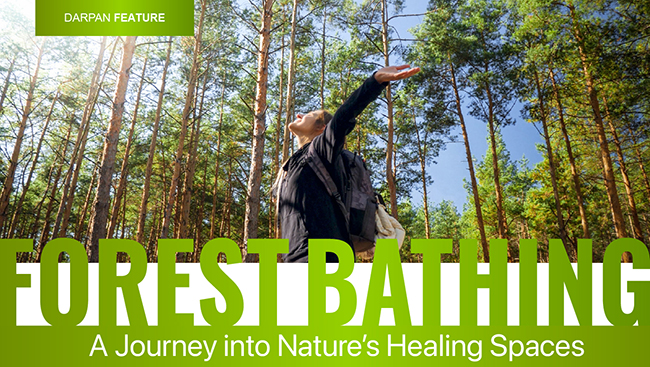
In a world often driven by speed, screens, and constant demands, more people are rediscovering the power of simply slowing down and stepping into the natural world.
One of the most profound ways people are doing this is through the practice of forest bathing, which is a mindful, sensory immersion in nature that invites us to be fully present with the world around us.
Though it originated in Japan in the 1980s as Shinrin-yoku, forest bathing has taken root globally and continues to grow as a wellness practice with both scientific support and deep emotional resonance.
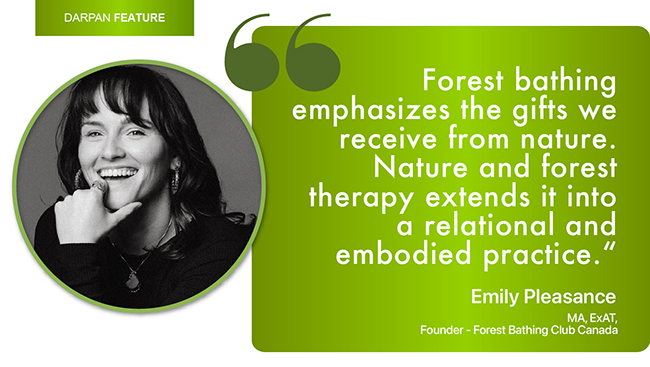
Emily Pleasance, MA, ExAT, nature & forest therapy guide, ecopsychology practitioner, and founder of the Forest Bathing Club Canada, explains that forest bathing is not just about the benefits we can extract from nature, but about cultivating a reciprocal relationship with the land, “Forest bathing emphasizes the gifts we receive from nature. Nature and forest therapy extends it into a relational and embodied practice. While we still receive support from the natural world, this approach also asks: how might we give back? How can we be in a meaningful relationship with the land, not just as users of its benefits, but as participants in a living, reciprocal connection?”
Pleasance’s journey into forest bathing began during the early days of the COVID-19 pandemic, a time when life slowed down and many sought new ways to reconnect. What started as simple walks with friends and family quickly became a meaningful practice that supported both personal and community well-being. What makes the Forest Bathing Club unique, she explains, is its core belief that human health and planetary health are inseparable. The practice isn’t limited to remote forests; it can take place in city parks, backyards, or even from a window.
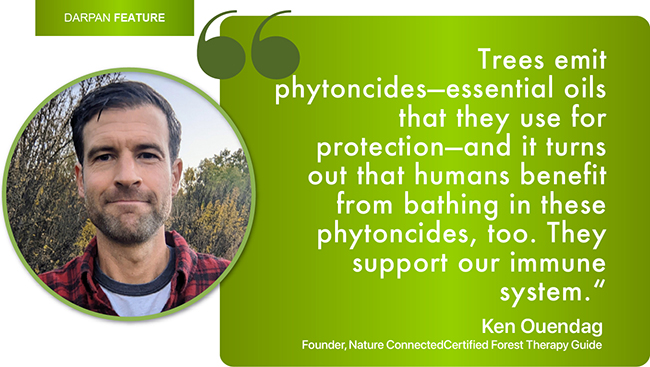
Ken Ouendag, founder of Nature Connected, certified forest therapy guide, and trainer with the Association of Nature and Forest Therapy, echoes this point, noting that forest bathing is fully accessible to urban dwellers. “Whether a tree is in the middle of a park or deep in the forest, people can still connect with it,” he reveals. He often emphasizes that forest bathing is about slowing down, awakening the senses, and simply being with the forest. “We're literally bathing in the atmosphere of the forest,” Ouendag notes. “Trees emit phytoncides—essential oils that they use for protection—and it turns out that humans benefit from bathing in these phytoncides, too. They support our immune system.”
Pleasance also emphasizes that forest bathing is not just about what we gain, such as stress relief and improved focus, but about fostering genuine connection with the natural world. Participants often share that they feel grounded, emotionally lighter, and reconnected with themselves and their surroundings after a walk. “Some have shared that it was the first time they truly slowed down in years,” she highlights. However, not all experiences are immediately peaceful. Sometimes, slowing down brings restlessness, grief, or even anger. “That’s all part of the practice,” Pleasance reassures.
Ouendag notes that participants frequently describe the practice as “effortless” and more approachable than traditional meditation. “Common words I hear are grounded, calm, relaxed, alive, and supported,” he observes. Forest bathing, as he guides it, can feel serious or playful, quiet or communal. His advice to beginners is to seek out a certified guide who can offer invitations to explore nature in new ways and create a safe, supportive environment.
For those starting their practice, Pleasance encourages beginning with small, accessible steps: “Go to a natural space you feel comfortable in and simply notice. Engage your senses one by one: What do you hear? What do you see moving? Can you feel the sensation of air on your skin? Can you smell any scents flowing through the wind? It is useful to close your eyes and limit the amount of information so that you can get very tuned to one sense at a time. There’s no wrong way.”
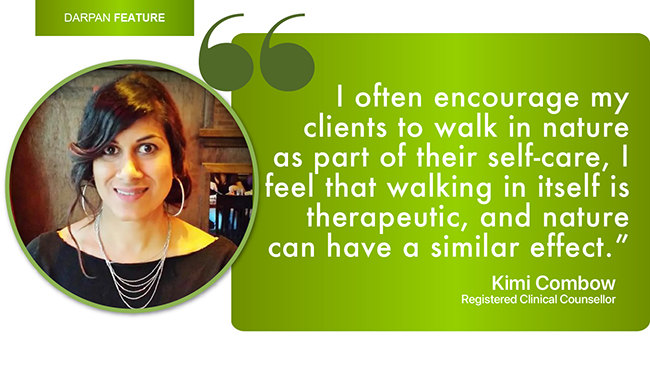
Registered Clinical Counsellor Kimi Combow also recommends the practice of walking in nature as a simple but powerful form of self-care. “I often encourage my clients to walk in nature as part of their self-care,” she reflects. “I feel that walking in itself is therapeutic, and nature can have a similar effect. Both can help us feel more present and grounded. I personally love walking by the ocean or hiking in a forest.” Combow’s approach reinforces the idea that even everyday walks can carry profound emotional benefits.
Pleasance believes that forest bathing offers not only personal restoration but a collective response to the ecological crises we face: “We can’t care for what we don’t love, and we can’t love what we don’t feel connected to.” Forest bathing, she argues, is more than a wellness trend. Rather, it is a radical, embodied act of choosing presence in the face of disconnection and loss. “When you relax your body, move through stress, and connect with the living world, you’re engaging in a kind of internal activism,” she points out.
Undoubtedly, the practice of forest bathing reminds us that nature is not a distant retreat, but a living, breathing partner in our everyday lives.