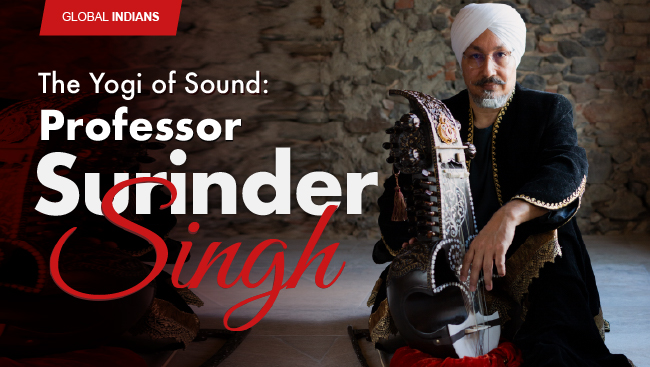
In a world where noise is constant but true connection feels increasingly rare, Professor Surinder Singh has devoted his life to reviving a sacred kind of listening, laced with healing, clarification, and reconnection to the inner self.
Through sound, scholarship, and decades of teaching, he has sparked a global renaissance in Sikh musical tradition and Naad Yoga, reawakening practices that once shaped entire communities.
Hailing from London, UK, Professor Surinder Singh is a scholar, musicologist, and trailblazer of Naad Yoga. Boasting 45 years of experience and students across the globe, he has spent more than three decades reestablishing the sacred link between sound, mind, and spirit. His mission began with a simple but radical belief: true transformation happens through education, not confrontation. Professor Surinder Singh shares, “My journey in developing the world’s first recognized degree in Sikh Music stemmed from a deep desire to combat the subtle manipulations and abuses that plagued the traditional approaches to Sikh music education.” Rather than criticize existing systems, he built new ones, forming the foundations of an educational shift that would ripple worldwide.
In September 1994, Professor Surinder Singh founded Raj Academy, a non-profit dedicated to teaching Gurmat Kirtan and Naad Yoga in their authentic forms. What began as preservation became a global movement, with structured courses, archival projects, and degree programs designed to make Sikh music accessible. “By creating structured educational pathways, we invited everyone to explore Gurmat Kirtan—not only the Sikh diaspora in the UK but people across the globe,” he highlights. Today, there are independent chapters across Europe and North America, where Germans, French, English, and Spanish individuals, among others, are breathing life into an authentic philosophy of sound.

One of Professor Surinder Singh’s most influential contributions is introducing Naad Yoga to contemporary audiences, an approach rooted in sound, not posture, that focuses on healing and inner awareness rather than physical mastery. “Sound is a direct line of communication with our mind,” he explains. “It allows us to perceive and understand its authentic state of being.” The idea that emotional states can be navigated and transformed through sound has resonated deeply with students seeking mental and spiritual well-being in an increasingly stressful world.
Yet, preserving Sikh musical traditions has not been without resistance, be it misconceptions that raags and instruments are only for a select few, or the effects of colonial disruption and modern pressures. Still, Professor Surinder Singh’s commitment to authenticity remains unwavering. Raag, he emphasizes, is not merely melody but emotional grammar, designed to unlock the psychological depth of Gurbani. Deviating from the original compositions, he cautions, risks losing the intended spiritual impact of the Guru’s teachings.
To youth, especially those in the diaspora, his message is one of clarity and purpose. He urges enthusiasts to avoid confusing Sikh musical traditions with classical Indian music or fusions that dilute their meaning. Instead, Professor Surinder Singh encourages them to embrace the spiritual discipline as it was designed. “Start with the openness and humility of a student,” he advises.
Professor Surinder Singh’s work is far from finished. Archival recordings of all 60 Sikh raags, a groundbreaking documentary, innovative wellness projects like Sohila, and an upcoming U.S.-published book all attest to a legacy still expanding. His mission remains clear: to ensure future generations inherit the sacred, healing power of Sikh sound traditions, and to help people around the world rediscover harmony through the wisdom of Naad.