For generations, success in many South Asian households followed a familiar script: pursue a stable profession, prioritize family, and seek security. Today, a growing number of South Asian women are rewriting that narrative, turning to entrepreneurship as a declaration of autonomy over their time, finances, creativity, and futures.
For them, business ownership is not just about income, but about alignment. It is about building lives that reflect who they truly are. In speaking with dynamic entrepreneurs, one theme is clear: entrepreneurship represents freedom, but also responsibility, visibility, and generational change.
Amneet Athwal

Bridal Stylist
1. What motivated you to start your own business?
I was motivated to start my own business because I wanted freedom: creative freedom, time freedom, and the ability to build something rooted in purpose rather than pressure. I’ve always been driven by intuition and storytelling, and entrepreneurship allowed me to design a life that aligns with who I am, not who I was expected to be.
2. What challenges or cultural expectations have you had to navigate?
As a South Asian woman, I’ve had to navigate expectations around stability, timelines, and what success is ‘supposed’ to look like. Choosing unconventional paths—creative work, fashion, styling, and entrepreneurship—often meant having to trust myself even when the journey didn’t look traditional. I’ve learned to balance honoring my culture while also redefining it for myself, especially when it comes to independence, ambition, and prioritizing fulfillment.
3. Any words of wisdom?
Entrepreneurship has taught me that success isn’t just growth or numbers. It's alignment. Whether I’m styling a bride, building a brand, or curating experiences, my work is rooted in trust, vulnerability, and intention. I truly believe that when women allow themselves to listen inward and move with purpose, everything else follows naturally.
Aman Khinda

Brand Strategist & Designer
1. What motivated you to start your own business?
Starting my own business was never just about income. It was about ownership of my time, my ideas, and my impact. At 25, I moved out with $20K of savings and launched my business at the same time. It was intentional. I placed myself in a do-or-die situation because I knew comfort would never unlock my full potential. That decision reshaped my life. Entrepreneurship gave me independence not just financially, but mentally. It allowed me to build a life rooted in purpose instead of permission. Flexibility, for me, isn’t about working less. It’s about working intentionally and aligning my time with the legacy I want to create.
2. What challenges or cultural expectations have you had to navigate?
I was fortunate that my family always encouraged me, even if they didn’t fully understand what I was building. For years, they genuinely had no idea what I did for work. Creative entrepreneurship can be difficult to explain in communities where success is often defined by traditional, easily recognizable careers. Now, when my clients grow powerful brands and credit me for their success, I know my family feels proud. That quiet pride means everything.
3. Any words of wisdom?
This may sound cliché, but you need an undeniable belief in yourself. Five years ago, no one fully understood what I was setting out to build. Frankly, I didn’t fully understand it either. But I always knew I would make something of myself. Entrepreneurship requires vision before validation. You have to move as if the future already exists, even when no one else can see it yet.
Kal Grewal
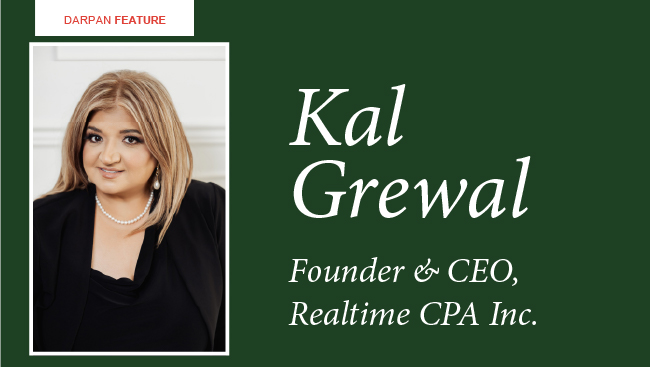
Founder & CEO, Realtime CPA Inc.
1. What motivated you to start your own business?
I didn’t start my business because I couldn’t succeed in the corporate world. I started it because I had already succeeded. After more than three decades in finance, I had built the knowledge, strategic insight, and operational depth to lead at the highest levels. I also had hands-on expertise with emerging financial technologies and could see clearly where the profession was heading: toward modern, AI-enabled, real-time firms. I didn’t want to adapt to that future; I wanted to build it. I knew that small and medium-sized enterprises—the backbone of Canada’s economy—would benefit most from this transformation.
2. What challenges or cultural expectations have you had to navigate?
South Asian women are often raised to excel, but quietly. To contribute financially, while still carrying the cultural and emotional architecture of the family. We are expected to preserve traditions, organize celebrations, maintain relationships, and show up fully at home—even as we build careers. Entrepreneurship does not remove those expectations; it magnifies them. I had to unlearn the belief that ambition must be softened to be acceptable. I chose visibility. I chose leadership without apology.
3. Any words of wisdom?
When South Asian women claim ownership, it is not just economic. It is generational. We are shifting narratives around money, authority, and autonomy. We stand on the shoulders of women who sacrificed, adapted, and endured so that we could have opportunities they did not. We are also proving that cultural pride and bold leadership can coexist, that honoring our roots does not limit our reach. This is not rebellion. It is evolution.
Simran Attli

Mortgage Specialist
1. What motivated you to start your own business?
I was motivated by a deep inner drive to create a life that feels aligned with who I truly am. Having experienced separation and mental health issues within my family, I deeply value time with loved ones and am intentional about creating a life that is rooted in connection, stability, and individuality, and breaks generational cycles. I realized early on that I was not meant to operate in a stagnant environment. I am wired to build, improve, and evolve, even when it feels uncomfortable or uncertain.
2. What challenges or cultural expectations have you had to navigate?
There is often pressure within our culture to choose stability over risk, prioritize family over individuality, and follow a more ‘secure’ path. For generations, women have been told that their voice does not matter, that they should be submissive, and that their lives are limited after having children or when they are married. I tried to take the ‘safer’ route and was laid off not once, but twice. Instead of holding me back, those experiences fueled my drive to become an entrepreneur. After my first layoff, I started a podcast to share my ideas, became an author, and even appeared on a Times Square billboard! It was scary, but deeply rewarding and aligned.
3. Any words of wisdom?
It’s time to choose the path less travelled and take the driver’s seat of your life, so you can pave the way for others along the way. Find a community that supports you and take the time to truly get to know yourself so you can build a life that is aligned with who you are. We have seen women, right in front of our eyes, do it again and again, and so can you.