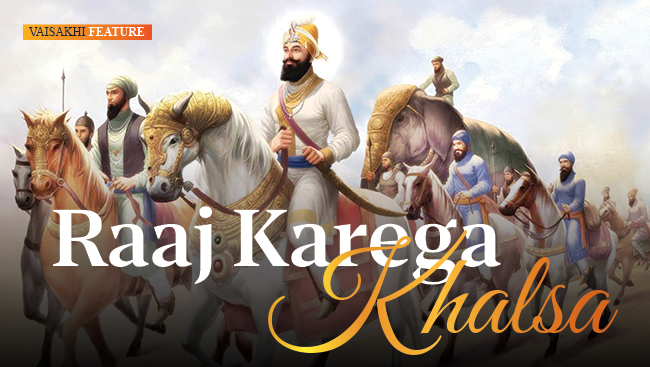
Globally, we will be celebrating the 326th birthday of the formation of the order of Khalsa this year. The word Khalsa originates from the word khalis, meaning pure. Khalsa is pure in thoughts, pure in action, and pure in commitment.
“Raaj karega khalsa, aaki rahe na koi,
Khuar hue sabh milenge, bachey sharan jo hoye.”
The pure consciousness of Khalsa will be that the rulers and sinners will be vanquished.
Those separated will unite, and all the devotees shall be saved.
We need to roll back our vision about three centuries in the past when it was ordained into the Sikh faith. The first nine Guru jis made us saints first, then came the miraculous act of being a soldier, which was done during the time of the 10th Guru ji.
Several months before Vaisakhi of 1699, our tenth Master, Guru Gobind Singh, invited his followers from all over India to come to Anandpur Sahib. As a result, on that particular day, hundreds of devotees and onlookers gathered. Many came as a sign of respect for the Guru and following his invitation, while some came out of curiosity. On the appointed day, the Guru addressed the congregants with a stirring oration on his divine mission of restoring their faith and preserving Dharma (righteousness).
After his inspirational discourse, he flashed his samsheer and said that every great deed was preceded by equally great sacrifice. He asked, with a naked sword in his hand, "Is there anyone among you who is prepared to die for their faith?" When people heard his call, they were taken aback. Some of the wavering followers left the congregation, while others began to look at one another in amazement. It was a crowd of over 80,000 people.
After a few minutes, a brave Sikh from Lahore named Daya Ram stood up and offered his head to the Master. The Guru took him to a tent pitched close by and, after some time, came out with a blood-dripping sword. The Guru repeated his demand, calling for another Sikh who was prepared to die at his command. At this second call, even more people were shocked, and some were frightened. A few more of the wavering followers discreetly began to filter out of the congregation.
However, to the shock of many, another person stood up. The second Sikh who offered himself was Dharam Das. This amazing episode did not end there. Soon, three more—Mohkam Chand, Sahib Chand, and Himmat Rai, offered their heads to the Guru. Each Sikh was taken into the tent, and some thought that they could now hear a 'thud' sound—as if the sword was falling on the neck of the Sikh.
Guru ji then brought these 5 brave men out of the tent, wearing the 5 Kakkars—Kesh (uncut hair), Kanga (wooden comb), Kara (iron bracelet), Kachera (military shots) and Kirpan (sword). Guru ji prepared Amrit with water in a sarab loh (pure iron) vessel, Mata Sahib Kaur put patasey (sugar puffs) into the water, and a khanda (double-edge sword) was used to stir it while the bani of japji, jaap, savayiyae, choupai benti and Anand Sahib were recited. Guru ji then baptized these five brave hearts by sprinkling Amrit in their eyes and hair and asked them to drink it five times while saying "Waheguru Ji Ka Khalsa, Waheguru Ji Ki Fateh!"
Guru ji called them the Panj Pyaare or the beloved ones, changing their names to Daya Singh, Dharam Singh, Himmat Singh, Mohkam Singh, and Sahib Singh. These are the stages of the spiritual journey through which one will have to start from Daya to meeting Waheguru ji.
Guru Gobind Rai then stood in front of these Panj Pyaare and asked for the blessing of the Amrit, changing him to Guru Gobind Singh Ji. This act created the abolition of prejudice, equality, democracy, common worship, and a common external appearance—combining Bhakti and Shakti.
The creation of Khasa culminates 240 years of training by each Guru ji to create the perfect image of a saint, scholar, and soldier. In order to mold his personality, the Guru inculcated in him the five virtues - Sacrifice, Cleanliness, Honesty, Charity, and Courage, and prescribed Rehat or Maryada - the Sikh code of discipline.
In Surrey and Vancouver, British Columbia, Canada, we have some of the world’s largest Nagar Kirtans to celebrate the birth of Khalsa with a devotional congregation of over 650,000 people.