

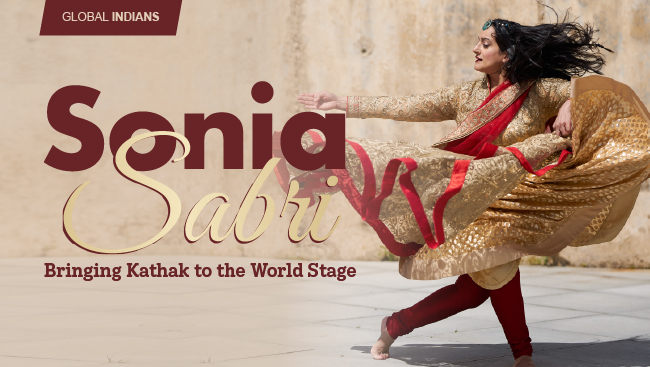
When internationally acclaimed Kathak artist and choreographer Sonia Sabri received her MBE for Services to Dance at Windsor Castle on November 12, 2025, it marked a defining moment not just for her, but for South Asian performing arts in the U.K. The first British-born Indian woman fully trained in Kathak in the U.K. to receive the honor, Sonia’s journey has been one of persistence, innovation, and cultural pride.
Born in Wolverhampton to a working-class immigrant family, Sonia transformed her early struggles with shyness and racism into artistic power, using Kathak as both a creative outlet and a means of self-discovery. Today, as the Artistic Director of the Sonia Sabri Company, co-founded with her husband and tabla maestro Sarvar Sabri, she continues to expand the boundaries of traditional Kathak, blending classical precision with contemporary storytelling.
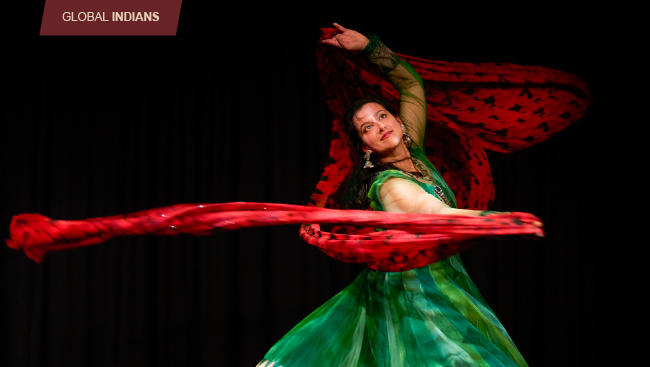
In this exclusive conversation with DARPAN, the multi-award-winning Kathak powerhouse reflects on her artistic evolution and the global significance of South Asian classical dance.
Q: Your work blends traditional Kathak with contemporary storytelling. How do you stay rooted in classical heritage while pushing boundaries?
A: The training of Kathak is such that one cannot break the rules of the style; the heritage creates the language, technique, discipline, expressions, and costume principles. Storytelling techniques I use are within Kathak’s vocabulary, but I also explore my own body language for specific themes. I trained in Theatre under LAMDA and work in community settings with people from diverse backgrounds, giving voice to personal experiences. The stories I tell are of today’s everyday people—raw, courageous, bold, and sometimes controversial. Kathak is like a language; you can say anything, past or present.
Q: How has your cultural identity shaped your journey, and what does it mean to represent South Asian artistry globally?
A: Born and trained in the U.K., I grew up balancing a traditional Indian family with British schooling. This dual identity shaped my distinctive style and subject choices. Audiences, from British Asians to international viewers, find my work relevant without needing spoken language—movement and music speak universally. Performing for legends like Pandit Birju Maharaj and Aditi Mangaldas has been humbling. It shows anyone, anywhere, can learn Kathak with dedication, regardless of background. I’m proud to showcase my love for Kathak and hope to inspire others.
Q: Can you share your journey from your first steps in Kathak to key milestones and future projects?
A: I started Kathak at six; my father’s dream was Bollywood, but dance became my refuge from bullying and anxiety. By 12, I decided to become a professional. I toured internationally from 14, debuted solo at 17, and later co-founded Sonia Sabri Company with my husband, Sarvar Sabri. Key milestones include WOMAD, performing for Kathak legends, pioneering productions with digital artistry and a cappella, and co-choreographing the 2022 Commonwealth Games opening. Future projects include outdoor festivals and a solo with musicians from non-Indian backgrounds.
Q: What challenges did you face creating space for South Asian arts in the U.K., and what kept you committed?
A: Initially, South Asian arts were undervalued compared to theatre, ballet, or contemporary dance. I had to prove Kathak’s depth and versatility. Another challenge was re-educating the South Asian community about their own arts. Through partnerships, collaborations, and ensuring representation at key platforms, South Asian arts gained visibility. My faith in the arts and personal experience of its transformative power kept me going.
Q: What advice would you give young South Asian artists balancing identity, belonging, and authenticity?
A: Learning classical art with integrity provides cultural grounding. Supplement practice with research into the art form’s history and heritage. Social media presents challenges, but it can also inspire self-discovery. Respect preserved cultural heritage while creating your own, grounded in experience and the deep layers of history, philosophy, spirituality, and science behind the art.
Through her artistry, Sonia Sabri continues to bridge heritage and modernity, proving that Kathak, in its truest form, is timeless and universal.