Across industries and communities, South Asian women are continuing to reshape what leadership looks like. They are educators, journalists, advocates, entrepreneurs, and changemakers—women who are not only building meaningful careers, but also creating opportunities for others along the way.
This International Women’s Day, DARPAN celebrates a group of inspiring women whose journeys reflect resilience, purpose, and the power of giving back. From global education policy and community advocacy to media and public leadership, each of these women has carved her own path while uplifting those around her.
Their stories are not just about professional success. They are about navigating challenges, embracing risks, and staying grounded in the values that shaped them. Through their work and their voices, they remind us that progress is rarely a straight line, but every step forward creates momentum for the next generation.
As we mark International Women’s Day, their experiences offer a powerful reminder that when women lead, communities grow stronger.
Angie Osachoff
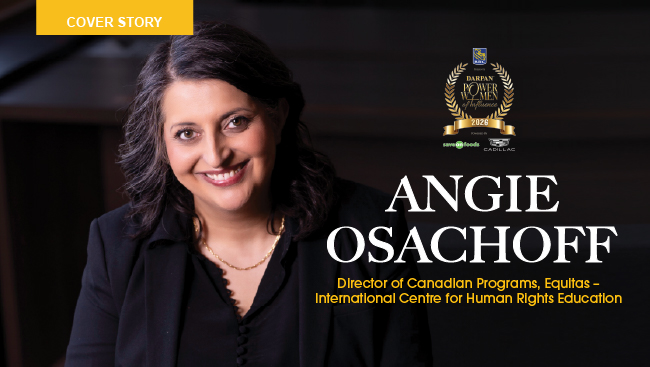
Director of Canadian Programs, Equitas – International Centre for Human Rights Education
Quote I Live By:
Beyond a wholesome discipline, be gentle with yourself. You are a child of the universe no less than the trees and the stars; you have a right to be here. - from the Desiderata
For Angie Osachoff, the idea of service was never abstract. It was something she grew up witnessing in quiet, everyday ways.
Her parents arrived in Canada in 1972 as refugees after South Asians were expelled from Uganda under Idi Amin’s regime. Newly married and in their early twenties, they left behind family, familiarity, and everything they owned. Canada offered them a second chance. That story of displacement and rebuilding became the foundation of Angie’s worldview.
“My dad used to tell me from as young as I can remember, you’re a girl, and you can be anything you want,” she recalls. “Get a good education because nobody can take that away from you. And this country saved our lives, so it’s our responsibility to make it stronger.”
Born in Hamilton and raised in Ontario, Angie grew up watching her parents volunteer relentlessly in their community. They ran multicultural associations, organized cultural festivals, and supported local initiatives. Service was simply part of life.
By eleven, Angie had begun volunteering with the Canadian Red Cross. What started as youthful curiosity soon grew into a deep interest in international humanitarian law and human rights. As a teenager, she was already giving presentations to adults about international law and children in armed conflict. Along the way, a constellation of mentors, many of them women, helped shape her path.
Today, Angie is one of Canada’s most experienced practitioners in human rights education, anti-racism, and children’s rights, with more than three decades of work shaping communities and institutions across the country.
As Director of Canadian Programs at Equitas – the International Centre for Human Rights Education, she leads national initiatives that reach more than 100 communities. Her work focuses on strengthening systems, supporting youth leadership, and ensuring that people of all ages are meaningfully included in decisions that affect their lives.
Beyond her professional work, Angie has also helped shape cultural spaces in the community. As outgoing Chair of the Board of the Indian Summer Arts Society, she guided the organization through leadership transitions and the challenges of the pandemic, helping strengthen its foundation while ensuring South Asian voices and artists continue to be celebrated across the Lower Mainland.
Angie’s contributions have earned her the Queen Elizabeth II Golden Jubilee Medal, the Canadian Red Cross Prix d’Excellence, the Canadian Red Cross Youth Service Award, and the United Way Community Partner Award.
She also sees her identity as both a bridge and a strength. As the daughter of refugees, a South Asian woman, and a Canadian raised in multicultural communities, Angie has often been able to move between worlds. “My identity has been my superpower,” she says.
For Angie, the work remains deeply personal. It is about honoring the sacrifices of those who came before her and ensuring the next generation inherits a more just world.
“Everything I do,” she says, “is about leaving the world better than we found it.”
Q&A
Q- This year’s International Women’s Day theme is ‘Give to Gain.’ What does that phrase mean to you personally?
A- Giving creates ripple effects. When we invest in others, communities grow stronger and we see the impact come back many times over.
Q- What’s one lesson you had to learn the hard way that shaped the woman you are today?
A- Protect the work and your integrity. Do good work for the right reasons and the outcomes will follow.
Q- Who is a woman you deeply admire, and what about her inspires you most?
A- My sister Amy. She lives with a chronic illness yet approaches life with resilience, joy, and grace.
Q- What’s one thing you hope more women give themselves permission to do?
A- To simply be themselves without feeling the need to shrink or code-switch to belong.
Anita Sodhi-Cavezza
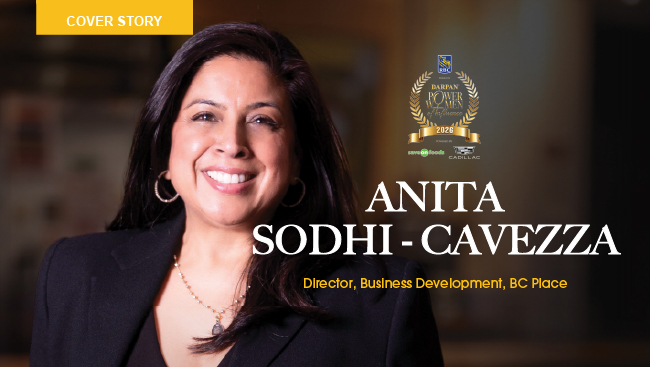
Director of Business Development, BC Place
Quote I Live By:
An important attribute of success is to be yourself. Never hide what makes you, you.
- Indra Nooyi, Former PepsiCo CEO
For Anita Sodhi-Cavezza, success was never part of a neatly drawn plan. Like many immigrant stories, hers was shaped by circumstance, resilience, and the quiet strength of family.
Her father first arrived in Canada in 1970, part of a generation of South Asian immigrants who came alone, hoping to build a future before bringing their families over. Anita followed with her mother when she was just three years old. Growing up in the 70s, she remembers a time when there were very few people who looked like them: “You really relied on your family. There wasn’t a big community around us the way there is now.”
That sense of family became even more important when tragedy struck. Anita was only sixteen when her father passed away. Overnight, the trajectory she had imagined for herself shifted.
“My mom suddenly had to take on everything,” she recalls. “It became less about following a plan and more about survival.” Her mother, widowed without financial support or extended family nearby, carried the responsibility of raising the family alone. Watching her navigate that reality left a lasting mark on Anita. “She was the symbol of strength in my life,” she says. “To see her resilience and determination at that time… I don’t know that I could ever live up to what she did.”
Instead of following the traditional path that many South Asian families envisioned for their children, Anita’s career unfolded more organically. She began working early, taking on roles that helped support her family. Her first job was in airport security, followed by a position with Continental Airlines. During this time, she discovered an opportunity in the tourism and events industry—an area she hadn’t previously considered but one that quickly resonated with her strengths.
She later joined the Vancouver Convention Centre, where she steadily built her career by gaining experience across multiple divisions. Over time, she developed a deep understanding of the venue’s operations and eventually moved into the sales team in 2000. Her role grew significantly when the convention centre expanded in 2010, tripling in size and creating new opportunities to diversify the organization’s business and attract major events.
Today, Anita serves as Director of Business Development at BC Place, Western Canada’s premier venue for major sporting events, concerts, and community gatherings. From international sporting competitions to global music tours, she has played a key role in bringing some of the city’s most high-profile events to Vancouver.
Her work sits at the intersection of strategy, relationships, and community impact. Anita has helped support major sports networks with broadcast infrastructure during the FIFA Women’s World Cup, secured the final three Vancouver shows of Taylor Swift’s Eras Tour, and played a role in bringing Diljit Dosanjh’s historic stadium concert to BC Place, the largest Punjabi stadium show ever held outside India. Most recently, she helped drive another milestone, with BC Place announcing record-breaking five Bruno Mars shows.
In 2025, Anita’s work was recognized when she was honored among women leaders at BC Place during the City of Vancouver’s Women Behind the Sound Day, celebrating the women shaping the region’s events and entertainment industry.
Through it all, Anita continues to carry the lessons she learned growing up. The importance of authenticity. The strength that comes from adversity. And the example of a mother who showed her what resilience truly looks like.
Q&A
Q- This year’s International Women’s Day theme is ‘Give to Gain.’ What does that phrase mean to you personally?
A- When you give your time, support, and mentorship to others, the impact always finds its way back. Communities grow stronger through that exchange.
Q- What’s one lesson you had to learn the hard way that shaped the woman you are today?
A- Life rarely follows the plan you imagine. Learning to adapt and keep moving forward is what builds resilience.
Q- Who is a woman you deeply admire, and what about her inspires you most?
A- My mom. After losing my father, she raised our family with incredible strength and determination.
Q- What’s one thing you hope more women give themselves permission to do?
A- Permission to fail. We often feel pressure to get everything right, but growth doesn’t happen without risk. What matters is what you learn from it and how you move forward stronger.
Gurnaz Kaur
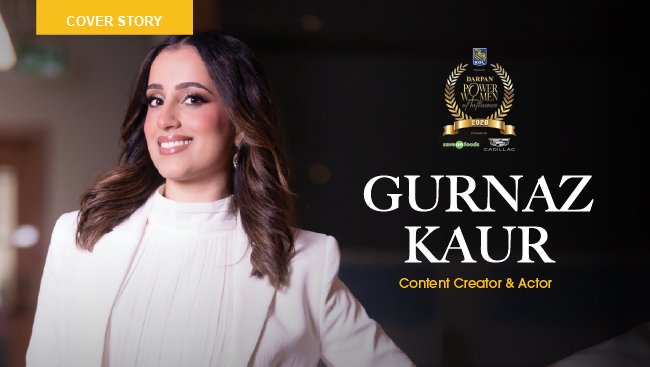
Content Creator & Actor
Quote I Live By:
The Universe helps those who help themselves. Never give up, move with honesty, and you'll be led to where you're meant to be."
- Something my Nani always said
For Vancouver-based content creator and actor Gurnaz, building a career online was never part of a grand plan. In many ways, it simply grew out of a lifelong instinct to create.
Her journey on the internet began more than a decade ago on Vine, the short-form video platform that launched the careers of many early digital creators. At the time, she was simply experimenting—posting comedic skits and snippets of everyday life without much expectation beyond having fun. When Vine eventually shut down, she continued creating, slowly building her presence across Instagram, YouTube, and eventually TikTok.
Consistency — rather than strategy — became the foundation of her growth.
Today, the Miss Teen Greater Vancouver's (2017) audience spans more than 1.3 million followers across platforms. Her content ranges from beauty tutorials and makeup artistry to humor, motivational reflections, and cultural storytelling, which even led her to acting in films.
At the center of it all is something deeply personal: her identity.
Growing up, she rarely saw South Asian women represented in the media spaces she loved. “I always wanted to be the representation that I didn’t see growing up,” she says. “South Asian women weren’t really visible in the media, especially just being themselves.” Rather than adapting her content to fit what she believed audiences expected, she leaned into her culture—something she says was not always encouraged. “There were definitely moments where people suggested that I make myself more ‘digestible’ for Western audiences,” she explains. “But that never felt right to me. I didn’t want to lose who I was.”
Punjabi language, humor, and cultural references became part of her content, something she now sees as one of the most meaningful aspects of her work.
One particularly memorable moment came during her time as a member of the Sephora Squad program, a competitive initiative that supports emerging beauty creators across North America. She pitched an idea that felt especially close to her heart - creating a fully Punjabi-language beauty video for Sephora. “I told them, ‘Let me try this in Punjabi. I promise it will connect with people,’” she recalls. The campaign went forward, becoming one of the first fully Punjabi-language beauty videos shared by the global brand. “It was such a proud moment,” she says. “It showed that culture and authenticity actually resonate with people.”
Despite the growing visibility, Gurnaz says the journey hasn’t always been easy. As a woman of color in the creator economy, she has faced everything from online harassment to systemic disparities in the industry. “There are still moments where I’m the only brown girl in the room,” she says candidly. But rather than letting those experiences discourage her, she says they have strengthened her commitment to showing up — both for herself and for others.
For Gurnaz, the goal has never just been numbers or followers. It has always been connection, and the possibility that something she creates might resonate with someone else. “Sometimes people come up to me and tell me that one of my videos made them laugh during a difficult time,” she says. “Or that it helped them feel more confident.” Moments like that, she says, are what make the journey worthwhile.
Q&A
Q- This year’s International Women’s Day theme is ‘Give to Gain.’ What does that phrase mean to you personally?
A- The more positivity and knowledge you put out, the more it eventually comes back to you. I grew up in a Sikh household where giving back and serving others was always emphasized, so that mindset has always stayed with me.
Q- What’s one lesson you had to learn the hard way that shaped the woman you are today?
A- Realizing that no one is coming to save you. At some point, you understand that your life is in your own hands. So write your story. Life doesn’t happen to you, it happens from you.
Q- Who is a woman you deeply admire, and what about her inspires you most?
A- My mom without a question. She’s full of so much love, kindness, and grace despite the adversities she’s faced. My drive in life has come through witnessing her resilience in uncertain and difficult moments in life. Moms truly are warriors, and they deserve the world!
Q- What’s one thing you hope more women give themselves permission to do?
A- Choose themselves. Especially in South Asian culture, women are often expected to prioritize others. But it’s important to honor who you are as an individual.
Rita Parikh
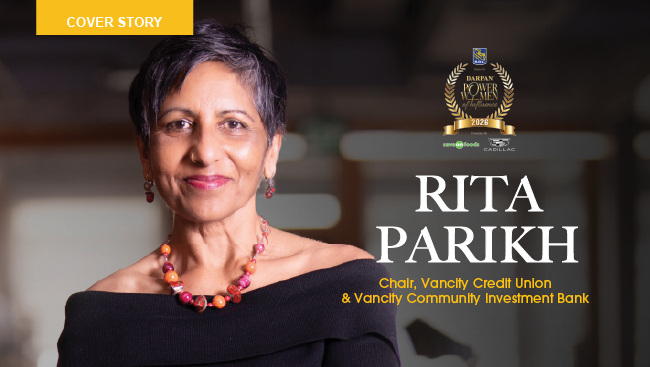
Chair, Vancity Credit Union & Vancity Community Investment Bank
Quote I Live By:
If the path before you is clear, you’re probably on someone else’s.
-Joseph Campbell
For Rita Parikh, leadership has never been a straight line. Her career has been shaped by curiosity, a commitment to justice, and a deep belief that systems can, and must, work for everyone.
“I thought I would be a journalist,” she says. “But after graduation, I realized I was drawn to international development, and in particular, women’s and human rights.”
Rita’s early career took her across Asia, the Caribbean and the South Pacific, working for Canadian NGOs collaborating with brilliant organizations on the ground to further their struggles for food, security, reproductive health, and women’s rights. Alongside that, she explored law and justice closer to home, serving as a part-time investigator for the Human Rights Commission. “I loved it. It let me pretend I was somehow a legal professional,” she recalls with a smile. Those experiences gave her a foothold in the world of regulatory systems and administrative justice, which would eventually become a defining thread in her career.
Back in Canada, Rita’s interest in governance began early. In her mid-20s, she joined the board of Mountain Equipment Co-op, drawn by concerns about environmental sustainability and ethical sourcing. “I wanted to marry my passions for justice with the governance world,” she explains. Over time, she became a recognized leader in the non-profit and cooperative sectors, shaping organizations that focus on community economic development, housing, financial inclusion, and climate action.
Her journey with Vancity began with admiration long before she became a member. Visiting their boardroom in her 20s, she was struck by the credit union’s commitment to the marginalized, community development and member livelihoods. “I remember leaving there thinking I cannot believe there’s a financial institution so committed to transforming economic systems,” she says. In 2016, she ran for the board of directors and was elected. Today, she chairs Vancity, guiding the credit union through challenges that impact communities across British Columbia.
Rita credits much of her worldview to her upbringing. “I identify as a hyphenated Canadian—someone of Indian heritage, a woman of color rooted in this country,” she says. Rita’s parents moved to Canada in 1960, and her family always emphasized justice, empathy, and awareness of global struggles. That perspective has informed how she approaches leadership, decision-making, and mentorship.
Awarded as one of Canada’s Top 100 Most Powerful Women by the Women's Executive Network (WXN), she continues to invest in others. She recently launched Wild Purpose Executive Coaching, supporting purpose-driven leaders, and mentors young women through WXN’s network. For her, creating space for others is as important as any boardroom decision.
Looking forward, she sees opportunity in collective action. “If we support each other, we are all collectively flourishing,” she says. Her vision is clear: resilient communities, equitable systems, and the next generation of leaders empowered to make change.
Q&A
Q- This year’s International Women’s Day theme is ‘Give to Gain.’ What does that phrase mean to you personally?
A- We all stand to gain so much by lifting each other up. Supporting each other strengthens communities, innovation, and economies. Giving to gain is about collective flourishing.
Q- What’s one lesson you had to learn the hard way that shaped the woman you are today?
A- Believing I belonged at the corporate board table. Early in my career, I doubted whether someone like me, a small brown woman without an MBA, could lead or make a difference. Over time, I realized my experiences mattered, especially in the corporate world and I needed to trust myself.
Q- Who is a woman you deeply admire, and what about her inspires you most?
A- My mom. She’s 89, lived through the Quit India campaign as a child, and remains an activist. She taught me about justice, empathy, and the importance of standing up for what’s right.
Q- What’s one thing you hope more women give themselves permission to do?
A- There is no more important time to be rebellious. We’re taught to forgive, nurture, and self-correct, but women need no permission to express, to challenge, and to claim our space unapologetically.
Rochelle Prasad
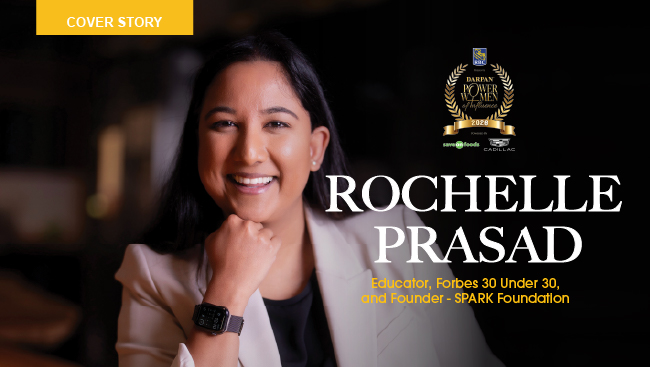
Educator, Forbes 30 Under 30, and Founder - SPARK Foundation
Quote I Live by:
Never doubt that a small group of thoughtful, committed citizens can change the world; indeed, it's the only thing that ever has.
-Margaret Mead
For Rochelle Prasad, the path to global education policy began long before boardrooms and international forums. It started at home, helping her immigrant parents navigate life in a new country.
Her parents immigrated to Canada from Fiji in the early 1990s after political unrest forced many Indo-Fijian families to leave. Like many immigrant households, the transition came with challenges — language barriers, unfamiliar systems, and the quiet pressure of starting over. “As a kid, I was translating documents, helping them at the doctor’s office, figuring out taxes or paperwork,” Rochelle recalls. “I grew up really fast because I had to help them navigate things.”
Those early responsibilities shaped the lens through which she would later see the world. Watching her parents adapt to a new system made her acutely aware of the gaps that exist for newcomers and marginalized communities. “I started noticing barriers early,” she says. “And when you see those gaps young, you start asking how systems could work better.”
Her instinct to challenge systems showed up early. In elementary school, Rochelle launched her first advocacy campaign after noticing that school buses didn’t have seatbelts. Instead of going on a field trip, she stayed behind to organize a petition calling for change, an experience that would become her first introduction to policy advocacy. “That was my first campaign,” she says with a laugh. “I realized early on that if something didn’t seem right, you could speak up about it.”
Years later, that same instinct led Rochelle to found the SPARK Foundation, a youth-led nonprofit focused on removing barriers to education. Over more than a decade, the organization has built schools in Kenya and Ecuador, provided scholarships and resources to students around the world, and supported programs that have impacted more than half a million young people.
Today, Rochelle works at the intersection of education, policy, and global advocacy. Alongside teaching high school and post-secondary students, she advises governments and multilateral institutions through the United Nations system on youth engagement and education policy.
She describes her career as what she calls a “squiggly path”—one that moved between nonprofit leadership, teaching, advocacy, and even a municipal election campaign before returning to education policy. “There wasn’t a straight line to where I am,” she says. “But every step taught me something about how systems work, and how they can change.”
Her Indo-Fijian heritage continues to shape the way she leads. In classrooms filled with students from diverse backgrounds, Rochelle believes representation and empathy matter. “When you’ve lived those experiences yourself, you understand how to reach students who might feel overlooked,” she says. “It teaches you how to lead with empathy.”
Despite international recognition for her work—including being named to the Forbes 30 Under 30 list and receiving the Governor General’s Award in Commemoration of the Persons Case—Rochelle remains grounded in a simple belief.
At the heart of everything she does is the idea that education is more than a classroom experience. “Education is the most powerful tool we have to change the world,” she says. “And every young person deserves access to it.”
Q&A
Q- This year’s International Women’s Day theme is ‘Give to Gain.’ What does that phrase mean to you personally?
A- I’ve always believed in contributing before expecting recognition. When people give in a genuine way, trust and community grow. And when one woman opens a door, she holds it open for others, too.
Q- What’s one lesson you had to learn the hard way that shaped the woman you are today?
A- Learning that it’s okay to ask for help. For a long time, I felt like I had to do everything on my own. Realizing that you’re not a burden for needing support was a big lesson for me.
Q- Who is a woman you deeply admire, and what about her inspires you most?
A- I really admire Annalena Baerbock, who has served in leadership within the United Nations General Assembly. What struck me most was how intentionally she included young people in conversations about diplomacy and policy.
Q- What’s one thing you hope more women give themselves permission to do?
A- Rest. There’s often this pressure to always be doing something or proving something. Learning to rest without feeling guilty is something I’m still working on myself.
Simi Sara
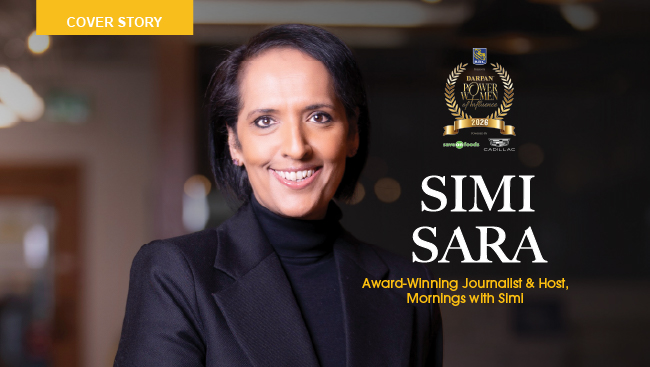
Award-Winning Journalist & Host, Mornings with Simi
Quote I Live By:
Stuff happens, but you need to move forward. Don't look back, don't regret things, maintain the forward momentum.
For Simi Sara, journalism was never just a career choice. It was something she knew she wanted long before she stepped into her first newsroom.
She was in Grade 10 when she worked on her school newspaper and realized she loved the process of telling stories and making sense of the world. By Grade 12, after taking a journalism class, the direction felt even clearer. At a time when very few South Asian faces appeared on Canadian television, Simi had only one role model she could look to. “I used to tell my mom I wanted to be like Belle Puri,” she recalls with a smile. “People would laugh a little because it felt like such a far-fetched dream.”
Meeting Puri at an event as a teenager only strengthened that belief. It showed her that a path was possible. But life had other plans before that path fully unfolded. During her first year at Simon Fraser University, tragedy struck. Simi was just 18 when her mother died in a car crash. “It completely changed the direction I thought my life would take,” she says quietly.
She left university soon after and enrolled earlier than expected in Langara’s journalism program. The moment she walked into her first class, something clicked. “I remember thinking immediately, this is where I’m supposed to be.”
From there, Simi began building the career that would eventually make her one of the most recognizable voices in British Columbia. She started as a reporter at The Surrey Leader, the hometown newspaper that gave her her first real newsroom experience. Television followed soon after, where she spent 15 years learning every side of the business. “I did everything,” she says. “Writing, producing, reporting, anchoring. It was the best training you could get.”
One defining moment came early in her television career. After doing a live on-air news update for the first time, a senior producer called the station’s news director to watch her. Minutes later, she was offered a job. “That moment changed the trajectory of my life,” Simi says. “She didn’t have to do that for me. And I’ve never forgotten that kindness.”
Over the past three decades, Simi has navigated both success and setbacks. She has faced layoffs, industry shifts, and the quiet skepticism that many women of color in media know well. More than once, she was told the only reason she got a job was because she was “brown.” “I knew that wasn’t true,” she says simply. “I knew how hard I worked.”
Today, as host of Mornings with Simi on 980 CKNW, she brings more than three decades of perspective to conversations that shape the province. Her thoughtful, accessible approach has earned her national recognition, including RTDNA awards, a Jack Webster Award, and multiple Canadian Radio Awards as Best On-Air Host in the country.
Yet for Simi, the real measure of success is simpler.
“If people trust you enough to listen and understand what’s happening in their community,” she says, “that’s everything.”
Q&A
Q- This year’s International Women’s Day theme is ‘Give to Gain.’ What does that phrase mean to you personally?
A- It’s about stepping up when the community needs you. Through programs like the CKNW Kids Fund, we see families who just need a little help, and being part of that support system matters because you never know when you might need help too.
Q- What’s one lesson you had to learn the hard way that shaped the woman you are today?
A- Respect and awareness. Be thoughtful about what you say, being respectful of the people you work with, and showing up prepared every day really matters.
Q- Who is a woman you deeply admire, and what about her inspires you most?
A- Tamara Stanners was one of the first people who believed in me when I was starting out, and my current program director, Kathryn Stewart, is someone I deeply admire.
Q- What’s one thing you hope more women give themselves permission to do?
A- Have families if that’s what they want. For a long time, women in this industry felt like having children would derail their careers. Women deserve the chance to build both a career and a family.