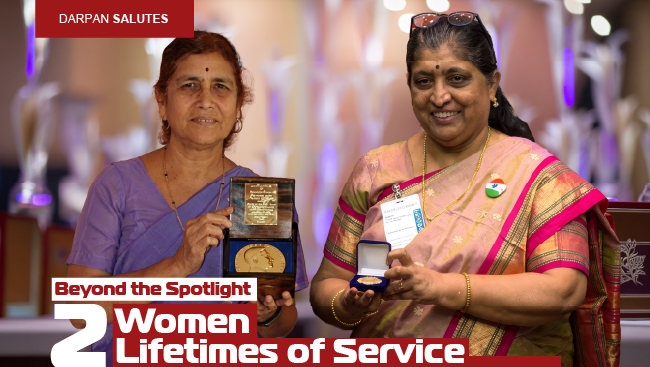
Not all heroines make flashy entries; some arrive quietly, without any fanfare, roll up their sleeves, and simply get to work. No spotlight, just sheer dedication to life-altering service. This International Women’s Day, DARPAN salutes two such women—Dr. Mandakini Amte and Advocate Varsha Deshpande. These public-spirited women showed up for communities that had long been forgotten by society and continue to serve them tirelessly, striving to make their lives better.
Dr. Mandakini Amte
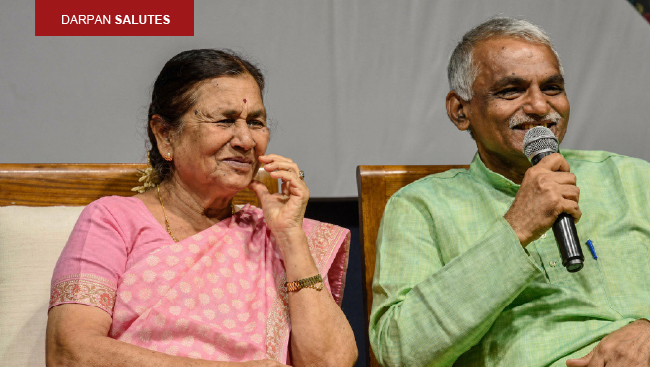
For many of us, giving up a comfortable life to live in a remote forest settlement feels unimaginable. But when your goal in life is altruism, choosing purpose over comfort comes naturally. And Dr. Mandakini Amte did precisely that.
She could easily have followed a successful path in medicine. But the universe had other plans for her. She met Dr. Prakash Amte, a young doctor driven by a deep sense of social commitment. What began as a friendship turned into a shared dream: to serve those with little or no access to healthcare. Prakash had grown up watching his father, Baba Amte, build Anandwan, a rehabilitation community for people affected by leprosy. But he wanted to work in the forests of Gadchiroli with the Madia-Gond Adivasi community.
“Till MBBS, I lived an ordinary life in Nagpur. When I met Prakash during post-graduation, he was working in surgery, and I was working in anesthesia. We became friends, gradually fell in love, and decided to marry. I knew a bit about Baba Amte and his work in Anandwan. Prakash told me that he was not going to work in Anandwan, but even farther, in the Adivasi villages of the remote Gadchiroli district, and that if I agreed with this, we should marry,” she recalls.
Mandakini knew one thing—their values aligned. So, despite strong opposition from her family, she married Dr. Prakash Amte. In 1973, the young couple moved to Hemalkasa and began what would become the Lok Biradari Prakalp. The early years were harsh. There was no infrastructure, and the Madia-Gond tribal community was suspicious of the Amtes. Communication itself was a challenge due to a language barrier. With patience, humility, and consistency, they slowly gained the trust of the community.
What began as a modest effort eventually became a successful initiative. Today, their work has expanded into three major pillars: a hospital providing free medical care, a residential school for tribal children, and an animal orphanage for injured and rescued wildlife.
In 2008, Dr. Mandakini and Dr. Prakash Amte were honored with the prestigious Ramon Magsaysay Award for Community Leadership. Yet awards have never defined her journey. She had the choice of a comfortable life but instead chose to stand beside those forgotten by the system. The society is richer because of that choice.
Visit www.lokbiradariprakalp.org/ to volunteer or donate.
Advocate Varsha Deshpande
As much as the modern Indian woman is celebrated for her growing global presence, a harsh reality continues to exist. There is still a huge section of Indian society where women are still devalued and treated inhumanely. Female feticide continues despite strict laws, and women from marginalized communities still struggle for dignity, safety, and a stable livelihood. The reality is disturbing, but there is still some hope if women like Advocate Varsha Deshpande exist.
For over three decades now, Varsha Deshpande has been spearheading some of India’s most difficult battles, including gender discrimination, female feticide, child marriage, and the systemic marginalization of women.
Hailing from Belgaum, Varsha was always inclined towards social service, but it was not until she witnessed the struggles of socially deserted women of rural Maharashtra that she finally found her purpose. In 1990, she founded the Dalit Mahila Vikas Mandal (DMVM) in Satara. Her early work focused on women who were abandoned by husbands and left without identity documents, income, or social support. They were organized into self-help groups, given vocational training, and supported in securing separate ration cards and basic rights.
Simultaneously, Varsha also initiated a ‘Zunka Bhakri Kendra’ at the State Transport bus stand employing the most vulnerable women. The Zunka Bhakri Kendra has been functional ever since and has been helping deserted women since its inception.
Over time, Deshpande turned her attention to a deeper crisis: sex-selective abortions. Most notably, she helped initiate and support sting operations to expose doctors illegally conducting prenatal sex determination. So far, she has already conducted over 50 sting operations all over Maharashtra. These efforts strengthened enforcement of the PCPNDT Act, which prohibits sex selection.
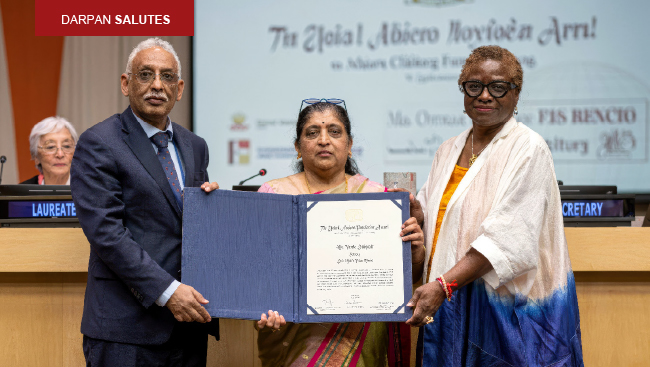
In 2025, she received the United Nations Population Award in the individual category, becoming only the third Indian to receive the honor after Indira Gandhi and J. R. D. Tata.
On receiving the award, she described it not as personal recognition but as a tribute to collective efforts to restore value to the girl child. “I am deeply honored to receive the prestigious UN Population Award... This award is not a personal accolade, but a tribute to the collective work of countless individuals and institutions who engage with communities to drive meaningful change and empower them”, she said.
May many more voices like hers rise with the same fearlessness and dedication.
Support Varsha’s mission here: www.dmvm.in