

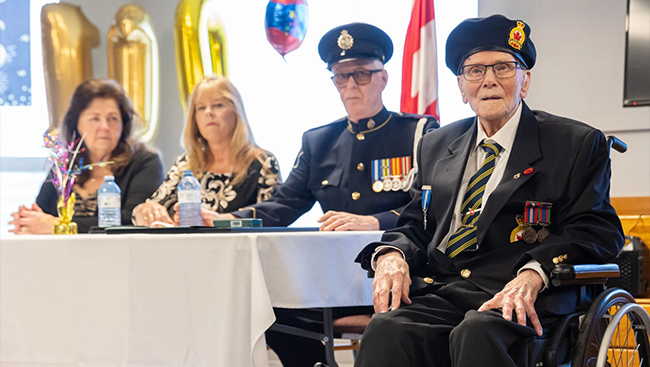
One of Canada's oldest veterans, Burdett Sisler, says it's not that hard to make it to 110 years old – all you have to do is stay alive.
"Anybody can do it," the supercentenarian said in a recent interview. "I don't feel any different as any other day really, except I can't move as fast or think as fast."
Sisler is believed to be the oldest living man in Canada, according to the Gerontology Research Group. He celebrated his 110th birthday on April 13 at a Royal Canadian Legion in Fort Erie, Ont., alongside his family, friends and community members.
"It was amazing," he said. "To me it was going to be just another birthday and it turned out to be an amazing display."
Eighty years after the Allied forces' Second World War victory in Europe, Sisler said he's grateful that his service is still recognized today – even by strangers on Facebook – but his mind goes to fellow soldiers who were sent to the battlefields.
"I have to think back to those who had a rougher time than I had. I never got the chance to go overseas," he said. "A lot of soldiers didn't come back."
Born in Akron, Ohio, Sisler moved to the Toronto area when he was three years old. He met his wife, Mae, through a high school classmate and they married in 1939 – just three days after Britain declared war on Germany.
When Sisler enlisted in the Royal Canadian Army in 1943, Mae expected him to go overseas and not come back so she asked for something that would remind her of her husband, their son Norman said in an interview.
"So they had a baby girl in 1943," Norman said.
Sisler said he originally wanted to join the Royal Canadian Air Force but even though enlistment officers told him he was one of their best candidates, he was turned away because of "one bad eye."
"I'd never needed glasses in my life," Sisler said. "They were afraid I couldn't bring the airplane into the landing."
Instead, Sisler joined the army. While waiting to be sent to basic training, he volunteered for chemical warfare trials in Ottawa – a series of experiments involving chemical and biological agents that left thousands of soldiers with chronic health problems. One trial tested how mustard gas would react to a salve placed on Sisler's skin for 14 days.
"I got a raise in pay after that," he recalled.
Many years later, Sisler was part of a class-action lawsuit against the Department of National Defence and received a settlement.
Sisler trained to become a military gunner in Nova Scotia and later took radar training in Barriefield, Ont., where he became a telecommunications mechanic. In 1945, he joined the Corps of Royal Canadian Electrical Mechanical Engineers, where he ultimately became a sergeant.
The Second World War ended before Sisler had a chance to fight overseas.
He stayed in the military until 1947, and after the war he worked with the Royal Canadian Ordnance Corps just outside of Montreal, where he examined war equipment coming back from Europe. He was stationed there for 13 months before he was discharged due to demobilization.
A civilian once again, Sisler settled his young family in Fort Erie, where he soon became a customs agent with the Department of National Revenue, stationed at the Peace Bridge border crossing.
The couple had four more children – twin boys and two more girls – and made frequent summer camping trips to Ontario's provincial parks. Sisler also sang in a barbershop quartet in the 1960s and ran a side business with a friend fixing TVs and radio sets.
"(He had) an ad in the newspaper that said, 'If you've got a whistler, call Hanes and Sisler,'" Norman said with a laugh.
Sisler's wife died in 1985, a few days before his 70th birthday.
He has 11 grandchildren, 22 great grandchildren and 14 great great grandchildren. He stayed in his Fort Erie home until 2022, supported by family members until the COVID-19 pandemic eased up, and now lives at a retirement home where he gets frequent visitors.
When asked for the secret to longevity, Sisler admitted he didn't have any significant tips. It helps that he never enjoyed the taste of cigarettes, he said, and mostly liked to have a cold beer after mowing the lawn on a hot day.
Even though he's not as mobile as he used to be, he still enjoys a good meal, reading the newspaper and keeping in touch with his grandchildren.
"Every day is fun because I'm still alive."
Picture Courtesy: THE CANADIAN PRESS/HO-Alex Heidbuechel,


