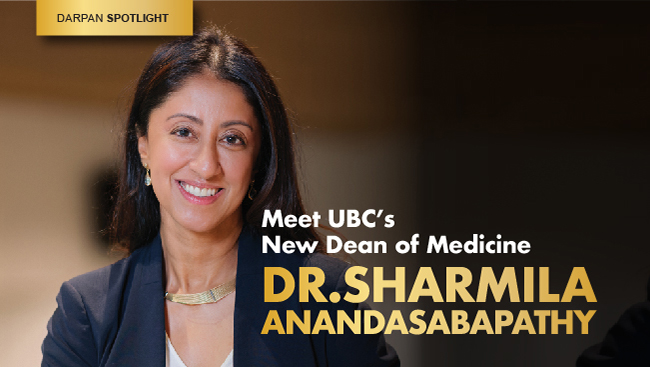
In November 2025, Dr. Sharmila Anandasabapathy stepped into her role as Dean of the Faculty of Medicine and Vice-President, Health at the University of British Columbia (UBC) at a pivotal moment for health both in British Columbia and globally. An internationally renowned clinician-scientist and gastroenterologist, she brings a career defined by innovation, interdisciplinary collaboration, and a deep commitment to equity, signaling both continuity and bold new direction.
“My path was shaped early on by my parents, who came to the U.S. from Sri Lanka when I was a child. My father was a physician, and my mother was an artist, which meant I grew up immersed in both science and the arts. That dual perspective continues to shape how I lead today, combining scientific rigor and curiosity with creativity, empathy, and a strong sense of human connection,” shares Dr. Anandasabapathy.
That early blending of science and humanity would come to define her career. A gastroenterologist by training, Dr. Anandasabapathy has built her work at the intersection of translational science, cancer early detection, and global health equity. She develops and validates scalable technologies for early gastrointestinal cancer detection, translating lab discoveries into practical solutions worldwide.
A Principal Investigator on four NIH- and National Cancer Institute-funded grants before joining UBC, she also leads international clinical trials of lower-cost diagnostics, grounded in her belief that innovation must be accessible, not exclusive. Before joining UBC, she served as Vice-President and Senior Associate Dean, Global Programs, at Baylor College of Medicine in Houston, Texas.
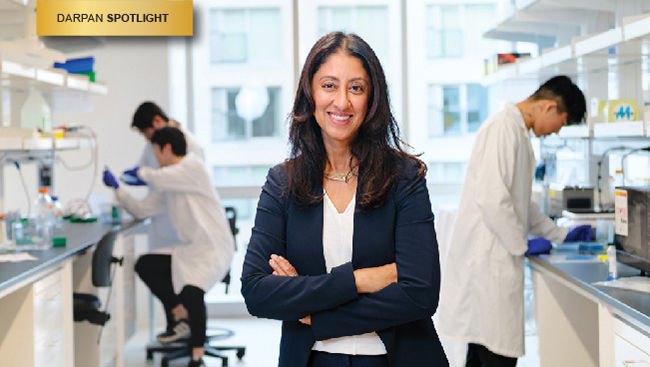
Her global work has taken her across continents, shaping both her scientific priorities and her worldview. “Working in countries such as Malawi, India, and Brazil, I have seen firsthand how inequities in access, often affecting women and children most, shape health outcomes. Those experiences have reinforced my commitment to advancing innovative health solutions that meet the needs of underserved patients, both here at home and around the world,” she says.
Those experiences solidified her sense of responsibility. For Dr. Anandasabapathy, the urgency of her work is grounded in both challenge and possibility, depicting immense health pressures locally and globally, paired with unprecedented scientific tools. Rather than viewing complexity as a barrier, she sees it as a call to action.
At the heart of that action is a clear definition of equity. “Health equity means designing systems and solutions that work for everyone, including those who have historically been underserved. In my own work as a clinician-scientist, that has meant developing low-cost, scalable technologies for early detection of gastrointestinal cancer that can reach patients in resource-limited settings globally.”
Her academic journey reflects the breadth of her perspective. She earned a Bachelor of Arts in English Literature from Yale University before pursuing her MD, with Distinction in Research, at the Albert Einstein College of Medicine. She completed her internal medicine training at New York Hospital-Cornell Medical Center and Memorial Sloan Kettering Cancer Center, followed by a gastroenterology fellowship at Mount Sinai Medical Center in New York. In addition to her primary appointment at Baylor, she held an adjunct appointment in bioengineering at Rice University.
An interdisciplinary ethos remains central to her leadership philosophy. As she describes it, “UBC has an incredible depth and breadth of expertise across the university, and by connecting those strengths, we can help build a more responsive, equitable and sustainable health system for people in the Fraser and across the province.” For Dr. Anandasabapathy, progress lies in connection, be it between disciplines, between institutions, or, most importantly, between people.
Beyond systems and structures, her focus consistently returns to the human experience. “The future of medicine will be interdisciplinary and technology-enabled, but importantly, we must never lose sight of the people at the center. In fact, as medicine becomes more technologically advanced, the human connection becomes even more important.”
The renowned trailblazer places foremost priority on culturally safe, compassionate, and responsive care for diverse populations. She speaks of evolving medical education to include team-based training, a focus on innovating new and better health solutions, and ensuring that emerging AI and digital tools are used safely, responsibly, and ethically; they are not replacements for care, but enhancements.
Underlying her work and leadership is a defining value: courage. “A core value that underpins all of this is courage—the courage to innovate, to stand up for what is right, and to try new approaches even when the path forward isn’t certain. I’ve seen firsthand through my global work that some of the most meaningful advances come from people willing to challenge the status quo in service of patients and communities.”
Dr. Anandasabapathy’s trajectory reflects a rare synthesis of scientific excellence, global perspective, and human-centered leadership. Her work spans bench-to-bedside diagnostics, engineering collaborations, and community-based implementation strategies around the world.
As she embarks on a new chapter, her outlook remains both pragmatic and hopeful. She recognizes the scale of today’s health challenges, yet she remains energized by the possibilities of modern science and collective effort. In Dr. Sharmila Anandasabapathy, the community sees not only a distinguished scientist and academic leader, but a genuine leader committed to advancing medicine in ways that are innovative, inclusive, and deeply responsive to the communities it serves.