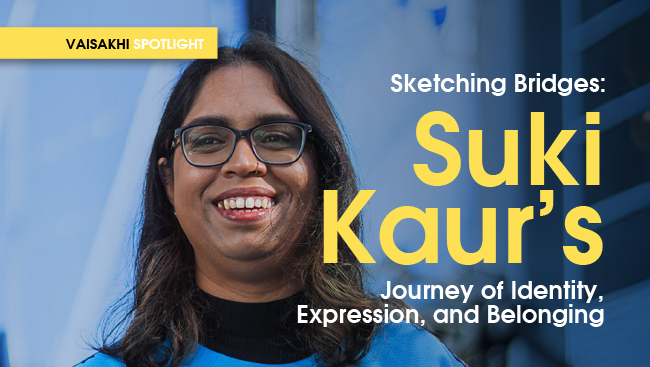
In Surrey, British Columbia’s vibrant South Asian community, sketch artist and illustrator Suki Kaur is redefining what it means to create with purpose. Her work is not just visual; it is deeply emotional, cultural, and connective, offering a language that transcends words.
“At its most basic level, art is an outlet,” says Suki. Growing up as a child of immigrants, she often found herself navigating an in-between space, struggling to fully belong to her roots while also trying to fit into Western society. “I had a hard time connecting with both worlds. Art became my way of communicating.”
What began as a quiet form of self-expression has since evolved into something far more powerful. Today, Kaur sees art as a bridge, “a second or even third language”, that allows her to connect communities, generations, and identities in ways words often cannot.
From Silence to Storytelling
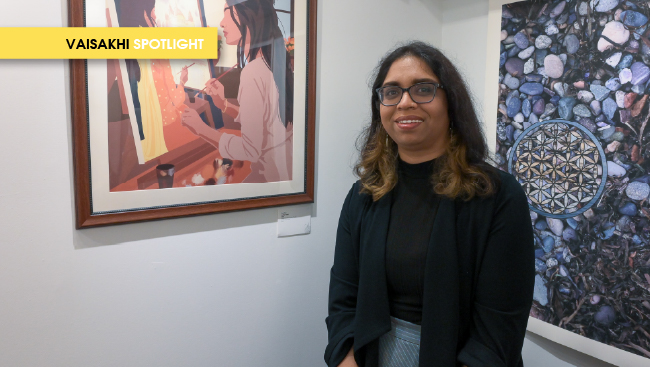
Suki’s journey with art began not as a choice, but as a necessity. As a child, she experienced selective mutism, a condition that made verbal communication difficult in certain environments. In those formative years, drawing became her voice.
“Whatever I was feeling, I had to get it out,” she recalls. “Art was the only way I knew how.”
Though her path wasn’t linear, she explored careers in aesthetics and early childhood education; art remained a constant thread. “Everything always circled back to it,” she says. “So, I decided to fully embrace it.”
Rediscovering Roots
Like many children of immigrants, Kaur’s relationship with her cultural identity evolved over time. In her early years, she consciously distanced herself from her heritage, shaped by an environment that emphasized assimilation. “I tried to create work that felt separate from my culture,” she admits.
That changed gradually, particularly after marriage. Her husband, who was raised in India, reintroduced her to language, traditions, and lived cultural experiences in a way that felt authentic and grounding. Weekly visits to the gurdwara, relearning Punjabi, and reconnecting with everyday rituals reignited a sense of belonging she had once lost.
“It brought me back to that love I felt as a child,” she reflects.
Today, her work draws deeply from those rediscovered roots, often inspired by the quiet beauty of everyday South Asian life. From stories of grandparents to moments of shared care and connection, her art celebrates a tenderness that is both nostalgic and universal. “I like to create pieces that show people loving each other,” she says. “That simplicity, that warmth, that’s what inspires me.”
A Defining Moment: The Canucks Collaboration

A major milestone in Kaur’s journey came with her collaboration with the Vancouver Canucks for their 2025 Diwali logo. Despite a modest online presence, her work caught the attention of Randip Janda, leading to a two-stage selection process. She was chosen to collaborate with the team’s creative departments, shaping a design that reflected both culture and community.
Drawing inspiration from Phulkari, the traditional Punjabi embroidery known for its intricate floral patterns, Kaur infused the design with cultural meaning. “Phulkari represents joy, resilience, and pride,” she explains.
The color palette was equally intentional - bright yellow and deep pink reflected vibrancy and tradition, while blue symbolized calm and depth. “The idea was to move beyond visual celebration,” Kaur says. “For me, Diwali is about hope overcoming despair, light triumphing over darkness. I wanted it to connect the South Asian community with others across Canada, to reflect shared resilience and humanity.”
Creating Work That Resonates
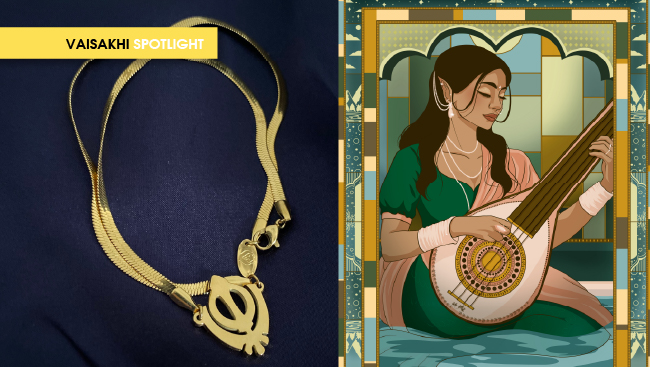
While the Canucks collaboration brought recognition, it is the emotional impact of her work that remains most meaningful to Kaur.
She recalls a moment at a local Christmas market, where a young woman stopped in front of her artwork depicting an elderly South Asian couple sharing tea. The woman picked up the piece and began to cry. “She told me she had needed to see something like that her whole life,” Kaur says.
For her, that moment defined success. “That’s when I realized, this is why I do what I do.”
Balancing Life, Art, and New Beginnings
Behind her creative practice lies a full and grounded life. Kaur lives in a large, multigenerational household, balancing her roles as an artist, writer, wife, and mother.
Her parents, who immigrated to Canada in the mid-1980s, navigated significant challenges while building a life for their family. While those experiences shaped her upbringing, Kaur carries them with quiet understanding, allowing them to inform, but not overshadow her journey.
Alongside her visual art, she is working on her debut novel, an East-meets-West fantasy inspired by Vedic times, as well as a culturally rooted coloring book celebrating everyday South Asian life.
Writing, much like sketching, has always been an extension of her voice. “It started with poetry, then short stories,” she shares. “Now it’s grown into something much bigger.”
Beyond Recognition: A Deeper Purpose
In a world where identity can often feel fragmented, Suki Kaur’s art offers something deeply reassuring, a sense of wholeness. Through every line, color, and story, she creates spaces where cultures meet, emotions surface, and people find themselves reflected. And in doing so, she reminds us that art, at its truest, is not just about what we see, but about what we feel, remember, and carry forward.