In an exclusive interview with DARPAN magazine, Dr. Bal Pawa shares knowledge and advice on mental health challenges and ways for people to cope with it.
The number of people suffering from anxiety, loneliness and depression has spiked amidst COVID-19, and with lockdowns around the world, people’s mental health has been severely impacted. We spoke to Dr. Bal Pawa on how one needs to deal with depression and anxiety during these unprecedented times. Dr. Bal Pawa is a physician, pharmacist and author of the self-help REFRAME Toolkit and The Mind-Body Cure book.
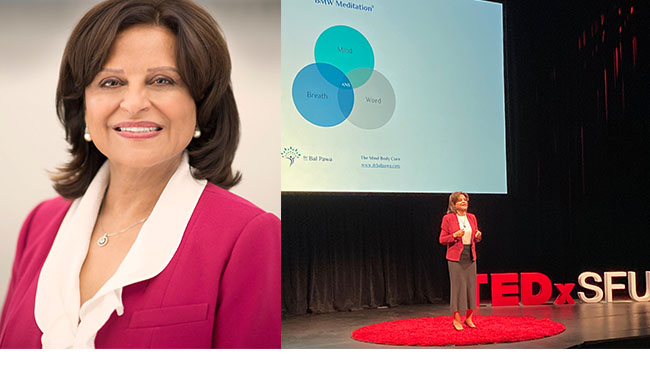
With 30 years of clinical experience backed with academic credentials, Dr. Pawa provides actionable advice that you can implement while dealing with fear, uncertainty and beyond. She works with organizations to transform health in the workplace and optimize employee performance, engagement and productivity. Dr. Pawa has received training through Institute of Functional Medicine for Immune health and GUT/Brain health and acertification from Harvard on Mind/Body Medicine, among other credentials. She is the co-founder of Westcoast Women’s Clinic, a board-certified menopause clinician, and a well-known TEDx Speaker on the effects of stress hormones on the body. She is a Clinical Instructor at UBC’s Faculty of Medicine. In an exclusive interview with DARPAN magazine, Dr. Pawa shares knowledge and advice on mental health challenges and ways for people to cope with it.
Dr. Bal Pawa's 'REFRAME' Toolkit
'REFRAME' is all about looking at health from a different perspective.
- R stands for the resetting of your nervous system – that is through the BMW meditation: Breath, Mind, Word meditation and doing deep controlled breathing.
- E is for exercise which is key for mental health. When you exercise you make more serotonin, and it is also important for your immune system because you are pushing your lymph around which fights virus.
- F is for food - what kind of food are you choosing to improve your immune system? 85 per cent of your immune system is located in the gut, so eat foods rich in fibre and probiotics, and that way you keep your gut healthy.
- R is for rest and sleep. Rest is different from sleep, it means having down time which helps improve your nervous and immune system.
- A is for looking at the dialogue that you are having with yourself. What sorts of thoughts dominate your day? If your thoughts are negative then they feed into your nervous system and affect your immune system. It is about making healthy choices and living with trust and positivity.
- M is for mindset, mindset is how you look at the world and to choose responding over reacting. With a responding mindset versus a reaction mindset, you are saying no matter what I am okay even if there is uncertainty with COVID-19 and fear.
- E is for examination and evaluation. If your symptoms are severe, it does not mean you are a failure, it just means that biologically your body is not able to cope and you need help.
Q & A with Dr Pawa
Q Due to COVID-19, many are feeling isolated at home which is taking a toll on their mental health. What are some tips you can offer during these challenging times?
We cannot control if we are going to get a vaccine and we can’t control if there is a second wave of the virus coming in the fall but what we can control is what we should put our energy into.
Practice a morning meditation, focus on deep, controlled breathing, and have a mantra to start your day with words such as peace, Om, and Amen. These are techniques to help you calm down your nervous system which indirectly helps your immune system. Once you get off the technological gadgets and the news, focus on how you respond to what you have heard or seen –you do not need to react negatively. You don’t need to consume news all the time and react from a place of fear and wonder about the state of economy or on what’s happening to people’s health – this creates more worry and stress hormones. Instead, shift your focus and stay informed by taking in what you need to hear, take a deep breath and make a measured response so that your nervous system always stays calm. The main thing is to not react but respond in a way that does not put you in a state of anxiety.
Q What are the signs and symptoms that family or friends can look out for to help a person suffering from a mental issue? How can they initiate the conversation?
If you are worried that your family member or somebody close to you is dealing with severe anxiety or depression, there are some signs you want to look out for. The ones experiencing anxiety and depression are consumed with it and will talk about it all the time. These individuals will also be socially distanced; they will find doing simple tasks like going out as pointless, they will not want to engage with others, and think there is no point in living – these are signs that you should look into resources available to help them out. COVID-19 protocol of physical distancing is important but that does not mean you cut yourself off from others. The most important thing is to also not judge anyone who has a mental illness but see it like any other medical condition. It is common in the South Asian community to be judgmental and see mental health issues as a sign of weakness. It is important to be open-minded and have conversations that engage the person suffering from a mental issue so that he/she feels comfortable to seek help and are able to get out of the state of denial.
Q Why it is hard for people to accept that there is a mental illness at play and seek help? What is your message to people dealing with these challenges?
Mental illness is not easily accepted in our society and we need to be culturally sensitive and help remove the stigma. Counsellors are needed who are aware of the risk in the South Asian community. It is important to find the root cause and not just prescribe a pill or a band-aid solution. People do not realize that stress exacerbates physical symptoms; you would be astonished to know that 75 per cent of people show up at a doctor’s office with symptoms that can be attributed to excessive chronic stress hormone exposure. It is extremely important to learn to connect the dots and remember that the body works as an integrated unit where all the different systems are working for the body.
Q Tell us about your recently-published book. How is it being received?
The book is a passion project of over three decades of experience as a doctor. It is called The Mind-Body Cure and includes a REFRAME Toolkit. I met with a horrible accident at the age of 32 and when I was hospitalized, I realized that there are some major gaps in the medical system that needed to be addressed. The medical system was great at giving me medications and doing surgery yet there was no emphasis on the involvement of the patient and their self-care as well as no body and mind integration model. You need to take charge of your health; you are your best doctor – you know your mind the best and you know how you react to situations. It is very important to become familiar with your mindset, and it is your mindset that helps you make choices around diet, sleeping habits and physical fitness. In the book, I have created a self-help REFRAME toolkit in order to give readers the knowledge and the tools to look after their health. We need medications and surgeries but for prevention you need to be your own best doctor. The book took two and a half years to complete and is now available on Amazon.
To learn more about Dr. Pawa and her work, visit her website, www.drbalpawa.com