There’s a good chance you’ve seen them before you’ve seen him.
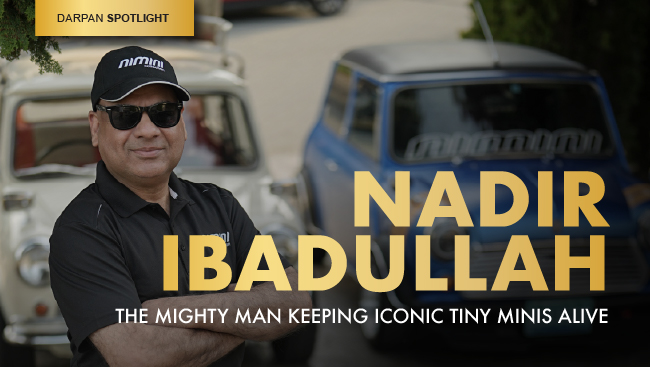
A convoy of tiny, colorful classic Minis cruising through Vancouver traffic. People pointing. Kids waving. Someone inevitably yelling, “Look! Mr. Bean’s car!” And somewhere in the middle of it all is Nadir Ibadullah, smiling like a kid seeing his very first Mini all over again.
That love story began thousands of miles away in Pakistan when he was just a fifth grader. His uncle would occasionally pull into the family driveway in a yellow Mini, and while everyone else rushed to greet relatives, young Nadir had only one priority. “I didn’t care about my cousins or anyone,” he laughs. “I would just go sit inside the Mini.”
Something clicked instantly. He remembers cleaning the car, sitting in it for hours, admiring every inch of it long before he was old enough to drive. Eventually, after relentless convincing, his father persuaded his uncle to sell the car to him.
“My first Mini came into my life when I was in grade five,” he says. “I couldn’t even drive it yet, but I loved it.” That childhood fascination slowly turned into a full-blown obsession. By the mid-1990s, after completing his education and getting married, Nadir began buying and restoring Minis with his own money in Pakistan. Back then, maintaining one was anything but easy. Parts were nearly impossible to source, mechanics didn’t specialize in the car, and most people didn’t understand why anyone would spend so much effort restoring one.
But Nadir saw potential where others saw scrap metal. He would hunt down neglected Minis, restore them piece by piece, make them roadworthy again, and sometimes sell them on. He became resourceful too, often using modified parts from Suzukis, Mitsubishis or Hondas to keep them running.
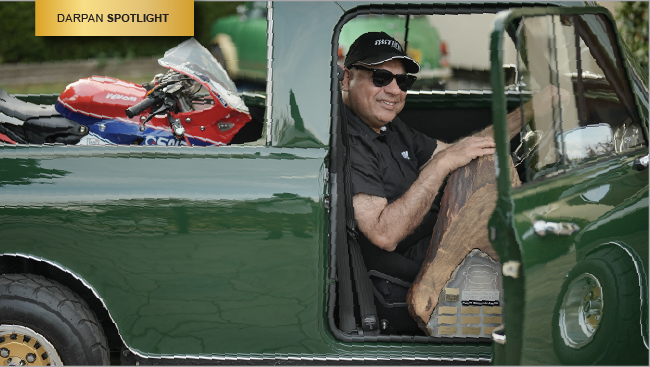
Then came the Mini that changed everything.
Before immigrating to Canada in 2004, Nadir had restored what he calls his “perfect Mini.” It had won admiration back home and even placed first at a local mall display. He parked it safely in his father’s garage before leaving, fully intending to one day ship it to Canada. But time and weather had other plans.
The car slowly deteriorated in storage. Rust began taking over, and eventually, Nadir made the difficult decision to sell it. Years later, regret hit hard. He asked family and friends to track it down again. When they finally found it, it was too late. “It was just a shell,” he says quietly. “That broke my heart.” That moment changed his relationship with Minis forever. “Since then, I decided I’m never selling another Mini again.”
Today, Nadir owns 17 Minis, with one currently undergoing a full restoration. His nimini collection includes rare variants, long-wheelbase pickups, automatic Minis, and highly sought-after classics like a 1967 Mk I Super Deluxe and a 1969 Cooper S Mk II.
“Whenever the Minis are outside, people smile,” he says. “I always say I’m spreading smiles.” And honestly, he’s not wrong. At local car shows, his Minis draw crowds instantly. Some people are fascinated by the engineering. Others just find them adorable. “I’ve heard ‘Oh my God, so cute!’ thousands of times,” he says with a grin. The reactions are part of what fuels him, but there’s a bigger mission behind all this, too.
Nadir wants younger generations to care about these cars. In a world moving rapidly toward electric vehicles and modern performance cars, he worries classic Minis could slowly disappear from the roads altogether. That’s why he’s made it his goal to get more young people behind the wheel—literally.
If teenagers visiting car shows don’t know how to drive a stick shift? No problem. Nadir went out and bought automatic Minis specifically so younger drivers could experience them. At this year’s Vancouver International Auto Show, he did something that shocked even longtime Mini collectors. He allowed visitors—including children—to sit inside one of his rarest Minis all day long. Most collectors would never risk it. “My heart was beating the whole time,” he admits. “But I wanted people to experience the car.”
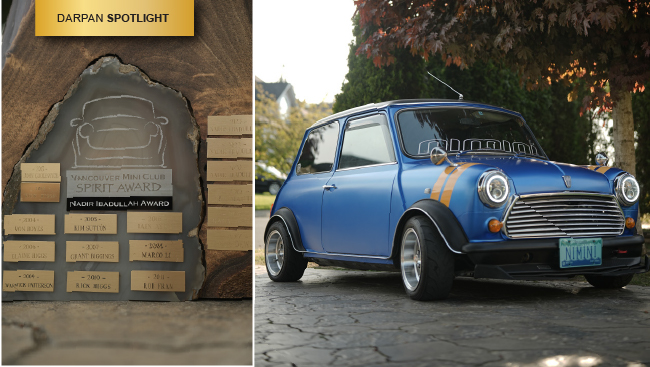
For Nadir, preserving Mini culture isn’t about locking the cars away. It’s about keeping them alive, visible, and loved. That passion has made him something of a legend within Vancouver’s Mini community. He’s won the Vancouver Mini Club Spirit Award multiple years in a row—so consistently, in fact, that the club recently renamed the award after him. Now officially called the Nadir Ibadullah Award, it recognizes the exact spirit he brings into every room, every car show, and every Mini convoy.
And perhaps that’s the legacy he wants most. Not just the collection itself, but the joy attached to it. Because for Nadir, a Mini has never simply been a car. It’s the sound of gears shifting. It’s memories of Pakistan. It’s friendships formed at car shows. It’s the feeling of becoming “a 20-year-old boy again” every time he gets behind the wheel.
Most of all, it’s proof that passion, no matter how small it may look from the outside, can take up a very big space in someone’s life.