
In many South Asian families, daughters grow up knowing that love and approval are tied to how well they perform. From a young age, they learn to be responsible, accommodating, high-achieving, and emotionally attuned to everyone around them.
They are encouraged to dream big, but not in ways that disrupt family harmony. Over time, excellence becomes expectation, and expectation becomes identity. What looks like success often hides a quiet exhaustion.
Navjit Navi Sandhu, RTT specialist and founder of ART of Healing: Authentic, Revolutionary, Transformational Healing, sees this pattern repeatedly in her work with South Asian women. “The pressure to be ‘the perfect daughter’ feels less like a choice and more like an inherited script, one handed to us long before we had the chance to write our own,” she says. “On one hand, there is professional excellence, ambition, and independence. On the other hand, family expectations, cultural loyalty, and emotional responsibility. We are expected to carry both and carry them flawlessly.”
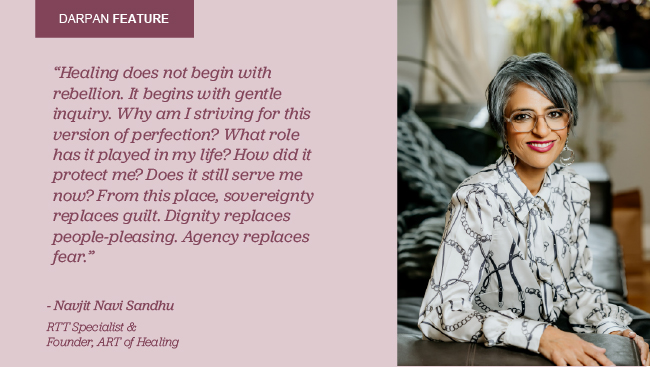
Sandhu notes that many of us grew up watching our mothers give selflessly, rebuilding their lives in new countries and becoming everything at once: homemaker, financial contributor, mother, cultural bridge, and emotional anchor. In the process, many quietly diminished parts of themselves in order to hold everyone else up, leading their daughters to inherit what she calls a quiet internal tug of war. “Who am I outside of what I do for others? If I stop overperforming, overachieving, and overgiving, who am I?” When identity becomes built on being needed, impressive, and selfless, authenticity begins to fade, she explains. “The pressure to be perfect fractures identity. Instead of living from alignment, she lives from obligation. This is where burnout begins.”
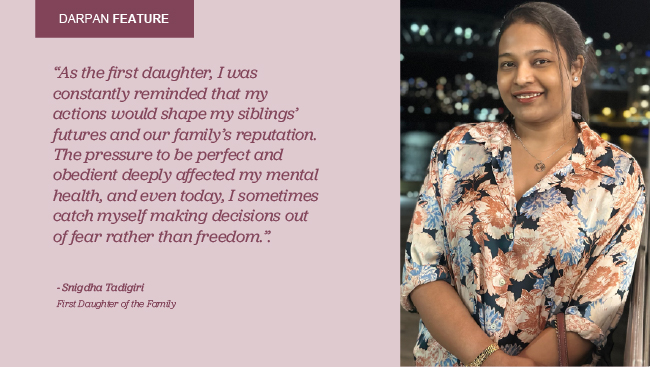
One woman who knows this intimately describes growing up as the eldest daughter in her family. “As the first daughter, I was constantly reminded that my actions would shape my siblings’ futures and our family’s reputation,” recalls Snigdha Tadigiri. “Statements like ‘What will people say?’ were repeated so often that I internalized the belief that one wrong step could damage everything.” The burden of representation became personal. “The pressure to be perfect and obedient deeply affected my mental health, and even today, I sometimes catch myself making decisions out of fear rather than freedom.”
Her experience reflects a common thread among South Asian women, particularly eldest daughters cast as role models, mediators, and emotional shock absorbers. “For me, reclaiming my sanity meant physically moving to another country,” she shares. “It was one of the hardest decisions I’ve made, but it gave me confidence I didn’t know I was capable of,” details Tadigiri.
From a clinical perspective, Sahaj Kaur Kohli, MA, LGPC, NCC, therapist, writer, speaker, author, and founder of Brown Girl Therapy and The Bicultural Brief, notes that many women grow up learning that love, safety, and belonging are conditional. This often manifests in socially rewarded ways. “This can show up as chronic anxiety, difficulty identifying one’s own needs, people pleasing, and a fragmented sense of self where a woman feels competent in many areas of life but disconnected from who she actually is,” Kohli highlights. Because perfection is tied to family stability and cultural survival in immigrant families, stepping outside the role can feel threatening. The cost is long-term. “Many women become highly capable adults who are deeply attuned to others but under-resourced in their relationship with themselves.”
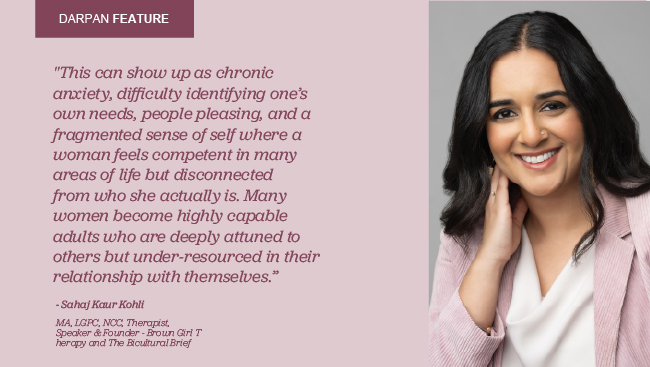
This tension persists even when women are objectively thriving. “Success does not resolve the internalized belief that one must keep earning worth,” Kohli says. Achievement becomes a moving target. “Burnout emerges when external success coexists with internal over-functioning: difficulty resting, saying no, disappointing others, or tolerating imperfection.” Guilt becomes the enforcer. “Guilt is often the emotional mechanism that keeps the cycle intact. It signals perceived disloyalty whenever a woman prioritizes her own needs over expectations.”
When it comes to healing, the answer does not entail rejecting culture or family. Rather, the solution involves becoming conscious within it. Sandhu encourages, “Healing does not begin with rebellion. It begins with gentle inquiry. Why am I striving for this version of perfection? What role has it played in my life? How did it protect me? Does it still serve me now?” When a woman anchors within herself, something shifts. “From this place, sovereignty replaces guilt. Dignity replaces people-pleasing. Agency replaces fear.”
Similarly, Tadigiri’s advice to other women is simple yet radical: “You are allowed to choose yourself, even if it disappoints others. Walking away from constant pressure doesn’t mean you love your family any less. It means you are prioritizing your peace.”
Kohli echoes, “When women begin to loosen perfection, they become more resourced, authentic, and capable of engaging in relationships that are rooted in mutual care rather than performance. Self-care is a form of community care in that taking care of yourself and unlearning this perfectionism can only help you show up in the roles you play and in the relationships you love.”
The perfect daughter narrative may once have ensured survival and belonging. Today, many South Asian women are questioning whether it still serves them, and arguably rightfully so. The intention is not to erase the sacrifices that came before, but to evolve them. Together, ‘perfect’ daughters are choosing to be imperfect. With that choice, they are modeling a more expansive, empowered, and sustainable legacy for the generations that follow.