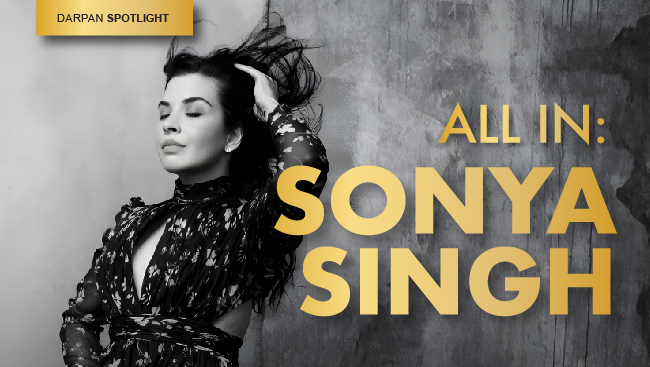
For many first-generation South Asian women, success comes with an unspoken rule: don’t take up too much space. Be grateful. Be agreeable. Be realistic. Sonya Singh has spent her career doing the opposite, not out of defiance, but out of necessity. From her instant national bestseller, Sari, Not Sari, to her upcoming title, The Fake Matchmaker, Singh’s work centers on women who refuse to shrink themselves to meet tradition, love, or industry expectations.
Now entering what she calls the “second act,” the multihyphenate author, producer, caregiver, and storyteller reflects on identity, ambition, and why creating your own space can be the most powerful move of all.
When Singh was told there wasn’t “room” for more than one South Asian author in a publishing cycle, the message wasn’t new. Her response, however, was decisive.
“My parents didn’t immigrate here so I could sit quietly in the corner waiting for someone to make room for me, and I always knew that. So, when I heard there wasn’t ‘room,’ I didn’t take it personally. I thought that sounds like a wall, and I'm going to break it down. There isn’t ‘one spot’ for a South Asian woman. There are millions of stories. And if the table is full? We build another one—and we build it together—for each other.”

That refusal to internalize limitation became central to Singh’s creative voice. Sari, Not Sari, resonated deeply with South Asian women because it articulated tensions many were taught to manage quietly.
“I can only speak from my experience, but in many of our homes, marriage and motherhood are still treated like the main event. Your ambition can feel like the side dish/ ‘fun hustle.’ There’s this subtle messaging: yes, be successful… but don’t let it intimidate anyone. Yes, dream big… but not bigger than your relationship/marriage timeline. That creates tension. And resentment. And guilt. And ...honestly, confusion, and I think... personally, you settle. I settled at times.”
Growing up first-generation Punjabi in Canada required Singh to perform different versions of herself, depending on the room she was in.
“Oh, the double life. There’s always some level of code-switching when you’re navigating cultures. But I stopped hiding. For years, I downplayed speaking Punjabi. I didn’t want to be ‘too ethnic.’ I wanted to blend. It wasn’t until Sari, Not Sari came out that I realized—wait, this is the magic that's been inside of me all this time.”
That realization reshaped how she shows up, personally and professionally.
“Now I’ll wear a sari one day and a power suit the next. I’ll go to the gurdwara and then pitch a rom-com. Turns out, I’m allowed to be all of it—and I can do all of it.”
As the oldest daughter of immigrants, Sonya was intimately familiar with the expectations placed on Punjabi women—and equally unwilling to comply quietly.
“As the oldest daughter of immigrants, and a fiery Aries, I was never going to follow that script quietly. I’ve definitely been called ‘too much.’ Too ambitious. Too opinionated. Too independent. The party girl. But I’ve learned something: the right people don’t shrink you. They celebrate you.”
“I didn’t dismantle the script through debate. I dismantled it by living differently. By building a career. By having a voice. By refusing to dim my personality to make someone else comfortable. And I’ve never believed my voice should be quieter just because I don’t have a brother. Sometimes I joke that maybe that’s why I have such a loud voice. I genuinely don’t know how to whisper. And when it comes to who I am, I don’t think I want to learn.”
That philosophy carries directly into her forthcoming novel, The Fake Matchmaker, where the protagonist opts out of waiting to be chosen.
“I was that woman. I’ve stayed in relationships that didn’t align because I thought I was supposed to make them work. At some point, I realized I didn’t want to be chosen. I wanted to choose, and I was done choosing someone else over me.”
She describes her current chapter as a “second act,” one shaped by boundaries and authorship.
“For me, therapy was a huge shift. I’ve been in therapy for more than five years, and that shifted things for me. The shift happens when you realize you’re allowed to have boundaries. That you can step back from community expectations without abandoning your culture. That your story doesn’t need another narrator. My second act is about authorship—literally and figuratively. I’m not waiting for someone else to define my narrative. I’m writing it myself and using my own voice.”
Asked what she would tell her younger self, Singh returns to hope—and compassion.
“She can always have hope. Hope to take up space. Hope to be as loud as she wants to be. Hope that she never has to apologize for who she is. Through years of therapy, I’ve learned to look back at that little girl with softness instead of judgment. She was doing her best. And she was always enough.”
After years of refusing to dim her light, Singh makes one thing clear: not settling isn’t rebellion—it’s authorship.
Picture Courtesy: George Pimental Photography