Wednesday, December 24, 2025
ADVT 
Health

Artificial retina could help restore vision of elderly

Darpan News Desk IANS, 13 Nov, 2014 10:35 AM
    A team of researchers has created a wireless and light-sensitive, flexible film that could potentially substitute a damaged retina.
     
    The team from Tel Aviv University, the Hebrew University of Jerusalem' Center for Nanoscience and Nanotechnology and Newcastle University in Britain, tested it with a chick retina that normally does not respond to light.
     
    They found that the film absorbed light and, in response, sparked neuronal activity.
     
    In comparison with other technologies, the researchers conclude theirs is more durable, flexible and efficient, as well as better able to stimulate neurons.
     
    "Patients with one type of eye disorder called age-related macular degeneration (AMD) could potentially benefit from such a device," said Yael Hanein from the Tel Aviv University in Israel.
     
    AMD usually affects elderly people, who have damage to a specific part of the retina, thereby limiting their vision.
     
    Scientists have been trying different approaches to develop an implant that can "see" light and send visual signals to a person's brain, countering the effects of AMD and related vision disorders.
     
    But the attempts so far have involved metallic parts and cumbersome wiring, and have low resolution.
     
    "The new technology uses semi-conductor nanorods and carbon nanotubes which are safe," the authors concluded in a paper that appeared in the ACS journal Nano Letters.


    MORE Health ARTICLES

    Health Alert- WHO report reveals worldwide threat to public health

    Health Alert- WHO report reveals worldwide threat to public health
    A new report by the World Health Organisation (WHO) - its first to globally look at antimicrobial resistance, including antibiotic resistance - reveals that this serious threat is no longer a prediction for the future but is happening right now in every region of the world and has the potential to affect anyone, of any age, in any country.

    Health Alert- WHO report reveals worldwide threat to public health

    TV shows can transmit stress too: Study

    TV shows can transmit stress too: Study
    Just like cold, stress can also be contagious and it matters only a little whether we have any relation with the stressed person that we may come in contact with or not, says a study.

    TV shows can transmit stress too: Study

    Vitamin D deficiency may lead to prostate cancer: Study

    Vitamin D deficiency may lead to prostate cancer: Study
    Get under the morning sun sooner rather than later as vitamin D deficiency has now been linked to aggressive prostate cancer, an alarming study indicated.

    Vitamin D deficiency may lead to prostate cancer: Study

    Where butterflies, bees feed on crocodile tears!

    Where butterflies, bees feed on crocodile tears!
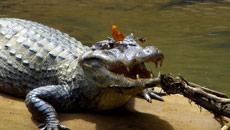
    Look at those crocodile tears in your kid's eyes more carefully. These are an abundant source of salt and other rare minerals and proteins for some!

    Where butterflies, bees feed on crocodile tears!

    Babies learn to recognise pictures before first birthday!

    Babies learn to recognise pictures before first birthday!
    If a mother shows her nine month-old baby a picture of her husband fighting a war in a distant land, she may find to her surprise that if he comes back soon after, the baby may well recognise the person in the picture.

    Babies learn to recognise pictures before first birthday!

    Men! Women prefer courtship over competitiveness

    Men! Women prefer courtship over competitiveness
    What do women prefer, lovers or fighters? The truth is out. Females prefer courtship over competitiveness.

    Men! Women prefer courtship over competitiveness