CHICAGO — Here's another reason for getting a second medical opinion: Biopsy specialists frequently misdiagnose breast tissue, potentially leading to too-aggressive treatment for some women and under-treatment for others, a study suggests.
The results indicate that pathologists are very good at determining when invasive cancer is present in breast tissue, but less adept at making the right diagnosis with less serious conditions or when biopsied tissue is normal.
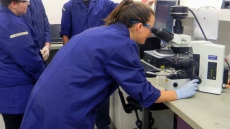
The study involved 115 U.S. pathologists and 240 breast biopsy specimens. Their diagnoses were matched against those of three experts. It was an experiment and may not reflect what happens outside a research setting, but the authors say the results highlight the challenges of accurately interpreting tissue under a microscope.
The study was published in Tuesday's Journal of the American Medical Association.
About 1.6 million breast biopsies are performed each year nationwide, typically after radiologists spot something suspicious on a mammogram. Tissue is withdrawn through a needle or from a surgically removed growth and examined under a microscope. Previous research has shown that interpreting mammograms can also be tricky and lead to under- or over-treatment.
Among the new study's findings:
—Pathologists correctly diagnosed abnormal, precancerous cells about half the time, no better than a coin toss, said lead author Dr. Joann Elmore, a University of Washington researcher. Treatment for this condition typically includes frequent monitoring and sometimes medication. About a third of these cases were misdiagnosed as not worrisome or normal, while 17 per cent were deemed more suspicious or cancer. Since as many as 160,000 U.S. women each year are diagnosed with this condition, the results suggest many may be getting inappropriate treatment, Elmore said.
—Pathologists mistakenly found something suspicious in 13 per cent of normal tissue.
—They had similar trouble with a condition called DCIS — 13 per cent of these cases were misdiagnosed as less serious, while 3 per cent were mistaken for invasive cancer. DCIS involves abnormal cells confined to a milk duct and is diagnosed in about 60,000 U.S. women each year. Cases have increased because of rising mammogram use, and it can sometimes spread so usual treatment is surgery and radiation.
"As a woman, I would probably want to get a second opinion" with a diagnosis of abnormal pre-cancer or DCIS, Elmore said.
A JAMA editorial notes that the study lacks information on patient outcomes, so there's no proof that the experts made the correct diagnosis. Also, pathologists weren't allowed to consult with colleagues when they were uncertain about findings — while in the real world those consultations happen frequently, said editorial co-author Dr. David Rimm, a Yale University pathology professor who also interprets biopsies.
Still, he said the results are troubling and highlight that pathology is an imperfect science. Rimm said he has been asked to offer a second opinion, and that patients make those requests though their primary care physicians.
The editorial says the results "should be a call to action for pathologists and breast cancer scientists" to improve and refine definitions of breast tissue abnormalities.