lya Martinson has two important milestones approaching: the anniversary of her cancer diagnosis on Friday, and on Tuesday, the day she'd be fully immunized against COVID-19 — if her second vaccine dose is not delayed four months.
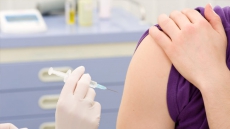
The single mother of three in Kelowna, B.C., received her first shot of the Pfizer-BioNTech vaccine on April 14, and says she was told at the time she would have to wait until August before booking again, despite having stage 4 lung cancer.
Pfizer recommends a 21-day interval between shots of its two-dose vaccine, and like several provinces, British Columbia does not offer medical exemptions for higher risk cancer patients like Martinson.
This week, patients and advocates mounted a national campaign to prioritize people with cancer by adhering to the manufacturer's schedule. In the case of Pfizer, that's a three-week delay, while Moderna dictates a four-week gap between doses, and Oxford-AstraZeneca recommends waiting between four to 12 weeks for a second shot.
Medical experts say emerging research suggests many cancer patients have a reduced immune response to the vaccine, so a single COVID-19 shot may leave them insufficiently protected.
"We're not asking for special treatment. We're just asking for equality," says Martinson, 37. "In order for us to get the same efficacy as everyone else with one vaccine, unfortunately, we do need two vaccines."
There are patients like her in many parts of the country, say advocates, who are calling for a national policy to exempt people with cancer from extended dose delays.
Earlier this month, the National Advisory Committee on Immunization affirmed its recommendation that a second dose be delayed as long as four months in order to offer more people a first dose faster.
NACI left it to provinces and territories to decide if exemptions should be made for high-risk groups.
Some provinces, such as Ontario and Alberta, chose to prioritize some people with weakened immune systems, including certain cancer patients. But elsewhere, including British Columbia and Quebec, the four-month interval applies across theboard.
The president of the Canadian Association of Pharmacy in Oncology says the patchwork of policies leaves many patients in the lurch. Even in jurisdictions that permit earlier doses forcancer patients, confusion reigns,says Tina Crosbie.
"If we have something on a national level, then that will help for that trickle-down effect to be able to implement it and roll it out in the various health units," Crosbie says.
Dr. Keith Stewart, director of the Princess Margaret Cancer Centre in Toronto, says people with cancer often have weakened immune systems, both because of the disease itself and the treatments for it.
Blood cancers, in particular, often impair the immune system. Solid tumours, such as thosein colon cancer or lung cancer, are often treated with therapies that destroy cancer cells, but can also damage the healthy cells involved in the body's immune response.
COVID-19 vaccines trigger the body's immune response to produce antibodies that help fight off infection. But in cancer patients, that response will be diminished, says Stewart.
"Not enough cancer patients respond to the first dose to be comfortable leaving them without the second," he says. "Even with the second dose, protection will be suboptimal. But any protection is better than none."
Researchers in London published a paper in the Lancet this week suggesting a single dose of the Pfizer vaccine leaves many cancer patients partially or mostly unprotected, based on data collected from 151 cancer patients and 54 healthy controls.
Three weeks after receiving one shot of Pfizer, the study found an immune response in 38 per cent of people with solid cancer, and 18 per cent of patients with blood cancer. That's compared to 94 per cent of those without cancer.
However, immunity response improved in patients with solid cancer who received a boost 21 days after their first shot.
A Health Canada spokesman says there's little data on the issue because cancer patients wereexcluded from clinical trials.
And early data suggesting a reduced immune response in some cancer patients does not necessarily indicate the level of real-world protection they'd have against COVID-19, Eric Morrissette said Wednesday in an email.
NACI will continue to monitor the evidence about the effectiveness of vaccines in high-risk groups and adjust its recommendations if needed, he added.
On Wednesday, a coalition of cancer advocacy groups published an open letter in the Globe and Mail calling on all levels of government to ensure Canadians with cancer aren't put at risk because of a delayed dose.
The executive director of Myeloma Canada, which was one of more than a dozen signatories of the letter, says anxiety over second doses has prompted some cancer patients to delay treatments that may impact the effectiveness of the vaccine.
"Because of COVID, many cancer patients have had their diagnosis or treatment delayed, which is a very stressful experience," Martine Elias says.
"Now, we are creating even more uncertainty for them by delaying their second vaccination dose."