Saturday, December 27, 2025
ADVT 
Health

DNA 'glue' can help grow tissues, organs

Darpan News Desk IANS, 15 Jan, 2015 11:18 AM
    DNA molecules can act as a glue to hold together 3D-printed materials that could be used to grow tissues and organs in the lab, researchers report.
     
    According to Andrew Ellington, professor of chemistry and biochemistry at The University of Texas - Austin, researchers have used DNA to assemble objects so tiny that humans cannot see them with the naked eye.
     
    Making them into larger, visible objects is cost-prohibitive. Current methods also do not allow for much control or flexibility in the types of materials that are created.
     
    With this in mind, Ellington's group set out to create a larger, more affordable material held together with DNA.
     
    The researchers developed DNA-coated nanoparticles made of either polystyrene or polyacrylamide material.
     
    DNA binding adhered these inexpensive nanoparticles to each other, forming gel-like materials that they could extrude from a 3D printer.
     
    The materials were easy to see and could be manipulated without a microscope.
     
    The DNA adhesive also allowed the researchers to control how these gels came together.
     
    "They showed that human cells could grow in the gels, which is the first step toward the ultimate goal of using the materials as scaffolds for growing tissues," the authors noted.
     
    The process was described in the journal ACS Biomaterials Science & Engineering.

    MORE Health ARTICLES

    Health Alert- WHO report reveals worldwide threat to public health

    Health Alert- WHO report reveals worldwide threat to public health
    A new report by the World Health Organisation (WHO) - its first to globally look at antimicrobial resistance, including antibiotic resistance - reveals that this serious threat is no longer a prediction for the future but is happening right now in every region of the world and has the potential to affect anyone, of any age, in any country.

    Health Alert- WHO report reveals worldwide threat to public health

    TV shows can transmit stress too: Study

    TV shows can transmit stress too: Study
    Just like cold, stress can also be contagious and it matters only a little whether we have any relation with the stressed person that we may come in contact with or not, says a study.

    TV shows can transmit stress too: Study

    Vitamin D deficiency may lead to prostate cancer: Study

    Vitamin D deficiency may lead to prostate cancer: Study
    Get under the morning sun sooner rather than later as vitamin D deficiency has now been linked to aggressive prostate cancer, an alarming study indicated.

    Vitamin D deficiency may lead to prostate cancer: Study

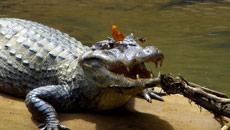
    Where butterflies, bees feed on crocodile tears!

    Where butterflies, bees feed on crocodile tears!
    Look at those crocodile tears in your kid's eyes more carefully. These are an abundant source of salt and other rare minerals and proteins for some!

    Where butterflies, bees feed on crocodile tears!

    Babies learn to recognise pictures before first birthday!

    Babies learn to recognise pictures before first birthday!
    If a mother shows her nine month-old baby a picture of her husband fighting a war in a distant land, she may find to her surprise that if he comes back soon after, the baby may well recognise the person in the picture.

    Babies learn to recognise pictures before first birthday!

    Men! Women prefer courtship over competitiveness

    Men! Women prefer courtship over competitiveness
    What do women prefer, lovers or fighters? The truth is out. Females prefer courtship over competitiveness.

    Men! Women prefer courtship over competitiveness