Wednesday, December 24, 2025
ADVT 
Health

DNA 'glue' can help grow tissues, organs

Darpan News Desk IANS, 15 Jan, 2015 11:18 AM
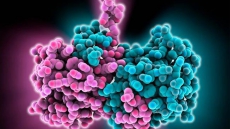
    DNA molecules can act as a glue to hold together 3D-printed materials that could be used to grow tissues and organs in the lab, researchers report.
     
    According to Andrew Ellington, professor of chemistry and biochemistry at The University of Texas - Austin, researchers have used DNA to assemble objects so tiny that humans cannot see them with the naked eye.
     
    Making them into larger, visible objects is cost-prohibitive. Current methods also do not allow for much control or flexibility in the types of materials that are created.
     
    With this in mind, Ellington's group set out to create a larger, more affordable material held together with DNA.
     
    The researchers developed DNA-coated nanoparticles made of either polystyrene or polyacrylamide material.
     
    DNA binding adhered these inexpensive nanoparticles to each other, forming gel-like materials that they could extrude from a 3D printer.
     
    The materials were easy to see and could be manipulated without a microscope.
     
    The DNA adhesive also allowed the researchers to control how these gels came together.
     
    "They showed that human cells could grow in the gels, which is the first step toward the ultimate goal of using the materials as scaffolds for growing tissues," the authors noted.
     
    The process was described in the journal ACS Biomaterials Science & Engineering.
    MORE Health ARTICLES

    Knee surgery not needed for mild osteoarthritis

    Knee surgery not needed for mild osteoarthritis
    Middle-aged and older patients with mild osteoarthritis of the knee may not benefit from the procedure of arthroscopic knee surgery, says new research....

    Knee surgery not needed for mild osteoarthritis

    Eye changes can predict dementia

    Eye changes can predict dementia
    A loss of cells in the retina is one of the earliest signs of a form of dementia in people with a genetic risk for the brain disorder - even before any changes appear....

    Eye changes can predict dementia

    Canadian doctors have begun using stem cell transplants to treat 'Stiff Person Syndrome'

    Canadian doctors have begun using stem cell transplants to treat 'Stiff Person Syndrome'

    TORONTO - Canadian doctors have begun using stem cell transplants to treat "stiff person syn...

    Canadian doctors have begun using stem cell transplants to treat 'Stiff Person Syndrome'

    Can right brain rhythm create a super-perceiving human?

    Can right brain rhythm create a super-perceiving human?
    A certain type of brainwave plays a key role in our sensitivity towards touch and driving. The right brain rhythm can make people have more perceptual and attentive powers...

    Can right brain rhythm create a super-perceiving human?

    Can Ebola strike India?

    Can Ebola strike India?
    There are about 500 Indians in Guinea, 3,000 in Liberia and 1,200 in Sierra Leone, from where the maximum cases have been reported. Nigeria has a much...

    Can Ebola strike India?

    Indian scientists find a 'wonder herb' in the high Himalayas

    Indian scientists find a 'wonder herb' in the high Himalayas
    In the high hostile peaks of the Himalayas where sustaining life is a challenge in itself, Indian scientists say they have found a "wonder herb" which can regulate...

    Indian scientists find a 'wonder herb' in the high Himalayas