Wednesday, December 24, 2025
ADVT 
Health

DNA 'glue' can help grow tissues, organs

Darpan News Desk IANS, 15 Jan, 2015 11:18 AM
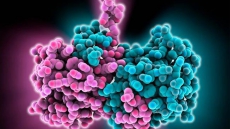
    DNA molecules can act as a glue to hold together 3D-printed materials that could be used to grow tissues and organs in the lab, researchers report.
     
    According to Andrew Ellington, professor of chemistry and biochemistry at The University of Texas - Austin, researchers have used DNA to assemble objects so tiny that humans cannot see them with the naked eye.
     
    Making them into larger, visible objects is cost-prohibitive. Current methods also do not allow for much control or flexibility in the types of materials that are created.
     
    With this in mind, Ellington's group set out to create a larger, more affordable material held together with DNA.
     
    The researchers developed DNA-coated nanoparticles made of either polystyrene or polyacrylamide material.
     
    DNA binding adhered these inexpensive nanoparticles to each other, forming gel-like materials that they could extrude from a 3D printer.
     
    The materials were easy to see and could be manipulated without a microscope.
     
    The DNA adhesive also allowed the researchers to control how these gels came together.
     
    "They showed that human cells could grow in the gels, which is the first step toward the ultimate goal of using the materials as scaffolds for growing tissues," the authors noted.
     
    The process was described in the journal ACS Biomaterials Science & Engineering.

    MORE Health ARTICLES

    Autistic adults at higher risk of sexual victimisation: Study

    Autistic adults at higher risk of sexual victimisation: Study
    The lack of sexual knowledge in adults with autism puts them at a higher risk of sexual victimisation - sexual coercion, unwanted sexual contact attempted rape...

    Autistic adults at higher risk of sexual victimisation: Study

    Decoded: How Ebola virus disables immune response

    Decoded: How Ebola virus disables immune response
    Researchers have revealed how Ebola virus blocks and disables the body's natural immune response - paving the way for developing a drug to treat...

    Decoded: How Ebola virus disables immune response

    HIV vaccine a step closer

    HIV vaccine a step closer
     Researchers have uncovered new properties of special HIV antibodies called "broadly neutralising antibodies" or BNAbs, a discovery that could shed...

    HIV vaccine a step closer

    Computer to help spinal cord injury victims walk

    Computer to help spinal cord injury victims walk
    For helping people with spinal cord injury walk better, researchers have made an artificial connection from the brain to the locomotion centre in the...

    Computer to help spinal cord injury victims walk

    How immune system triggers psychological disorders

    How immune system triggers psychological disorders
    People with high levels of "inflammatory marker" proteins released into the blood in response to infection are at greater risk of developing depression and psychosis, says a study....

    How immune system triggers psychological disorders

    'Love hormone' helps autistic kids

    'Love hormone' helps autistic kids
    Researchers from Stanford University have found that oxytocin has a tremendous effect on such kids' ability to function socially....

    'Love hormone' helps autistic kids