Monday, May 25, 2026
ADVT 
Health

Eating 'On The Go' Could Make You Fat

Darpan News Desk IANS, 21 Aug, 2015 01:16 PM
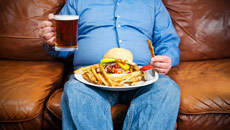
    Dieters who eat while performing other activities such as walking or watching television may increase their food intake later in the day which could lead to weight gain and obesity, says a new study.
     
    "Eating on the go may make dieters overeat later on in the day," said lead study author Jane Ogden, professor at University of Surrey in England.
     
    The study also showed that eating while walking around triggered more overeating compared to eating during other forms of distraction such as watching TV or having a conversation with a friend.
     
    "This may be because walking is a powerful form of distraction which disrupts our ability to process the impact eating has on our hunger. Or it may be because walking, even just around a corridor, can be regarded as a form of exercise which justifies overeating later on as a form of reward," Ogden noted.
     
    The team examined 60 women who were either dieters or non-dieters and gave them all a cereal bar to eat under three different conditions. 
     
    The first group was asked to watch a five-minute clip of the sitcom 'Friends' while eating. 
     
    The second group was asked to walk around the corridor while consuming the cereal bar, and the third group was simply asked to sit opposite a friend and have a conversation. 
     
    After the experiment, participants completed a taste test involving four different bowls of snacks, including chocolate, carrot sticks, grapes and crisps.
     
    The results showed that dieters ate more snacks at the taste test if they had eaten the initial cereal bar while walking around and specifically they ate five times more chocolate.
     
    "Even though walking had the most impact, any form of distraction can lead to weight gain,” Ogden noted.
     
    "When we do not fully concentrate on our meals and the process of taking in food, we fall into a trap of mindless eating where we do not track or recognise the food that has just been consumed," Ogden pointed out.
     
    The study was published in the Journal of Health Psychology.

    MORE Health ARTICLES

    Divorce may end in obese kids!

    Divorce may end in obese kids!
    Children, whose parents are divorced or not married but living together, are at a higher risk of obesity, a study has found.

    Divorce may end in obese kids!

    Bees create mental maps to reach home

    Bees create mental maps to reach home
    We have long wondered at the complex navigation abilities of the bees who use the sun as a compass. But bees do memorise a mental map too, like humans, despite their much smaller brain size, new research reveals adding a whole new dimension to complex bee-navigation abilities that have long fascinated scientists.

    Bees create mental maps to reach home

    Car buyers ready to give up sex than haggle over prices: Study

    Car buyers ready to give up sex than haggle over prices: Study
    What has purchasing a car and sex in common? Well, give your wavering thoughts a rest here as some Americans feel that it is better to give up sex than haggle over the price of a car!

    Car buyers ready to give up sex than haggle over prices: Study

    Night owls run great risk of becoming couch potatoes

    Night owls run great risk of becoming couch potatoes
    Do you stay up late at night busy surfing internet or chatting on your smart phone and wake up only when morning turns into noon?

    Night owls run great risk of becoming couch potatoes

    Why suicides peak between midnight and 4 a.m.

    Why suicides peak between midnight and 4 a.m.
    Apart from late-night parties, good night's sleep and some real action, the time between midnight to 4 a.m. is also known for another thing - suicide.

    Why suicides peak between midnight and 4 a.m.

    Anti-diabetic drug may slow aging too

    Anti-diabetic drug may slow aging too
    Keeping the years off your face may soon become a lot easier as researchers have now discovered new evidence that anti-diabetic drug metformin slows aging and increases lifespan.

    Anti-diabetic drug may slow aging too