CHICAGO — Fever? Headache? Muscle aches? Forget about Ebola — chances are astronomically higher that you have the flu or some other common bug.
That message still hasn't reached many Americans, judging from stories ER doctors and nurses swapped this week at a Chicago medical conference. Misinformed patients with Ebola-like symptoms can take up time and resources in busy emergency rooms, and doctors fear the problem may worsen when flu season ramps up.
That's one reason why doctors say this year it's especially important for patients to get their flu shots: Fewer flu cases could mean fewer Ebola false alarms.
"The whole system gets bogged down, even if it's a false alarm," Dr. Kristi Koenig said during a break at the American College of Emergency Physicians' annual meeting.
Since the first Ebola diagnosis in the U.S., on Sept. 30 in a Liberian man treated in Dallas, doctors say they've had to reassure patients with many fears but none of the risk factors.
Examples shared by those attending the meeting include:
—An Ohio patient who thought she had Ebola because her husband had worked in Dallas, but not with the Ebola patient.
—A New Mexico woman who sought ER testing for Ebola because she had visited Africa two years ago.
—Two Alabama patients who worried they were infected after travelling through an airport in Atlanta, the same city where Ebola patients were treated.

Those Alabama patients had intestinal symptoms but no contact with Ebola patients nor recent travel to Ebola-plagued countries in West Africa, and they were sent home after doctors consulted with the federal Centers for Disease Control and Prevention, said Dr. David Pigott, an emergency medicine specialist at the University of Alabama at Birmingham.
Flu and other airborne diseases can be transmitted by indirect contact with infected people. By contrast, the only way to get Ebola is through direct contact with blood, vomit and other body fluids from Ebola patients, experts say.
While Ebola can be quickly ruled out for many patients by asking about recent travel to West Africa and contact with Ebola patients, "there's still some concern about anybody with symptoms that could be Ebola because it's so much in the news right now," said Koenig, director of public health preparedness at the University of California in Irvine.
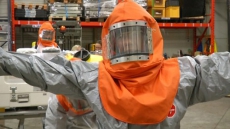
That means a patient with the flu could trigger a full-court press in the ER, including isolating the patient and ER staff grabbing the hazmat suits until Ebola is ruled out.
Ebola was among hot topics at the meeting, and hundreds packed sessions on how to handle a disease they most likely will never have to treat.
Only four people have been diagnosed with Ebola in the United States, and experts doubt that Ebola will become widespread in this country. But if more Ebola cases do occur, getting vaccinated against the flu now "would make the screening process a lot easier," said Dr. Daniel Bachmann, an emergency medicine physician at Ohio State University's Wexner Medical Center.
So far, flu activity is low nationwide and only one death has been reported, in a child earlier this month.
But unlike Ebola, flu contributes to thousands of U.S. deaths each year and many more hospitalizations. And unlike Ebola, there's a vaccine to protect against the flu, recommended annually for adults, teens and children starting at 6 months of age.
So when patients express fears about Ebola, Bachmann tells them, "Go get your flu shot."
Flu vaccination rates are low; a little over half of eligible U.S. children and teens and just 42 per cent of adults got vaccinated in the 2012-13 flu season, CDC data show.
While there have been reports of scattered flu vaccine shortages this fall due to delayed vaccine shipments, seven manufacturers have estimated that as many as 156 million doses — an adequate supply — will be available this flu season, said CDC spokeswoman Erin Burns.
"As of Oct. 17, 2014, manufacturers reported having shipped 117.8 million doses of flu vaccine," she said.
Flu season often begins in October, peaks between December and February and then tapers off.