Thursday, December 25, 2025
ADVT 
Health

High-Fat Diet Also Bad For Brain

Darpan News Desk IANS, 29 Nov, 2015 01:56 PM
    A high-fat diet also appears to prompt normally bustling immune cells in our brain to become sedentary and start consuming the connections between our neurons, a new study has found.
     
    However, going back on a low-fat diet for just two months may reverse this trend of shrinking cognitive ability as weight begins to normalise, researchers said.
     
    "Microglia eating synapses is contributing to synapse loss and cognitive impairment in obesity," said corresponding author Alexis M. Stranahan from Medical College of Georgia.
     
    "On the one hand, that is very scary, but it is also reversible, meaning that if you go back on a low-fat diet that does not even completely wipe out the adiposity, you can completely reverse these cellular processes in the brain and maintain cognition," he explained.
     
    The study provides some of the first evidence of why fat is bad for the brain.
     
    The trouble appears to start with too much fat in the body producing chronic inflammation, which stimulates microglia to have an autoimmune response.
     
    Microglia, like macrophages in the body, are known for their ability to ingest trash and infectious agents in the brain, and their highly acidic interior gets rids of it, which helps support the function and health of neurons.
     
    But as mice get obese, their microglia seem focused on overeating.
     
    "Normally in the brain, microglia are constantly moving around. They are always moving around their little fingers and processes. What happens in obesity is they stop moving," Stranahan said.
     
    "They draw in all their processes; they basically just sit there and start eating synapses. When microglia start eating synapses, the mice don't learn as effectively," Stranahan explained.
     
    The study was published in the journal Brain, Behaviour, and Immunity.
    MORE Health ARTICLES

    Now, 3D-printed plaster cast to heal wound faster

    Now, 3D-printed plaster cast to heal wound faster
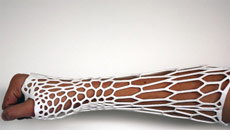
    In what could revolutionise plaster cast technology, a Turkish design student has unveiled a slick 3D-printed cast with ventilation holes that reduces healing time by around 40 percent than currently used plaster casts.

    Now, 3D-printed plaster cast to heal wound faster

    Smart cup that delivers coffee, news too!

    Smart cup that delivers coffee, news too!
    Reading the morning newspaper while sipping a cup of coffee is set to become an even smoother experience as a Finnish coffee roastery company has developed a smart coffee cup that could also display an e-paper.

    Smart cup that delivers coffee, news too!

    An 'upside-down planet' discovered

    An 'upside-down planet' discovered
    Like so many interesting discoveries, this one happened largely by accident. An astronomer has discovered an ‘upside-down planet’ that reveals new method for studying binary star systems.

    An 'upside-down planet' discovered

    Our ancestors enjoyed summer holidays at Antartica!

    Our ancestors enjoyed summer holidays at Antartica!
    If this information stands true, the history books have to be rewritten soon. According to scientists, some parts on the coldest region on our earth - Antartica - was as warm as today's California coast.

    Our ancestors enjoyed summer holidays at Antartica!

    Garnish food with edible flowers for disease-free life!

    Garnish food with edible flowers for disease-free life!
    Forget food, try some flowers instead to increase immunity. If we go by a new research, common edible flowers in China are rich in phenolics and have excellent antioxidant capacity.

    Garnish food with edible flowers for disease-free life!

    Humans left Africa in two migration waves: Study

    Humans left Africa in two migration waves: Study
    In a significant discovery, researchers have found that modern humans may have dispersed in more than one wave of migration out of Africa.

    Humans left Africa in two migration waves: Study