Monday, December 22, 2025
ADVT 
Health

Human sleep patterns evolved first in ocean?

Darpan News Desk IANS, 28 Sep, 2014 11:57 AM
  • Human sleep patterns evolved first in ocean?
The cells that control our rhythms of sleep and wakefulness may have first evolved in the ocean - hundreds of millions of years ago - in response to pressure to move away from the sun, shows a new study.
 
The researchers derived this conclusion from their findings that a hormone that governs sleep and jet lag in humans may also drive the mass migration of plankton in the ocean.
 
"The fascinating picture emerges that human biology finds its roots in some deeply conserved, fundamental aspects of ocean ecology that dominated life on the Earth since ancient evolutionary times," said lead researcher Detlev Arendt from the European Molecular Biology Laboratory (EMBL) in Heidelberg, Germany.
 
The molecule in question, melatonin, is essential to maintaining our daily rhythm and the scientists have discovered that it governs the nightly migration of a plankton species from the surface to deeper waters.
 
"We found that a group of multitasking cells in the brains of these larvae that sense light also run an internal clock and make melatonin at night," Arendt explained.
 
"So we think that melatonin is the message these cells produce at night to regulate the activity of other neurons that ultimately drive day-night rhythmic behaviour," Arendt noted.
 
The findings indicate that melatonin's role in controlling daily rhythms probably evolved early in the history of animals, and hold hints to how our sleep patterns may have evolved.
 
To find out the role of melatonin in other species and how it evolved to promote the task of sleep, the researchers turned to the marine ragworm Platynereis dumerilii.
 
The researchers discovered a group of specialised motor neurons that respond to melatonin.
 
Using modern molecular sensors, they were able to visualise the activity of these neurons in the larva's brain and found that it changes radically from day to night.
 
The findings were published online in the journal Cell.

MORE Health ARTICLES

Why westerners can't pronounce Sanskrit word 'Sri'

Why westerners can't pronounce Sanskrit word 'Sri'
Ever wondered why most Britishers could not pronounce the Sanskrit word 'sri' - a common Indian honorific for males - and instead settled for 'shri', a combination of sounds found in English words like shriek and shred?

Why westerners can't pronounce Sanskrit word 'Sri'

Men in 'healthy' countries have eyes for beauty!

Men in 'healthy' countries have eyes for beauty!
All the pretty women out there, if wooing a man is what is in your mind, move on to a country where conditions are not that harsh as feminine charm sweeps men living in countries with 'healthy' conditions.

Men in 'healthy' countries have eyes for beauty!

Health Alert- WHO report reveals worldwide threat to public health

Health Alert- WHO report reveals worldwide threat to public health
A new report by the World Health Organisation (WHO) - its first to globally look at antimicrobial resistance, including antibiotic resistance - reveals that this serious threat is no longer a prediction for the future but is happening right now in every region of the world and has the potential to affect anyone, of any age, in any country.

Health Alert- WHO report reveals worldwide threat to public health

TV shows can transmit stress too: Study

TV shows can transmit stress too: Study
Just like cold, stress can also be contagious and it matters only a little whether we have any relation with the stressed person that we may come in contact with or not, says a study.

TV shows can transmit stress too: Study

Vitamin D deficiency may lead to prostate cancer: Study

Vitamin D deficiency may lead to prostate cancer: Study
Get under the morning sun sooner rather than later as vitamin D deficiency has now been linked to aggressive prostate cancer, an alarming study indicated.

Vitamin D deficiency may lead to prostate cancer: Study

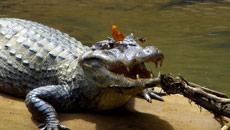
Where butterflies, bees feed on crocodile tears!

Where butterflies, bees feed on crocodile tears!
Look at those crocodile tears in your kid's eyes more carefully. These are an abundant source of salt and other rare minerals and proteins for some!

Where butterflies, bees feed on crocodile tears!