Sunday, December 21, 2025
ADVT 
Health

Indian-Origin Scientist Latha Venkataraman Creates First Single-Molecule Device

Darpan News Desk IANS, 26 May, 2015 12:48 PM
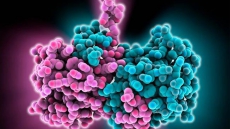
    A team of Columbia Engineering researchers led by an Indian-American scientist Latha Venkataraman has created a single-molecule electronic device which has a potential of real-world technological applications for nanoscale devices.
     
    Under the direction of Venkataraman, researchers created a single-molecule diode which performs 50 times better than all prior designs.
     
    Constructing a device where the active element is only a single molecule, has long been a tantalising dream in nanoscience.
     
    "Our new device represents the ultimate in functional miniaturisation that can be achieved for an electronic device," said Venkataraman.
     
    With electronic devices becoming smaller every day, the field of molecular electronics has become more critical in solving the problem of further miniaturisation.
     
    Single molecule represents the limit of miniaturisation.
     
    The idea of creating a single-molecule diode was suggested by Arieh Aviram and Mark Ratner who theorised in 1974 that a molecule could act as a rectifier, a one-way conductor of electric current.
     
    "It is amazing to be able to design a functioning single molecular circuit," Venkataraman said.
     
    She and her team are now working on understanding the fundamental physics behind their discovery and trying to increase the rectification ratios they observed, using new molecular systems.
     
    The report was published on May 25 in the journal Nature Nanotechnology.
    MORE Health ARTICLES

    Can Ebola strike India?

    Can Ebola strike India?
    There are about 500 Indians in Guinea, 3,000 in Liberia and 1,200 in Sierra Leone, from where the maximum cases have been reported. Nigeria has a much...

    Can Ebola strike India?

    Indian scientists find a 'wonder herb' in the high Himalayas

    Indian scientists find a 'wonder herb' in the high Himalayas
    In the high hostile peaks of the Himalayas where sustaining life is a challenge in itself, Indian scientists say they have found a "wonder herb" which can regulate...

    Indian scientists find a 'wonder herb' in the high Himalayas

    Robotic walking stick for visually impaired

    Robotic walking stick for visually impaired
    In a first, engineers have designed a robotic walking stick for the visually impaired that can detect the user's immediate path and store localised geographical information...

    Robotic walking stick for visually impaired

    Genes may influence hangover chances

    Genes may influence hangover chances
    According to new research from University of Missouri-Columbia, genetic factors accounted for 45 percent of the difference in hangover frequency in women and 40 percent in men...

    Genes may influence hangover chances

    Green tea can protect spinal cord neurons

    Green tea can protect spinal cord neurons
    Chinese researchers have found evidence that polyphenols can protect spinal cord neurons against oxidative stress and can reduce free radical damage....

    Green tea can protect spinal cord neurons

    Serotonin can reduce sensitivity to pain

    Serotonin can reduce sensitivity to pain
    Researchers at Portugal's Champalimaud Foundation said Friday that the molecule of serotonin in the organism can diminish sensitivity to pain...

    Serotonin can reduce sensitivity to pain