Monday, December 29, 2025
ADVT 
Health

New drug could transform leukaemia treatment

Darpan News Desk IANS, 08 Dec, 2014 11:58 AM
    A new type of cancer therapy has produced dramatic results in patients with advanced leukaemia in an early-phase clinical trial.
     
    Approximately 15 percent of acute myeloid leukemia patients have a mutated form of the IDH2 gene.
     
    This mutation prevents immature white blood cells from developing into healthy, infection-fighting cells which accumulate, crowd out normal cells, and lead to the development of acute leukaemia.
     
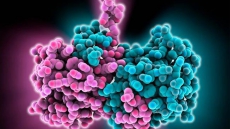
    AG-221 is an investigational drug that blocks the mutated IDH2 protein, effectively allowing these immature white blood cells to develop normally.
     
    "This drug has the potential to transform the treatment of leukemia," said lead study author Eytan M. Stein, medical oncologist at the Memorial Sloan Kettering Cancer Center in the US.
     
    "We have not yet reached the maximum tolerated dose and patients are responding dramatically. More research is needed, but I am optimistic that this drug will fundamentally alter the natural history of IDH2-mutant leukemia and other hematologic malignancies," Stein added.
     
    Instead of inhibiting a mutation that leads to cancer cell growth, the new drug works by targeting a gene that can transform cells into becoming healthy again.
     
    As part of the study, 45 patients with IDH2-positive leukaemia or haematologic malignancies were able to complete one cycle of therapy and were evaluated for efficacy.
     
    All patients had advanced disease that had relapsed or was unresponsive to prior therapy.
     
    Patients received up to 150 mg or 200 mg of AG-221 once or twice daily in 28-day cycles.
     
    The overall response rate was 56 percent; 15 patients (33 percent) achieved complete remission and 10 patients (22 percent) partial remission.
     
    The condition of 17 patients (38 percent) became stable.
     
    There were no treatment-related deaths.
     
    The findings were presented at the 56th annual meeting of the American Society of Hematology.

    MORE Health ARTICLES

    Autistic adults at higher risk of sexual victimisation: Study

    Autistic adults at higher risk of sexual victimisation: Study
    The lack of sexual knowledge in adults with autism puts them at a higher risk of sexual victimisation - sexual coercion, unwanted sexual contact attempted rape...

    Autistic adults at higher risk of sexual victimisation: Study

    Decoded: How Ebola virus disables immune response

    Decoded: How Ebola virus disables immune response
    Researchers have revealed how Ebola virus blocks and disables the body's natural immune response - paving the way for developing a drug to treat...

    Decoded: How Ebola virus disables immune response

    HIV vaccine a step closer

    HIV vaccine a step closer
     Researchers have uncovered new properties of special HIV antibodies called "broadly neutralising antibodies" or BNAbs, a discovery that could shed...

    HIV vaccine a step closer

    Computer to help spinal cord injury victims walk

    Computer to help spinal cord injury victims walk
    For helping people with spinal cord injury walk better, researchers have made an artificial connection from the brain to the locomotion centre in the...

    Computer to help spinal cord injury victims walk

    How immune system triggers psychological disorders

    How immune system triggers psychological disorders
    People with high levels of "inflammatory marker" proteins released into the blood in response to infection are at greater risk of developing depression and psychosis, says a study....

    How immune system triggers psychological disorders

    'Love hormone' helps autistic kids

    'Love hormone' helps autistic kids
    Researchers from Stanford University have found that oxytocin has a tremendous effect on such kids' ability to function socially....

    'Love hormone' helps autistic kids