Thursday, December 25, 2025
ADVT 
Health

New test for early cancer detection

Darpan News Desk IANS, 01 Oct, 2014 10:08 AM
    Early detection of cancer could now be as easy as a simple blood test.
     
    Researchers have found that this test may also eliminate the need for some types of biopsies and identify those more likely to develop cancer in the future.
     
    The test, called the "lymphocyte genome sensitivity" (LGS) test, could detect some cancers earlier than ever before, the study noted.
     
    "The test could allow earlier cancer detection, helping to save people's lives," said co-researcher Diana Anderson from University of Bradford in West Yorkshire, UK.
     
    To develop this test, the researchers took blood samples from a group of people that included healthy individuals, cancer patients and people believed to be at a higher risk than normal to develop cancer. 
     
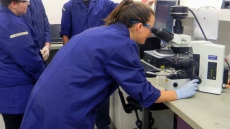
    White blood cells (lymphocytes) in these samples were examined in a "comet test," by embedding the cells in a jelly-like substance, called agar, on a microscope slide. 
     
    In this test, damage to the genetic material (DNA) of the cells was caused by treatment with ultraviolet (UVA) light. 
     
    This damage was observed in the form of DNA pieces being pulled within the agar in an electric field toward the positive end of the field.
     
    This caused a comet-like tail, and the longer the tail the more DNA damage. 
     
    In cancer patients, DNA-damaged tail responses remained high and in those people who might develop pre-cancerous diseases, tail responses were in between. 
     
    This means that people with cancer have DNA which is more easily damaged by UVA than other people, so the test shows the sensitivity to damage of all the genome in a cell. 
     
    The study appeared in The FASEB Journal.

    MORE Health ARTICLES

    Immigrant kids in US at higher obesity risk

    Immigrant kids in US at higher obesity risk
    Immigrant kids in the US are more likely to grow obese than US-born Caucasian children, a study says....

    Immigrant kids in US at higher obesity risk

    Artificial anti-cancer molecules created in a jiffy

    Artificial anti-cancer molecules created in a jiffy
    In what could lead to new anti-cancer drugs, researchers have developed a new method to produce molecules that have a similar structure to peptides...

    Artificial anti-cancer molecules created in a jiffy

    Neuronal 'sweet spot' can curb obesity

    Neuronal 'sweet spot' can curb obesity
    Preventing weight gain, obesity and diabetes could be as simple as keeping a nuclear receptor from being activated in a small part of the brain, says a new study....

    Neuronal 'sweet spot' can curb obesity

    First molecular map to detect vision loss created

    First molecular map to detect vision loss created
    An Indian-origin researcher-led team has created the most detailed map to date of a region of the human eye, long associated with blinding diseases...

    First molecular map to detect vision loss created

    Revealed: Why brain tumours are more common in men

    Revealed: Why brain tumours are more common in men
    The absence of a protein known to reduce cancer risk can explain why brain tumours occur more often in males and are more harmful than similar tumours in females....

    Revealed: Why brain tumours are more common in men

    In-flight infants at greater death risk: Study

    In-flight infants at greater death risk: Study
    If we believe a shocking in-flight pattern revealed by researchers, lap infants are at greater risk of dying on board owing to bad sleeping arrangements....

    In-flight infants at greater death risk: Study