Tuesday, December 23, 2025
ADVT 
Health

Scientists create Parkinson's disease in lab

Darpan News Desk IANS, 07 Nov, 2014 11:59 AM
  • Scientists create Parkinson's disease in lab
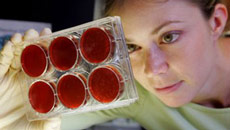
To unravel what actually goes wrong in people with Parkinson's disease and find out potential new therapy, scientists have successfully created a human stem cell disease model of Parkinson's disease in a dish.
 
The stem cell model allowed scientists to observe key features of the disease in the laboratory, specifically differences in the patients' neurons' ability to produce dopamine, the molecule that is deficient in Parkinson's disease.
 
The researchers studied a pair of identical twins, one affected and one unaffected with Parkinson's disease, another unrelated Parkinson's patient, and four healthy control participants.
 
"The subject of Parkinson's disease discordant twins gave us an incredible opportunity to utilise stem cell models of disease in a dish to unlock some of the biological mechanisms of disease," said Scott Noggle from New York Stem Cell Foundation (NYSCF) Research Institute.
 
Upon analysing the cell models, the scientists found that the dopamine-producing neurons from both twins had reduced GBA enzymatic activity, elevated I-synuclein protein levels, and a reduced capacity to synthesise and release dopamine.
 
In comparison to his unaffected brother, the neurons generated from the affected twin produced less dopamine, had higher levels of an enzyme called monoamine oxidase B (MAO-B), and poor ability to connect with each other.
 
Treating the neurons with molecules that lowered the activity of MAO-B together with overexpressed GBA normalised I -- synuclein and dopamine levels in the cell models.
 
This suggests that a combination therapy for the affected twin may be possible by simultaneously targeting these two enzymes.
 
The findings were published in the journal Cell Reports.

MORE Health ARTICLES

Birth control pills may influence your mating choice

Birth control pills may influence your mating choice
Birth control has not only changed family roles, gender roles and social life of women, it may also influence women's choice of sexual partners, a study has indicated.

Birth control pills may influence your mating choice

Why octopus never gets entangled

Why octopus never gets entangled
Ever wondered why the hundreds of suckers lining an octopus’ arms do not grab onto the octopus itself?

Why octopus never gets entangled

Medicines may help you quit drinking!

Medicines may help you quit drinking!
If you wish to stop drinking, visiting the doctor may be the last thing in your mind as you hardly come across doctors prescribing pills that can keep you away from visiting the bars in the evening.

Medicines may help you quit drinking!

How drug development can be a child's play

How drug development can be a child's play
Making and improving medical drugs could soon become as easy for chemists as stacking blocks is for a child.

How drug development can be a child's play

Prostate cancer linked with sex: Study

Prostate cancer linked with sex: Study
A study in the US has found that prostate cancer could be caused by a common infection passed on during intercourse, a leading English daily reported Tuesday.

Prostate cancer linked with sex: Study

Don't drink and swim: Drunk zebrafish shows why humans go nuts after booze

Don't drink and swim: Drunk zebrafish shows why humans go nuts after booze
High on booze, a zebrafish nearly doubled her speed in an experiment, leaving scientists with results that may help them find why some people on a high behave like weirdos in a party.

Don't drink and swim: Drunk zebrafish shows why humans go nuts after booze