Tuesday, April 7, 2026
ADVT 
Health

Study Finds If Diarrhea Serve A Purpose

Darpan News Desk IANS, 16 Jun, 2017 11:28 PM
    Despite thousands of years of pant-crapping history, there's a surprising amount we don't know about diarrhea. Does it actually help clear the bacteria causing a gastrointestinal infection, or is it merely a symptom of disease that should be prevented as much as possible?
     
    In a new study from Brigham and Women's Hospital, investigators explore the immune mechanism that drives diarrhea, concluding that it does play a critical role in pathogen clearance in the early stages of infection.
     
    The new study, published in Cell Host and Microbe, also uncovers a previously unrecognized role for interleukin-22, an immune system molecule, in the host's defense against infection.
     
    "The hypothesis that diarrhea clears intestinal pathogens has been debated for centuries," said corresponding author Jerrold Turner, MD, PhD, of the BWH Departments of Pathology and Medicine.
     
    "Its impact on the progression of intestinal infections remains poorly understood. We sought to define the role of diarrhea and to see if preventing it might actually delay pathogen clearance and prolong disease."
     
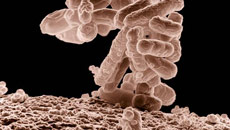
    To investigate, researchers used a mouse model infected with Citrobacter rodentium, the mouse equivalent of an E. coli infection. Using this model, they saw an increase in the permeability of the intestinal barrier within just two days of infection -- well before inflammation and epithelial damage.
     
    In particular, they uncovered a critical role for interleukin-22 that in turn influences another molecule called claudin-2, previously known to be involved in causing diarrhea.
     
    They found that diarrhea resulting from the signaling of these two molecules helped promote pathogen clearance and limited disease severity.
     
    Other investigators have proposed developing new therapeutics to inhibit claudin-2. However, Turner and colleagues explain that the activation of this pathway may be critical for combating an infection, particularly in the early stages of a disease.
     
    They conclude that diarrhea is critical to enteric pathogen clearance, and that IL-22 may play a key role in host defense.
    MORE Health ARTICLES

    Scientists rewrite code of life with 'alien' DNA

    Scientists rewrite code of life with 'alien' DNA
    In a major breakthrough that could re-write the history of life on earth, scientists have successfully added an alien pair of DNA "letters" (or bases) to create the first "semi-synthetic" bacterium.

    Scientists rewrite code of life with 'alien' DNA

    Now, a DNA tool to spot cancer

    Now, a DNA tool to spot cancer
    Detecting cancer could soon become a lot easier as scientists have used DNA to develop a tool that detects and reacts to chemical changes caused by cancer cells.

    Now, a DNA tool to spot cancer

    What you were waiting for! A device that detects pee in pool

    What you were waiting for! A device that detects pee in pool
    Those who have a habit of peeing in a swimming pool, beware. Here comes a device glows green the moment it detects traces of human waste in water.

    What you were waiting for! A device that detects pee in pool

    Do humans have spiders' genes?

    Do humans have spiders' genes?
    Not only the spiderman, even you may share certain genomic similarities with spiders, a study that for the first time sequenced the genome of a spider has revealed.

    Do humans have spiders' genes?

    Anger a better motivator for volunteers than sympathy?

    Anger a better motivator for volunteers than sympathy?
    Angry people do not always raise a ruckus; they may also bring about positive changes to society with a new study showing that anger may be more effective at motivating people to volunteer than other motives.

    Anger a better motivator for volunteers than sympathy?

    Impulsive people at greater risk of food addiction

    Impulsive people at greater risk of food addiction
    Impulsive people are at greater risks of food and drug addition as impulsivity is a result of cellular activities in the part of the brain involved with reward and not a result of dysfunctional eating behaviour, a study indicated.

    Impulsive people at greater risk of food addiction