Saturday, December 27, 2025
ADVT 
Health

Sweat-eating bacteria may treat acne

Darpan News Desk IANS, 30 Sep, 2014 11:10 AM
    Bacteria that metabolise ammonia - a major component of sweat - may improve skin health and some day could be used for the treatment of skin disorders such as acne or chronic wounds, shows new research.
     
    Human volunteers using the bacteria reported better skin condition and appearance compared with a placebo control group, said researchers after the study.
     
    For the study, researchers used a strain of Nitrosomonas eutropha -- ammonia-oxidising bacteria (AOB) isolated from organic soil samples.
     
    In the placebo-controlled study involving 24 volunteers, one group applied a suspension of the live bacteria on their face and scalp for one week while a second group used placebo.
     
    Both groups were followed for an additional two weeks.
     
    The AOB users reported qualitative improvements in skin condition compared with no or minimal improvement reported by the control group.
     
    "The use of a bacterial DNA detection assay demonstrated the presence of AOB in 83-100 percent of skin swabs obtained from AOB users but not in any of the placebo control samples," said Larry Weiss, chief medical officer at AOBiome, a biotech start-up in Cambridge, Massachusetts.
     
    Importantly, there were no adverse events associated with the topical application of AOB.
     
    AOB are ubiquitous in soil and water and are essential components of the nitrogen cycle and environmental nitrification processes.
     
    "Live Nitrosomonas are well tolerated and may hold promise as novel, self-regulating topical delivery agent of nitrite and nitric oxide to the human skin," Weiss concluded.
     
    The researchers presented the results at the fifth ASM Conference on Beneficial Microbes in Washington, DC recently.

    MORE Health ARTICLES

    Don't drink and swim: Drunk zebrafish shows why humans go nuts after booze

    Don't drink and swim: Drunk zebrafish shows why humans go nuts after booze
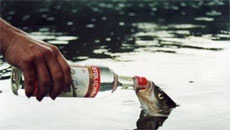
    High on booze, a zebrafish nearly doubled her speed in an experiment, leaving scientists with results that may help them find why some people on a high behave like weirdos in a party.

    Don't drink and swim: Drunk zebrafish shows why humans go nuts after booze

    E-cigarettes boost drug-resistant bacteria

    E-cigarettes boost drug-resistant bacteria
    Despite being labeled as a healthy alternative to cigarettes, e-cigarettes may increase the virulence of drug-resistant and potentially life-threatening bacteria, a study has warned.

    E-cigarettes boost drug-resistant bacteria

    Chip that precisely detects cancer early created

    Chip that precisely detects cancer early created
    What if we could diagnose cancer while it was still only affecting a few localised cells? Here comes an ultra-sensitive nano-chip that is capable of detecting cancer early.

    Chip that precisely detects cancer early created

    Yoga gets a new home in Finland

    Yoga gets a new home in Finland
    Yoga is set to get a new home in Finland when a studio is opened at the airport of this capital of the Nordic country.

    Yoga gets a new home in Finland

    Prehistoric skeleton confirms first American origins

    Prehistoric skeleton confirms first American origins
    Researchers said Thursday that they have identified a nearly complete skeleton in an underwater Mexican cave, a discovery that could help resolve a longstanding debate about the origins of the first people to inhabit the Americas.

    Prehistoric skeleton confirms first American origins

    Autism risk higher among kids with parents in technical jobs

    Autism risk higher among kids with parents in technical jobs
    Children of parents who are in technical occupations are more likely to have an autism spectrum disorder (ASD) and a more serious form of autism, a study suggested.

    Autism risk higher among kids with parents in technical jobs