Toronto Metropolitan University opened Canada's newest medical school this week, with 94 students who administrators believe reflect the diversity needed among this country's future doctors.
"It's very intentional for us to be locating the school in Brampton — a diverse community, underserved from a medical human resources standpoint," said Dr. Dominick Shelton, interim assistant dean and an emergency physician at Sunnybrook Health Sciences Centre in Toronto.
The University of Prince Edward Island also welcomed its first medical students this week as a regional campus of Newfoundland and Labrador's existing program at Memorial University. York University in Toronto and Simon Fraser University in Surrey, B.C., will also open new medical schools in the coming years.
Shelton hopes these new schools will help solve the shortage of primary-care physicians in Canada.
"We are going to be showing our students the joy of practising family medicine," he said, noting that TMU is establishing an integrated health centre in the community.
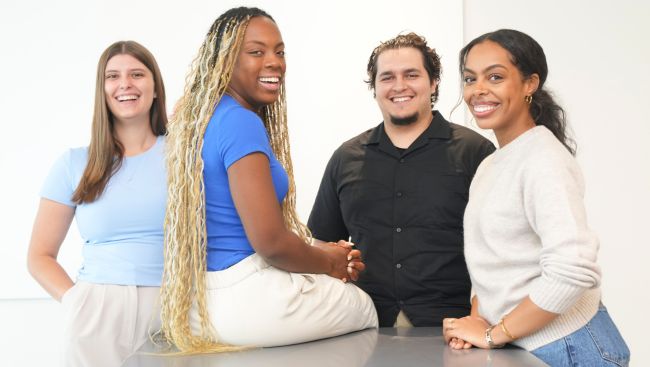
Four students in TMU's inaugural class shared what inspired them to become doctors and the barriers they overcame to get here.
ZAYNASHAE BORELAND
Zaynashae Boreland was born with a multicystic kidney that wasn't functioning and spent much of her childhood at SickKids Hospital in Toronto.
The now 26-year-old said the care she received was so good she was inspired to think about working in health care, but as a Black teen, she didn't know if it was a viable option for her.
"I wanted to be a health-care worker but I didn't see anyone that looked like me. So I was looking for a path," said Boreland.
That path became even more elusive when a high school biology teacher actively discouraged her.
"I must have gotten like a 70 on one of my midterms and I went to her to ask questions about what could I have done better and she said, 'if I'm being honest with you, I wouldn't go into health care," Boreland remembered.
"I listened because in my head, it's a teacher. A teacher is telling me not to do something. It's a mentor in my mind."
So Boreland went to the University of Ottawa to do an arts degree majoring in psychology. But a volunteer gig with the school's student emergency response team got her thinking about health care again.
"I was talking to the other members, some of them nurses, some of them were in med school," she said.
"It reignited the spark of 'right, that's exactly what I wanted to do. I lost sight of it, but now I'm back. Here I am, this is my path. Why did I let someone else tell me that it wasn't my path?'"
She went to nursing school at the University of Toronto and returned to SickKids Hospital, where she has worked as a nurse for two years. But during her time there, she realized the "itch" she was feeling was to become a doctor.
"It's a completely different profession but I also feel as if what you learn as a nurse and what you learn in nursing school completely complements what we're going to learn in med school," Boreland said.
Her dream is to open a multidisciplinary family practice clinic in Mississauga, where she has lived her whole life, or wherever primary care is needed the most within the region.
And, Boreland wants to be that face of health care that she didn't see growing up for Black children and teens in the community.
"I want them to feel as if they're heard and that they can see themselves within me as a Black physician and that they could also do this."
SAMAH OSMAN
After Samah Osman and her family immigrated to Canada from Sudan, her interest in medicine began at a very young age.
"I remember being a child and going with my mom to medical appointments and just helping her navigate a system that was ill-equipped to meet the needs of non-English speaking immigrants," said Osman, who is now 26.
"I was like interpreting, writing out complex forms with her. My sisters would help and the three of us would try to, you know, schedule appointments and we would attend appointments and try to relay information the best that we could."
Osman encountered the health-care system again when she was a teen and suffering from a health condition, but her doctor "dismissed" her symptoms.
"(I was) told they're just a normal part of puberty and development and you know, I knew that they weren't," she said.
Her condition worsened and she eventually had multiple surgeries while she was studying health sciences at Western University in London, Ont.
While doing her master's degree in public health, she had a realization.
"I was able to understand that as a Black woman my experiences and having my concerns dismissed is not unique," Osman said.
"This is something that is consistently reported by Black women and by Black populations, Indigenous populations, whether that be from things about maternal care to cancer screenings."
Osman knew she wanted to become a doctor and be part of the solution. She first worked in public health, knowing that learning about social determinants such as housing, nutrition and employment would make her "a better physician one day."
Now that the day has come to start that journey, her family is "so happy."
"My mom always said growing up — when we were having those experiences with the health-care system — she'd always say, 'I need you to become a doctor. Our community needs you to become a doctor,'"
"It's almost like a full-circle moment."
VANESSA WILSON
Vanessa Wilson didn't think about becoming a doctor until she became a patient at age 17.
"I was playing on my high school's badminton team and it just happened out of nowhere. I slipped and I fell in the middle of a match and I looked down and my leg was broken right in half," Wilson said.
At McMaster Children's Hospital in Hamilton, doctors found a cancerous tumour on her leg. Wilson had several surgeries over a couple of years and her orthopedic oncologist inspired her to pursue medical school.
"He became not only the person that cured my cancer, but a person that was really, really comforting during that entire experience," she said.
"That's kind of why I wanted to go into medicine, to be able to give that experience back to people because doctors can have such an important impact."
Wilson also developed a passion for accessibility after spending a lot of time in a wheelchair during her recovery.
She just finished a master's degree at the University of Toronto's Rehabilitation Sciences Institute and hopes to offer her patients accessible services when she becomes a physician.
"(Being in a wheelchair) completely changed my perspective on life. You don't understand all the barriers in place until you are actually the person sitting in the chair," said Wilson, who is now 24.
"It's a really dehumanizing experience that a lot of people just don't understand exists."
Wilson is the first person in her family to go to university and had to overcome financial barriers to make it possible. As soon as she could walk again, she worked two jobs throughout her undergraduate degree in health sciences at the University of Waterloo.
A lack of self-confidence was another barrier she had to overcome as she applied to medical school.
"With pretty much any pre-medical student, throughout your journey there's constant self-doubt," Wilson said.
"You're seeing like TMU had over 6,400 applicants and there was 94 seats for the class. So how could you not doubt yourself?"
Wilson said when she thought she wasn't "capable" of getting in, she remembered her oncologist — and all the barriers she had already overcome.
"Through how well he cared for me, I kind of learned even more the value a doctor can offer," she said.
"I thought, 'you know, if I went through all this when I was 17, I can do it.'"
ADRIAN SEJDIJAJ
Adrian Sejdijaj's parents met while taking English classes after immigrating to Canada. His mother came from Brazil and his father came from Albania.
"Growing up, they always taught me to be grateful for all the opportunity Canada has given to me," said Sejdijaj, who is 22.
He was attracted to health care, so he joined the Canadian Armed Forces soon after turning 18 and trained to become a medic, while also doing an undergraduate degree in biomedical science at TMU.
As a medic, he got to see the different roles each member of the health-care team played and was inspired by their holistic approach "where you see the patient as an entire person, not just a physical laundry list of symptoms to treat."
The physician role resonated most with him, but Sejdijaj said that as the first person in his immediate family to go to university, he had a crisis of confidence about whether he would be a "competitive applicant" — something his peers who were not first-generation students didn't appear to face.
"It was such an expensive process and time-consuming process to even apply to medical school," he said.
"I had no idea how to get into research opportunities, how to do extracurriculars. I didn't even know how the GPA system worked. So I was just trying to get the best grades I can," Sejdijaj said.
But while he was feeling overwhelmed, he thought about a cousin in Brazil who had gone to medical school and become a general surgeon.
"That was a real big motivator for me to see, you know what, (if) she could do it, I could do it," he said.
"That served as more of a confidence boost into me being able to continue down this path."
Picture Courtesy: THE CANADIAN PRESS/Chris Young