Friday, May 29, 2026
ADVT 
Health

This Automated, Robotic Drill May Perform Surgery In 2.5 Minutes

Darpan News Desk IANS, 01 May, 2017 12:27 PM
    A computer-driven automated drill that could perform a type of complex cranial surgery 50 times faster -- decreasing operating time from two hours to 2.5 minutes -- has been developed by researchers, including one of Indian-origin.
     
    A translabyrinthine surgery is performed to expose slow-growing, benign tumours that form around the auditory nerves.
     
    For such complex surgeries, surgeons typically use hand drills to make intricate openings, adding hours to a procedure and may also increase the risks of loss of facial movement. 
     
    However, the new automated machine replaces hand drills to produce fast, clean, and safe cuts, reducing the time the wound is open and the patient is anesthetised, thereby decreasing the incidence of infection, human error, and surgical cost. 
     
    "I was interested in developing a low-cost drill that could do a lot of the grunt work to reduce surgeon fatigue," said A.K. Balaji, Associate Professor at the University of Utah in the US. 
     
    The drill, which could play a pivotal role in future surgical procedures like hip implants, was developed from scratch to meet the needs of the neurosurgical unit, as well as developed software that sets a safe cutting path, the researchers said in the paper reported in the journal Neurosurgical Focus.
     
    First, the patient is imaged using a CT scan to gather bone data and identify the exact location of sensitive structures, such as nerves and major veins and arteries that must be avoided. Surgeons use this information to programme the cutting path of the drill. 
     
    In addition, the surgeon can programme safety barriers along the cutting path within 1 mm of sensitive structures. 
     
    If the drill gets too close to the facial nerve and irritation is monitored during surgery, the drill automatically turns off. 
    MORE Health ARTICLES

    Now, 3D-printed plaster cast to heal wound faster

    Now, 3D-printed plaster cast to heal wound faster
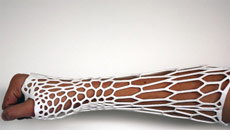
    In what could revolutionise plaster cast technology, a Turkish design student has unveiled a slick 3D-printed cast with ventilation holes that reduces healing time by around 40 percent than currently used plaster casts.

    Now, 3D-printed plaster cast to heal wound faster

    Smart cup that delivers coffee, news too!

    Smart cup that delivers coffee, news too!
    Reading the morning newspaper while sipping a cup of coffee is set to become an even smoother experience as a Finnish coffee roastery company has developed a smart coffee cup that could also display an e-paper.

    Smart cup that delivers coffee, news too!

    An 'upside-down planet' discovered

    An 'upside-down planet' discovered
    Like so many interesting discoveries, this one happened largely by accident. An astronomer has discovered an ‘upside-down planet’ that reveals new method for studying binary star systems.

    An 'upside-down planet' discovered

    Our ancestors enjoyed summer holidays at Antartica!

    Our ancestors enjoyed summer holidays at Antartica!
    If this information stands true, the history books have to be rewritten soon. According to scientists, some parts on the coldest region on our earth - Antartica - was as warm as today's California coast.

    Our ancestors enjoyed summer holidays at Antartica!

    Garnish food with edible flowers for disease-free life!

    Garnish food with edible flowers for disease-free life!
    Forget food, try some flowers instead to increase immunity. If we go by a new research, common edible flowers in China are rich in phenolics and have excellent antioxidant capacity.

    Garnish food with edible flowers for disease-free life!

    Humans left Africa in two migration waves: Study

    Humans left Africa in two migration waves: Study
    In a significant discovery, researchers have found that modern humans may have dispersed in more than one wave of migration out of Africa.

    Humans left Africa in two migration waves: Study