VICTORIA — Forget the long, sharp needles and vials of blood taken to check for cancers, diabetes and heart problems — researchers at the University of Victoria have developed a new test requiring only a single drop.
Retired University of Victoria biochemist Terry Pearson said in an interview that his researchers have developed a less invasive, cheaper and more personalized method of blood testing that relies on a pin prick and a single drop of blood.
The blood test, not yet available in Canada, is already being used at the Mayo Clinic in the United States to test for thyroid cancer, he said.
"It works, and it works well," said Pearson. "The technology is fabulous, actually. This is big. Our idea is to make diagnostic medicine better by a quantum leap by being able to test for multiple proteins at once, inexpensively."
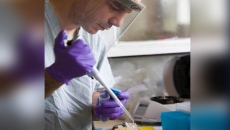
During the test, the drop of blood is collected on a filtered paper and taken to a laboratory, he said.
"We can do up to 25 tests on the one drop of blood," Pearson said, noting markers can be found for cardiovascular diseases, diabetes and signs of prostate and ovarian cancers.
"We think it's going to really, truly revolutionize diagnostic medicine."
The technology was developed at UVic over 13 years and in partnership with U.S. researcher Leigh Anderson, based in Washington, D.C.
Anderson founded in 2006 the non-profit Plasma Proteome Institute, which uses new technology to analyze blood and diagnose diseases.
Pearson said he and Anderson have been friends for more than 40 years and have worked together on blood-test research.
"Leigh was my scientific buddy," Pearson said. "We met at Cambridge when we were both studying there years ago. We've maintained friendship ever since. We co-developed that technology. That took 13 years, and three years ago we formed a company."
That company is called SISCAPA Assay Technologies, Inc., and it develops tools to conduct assays of blood proteins.
Pearson said the technology needs more testing before it can be used in Canada. He said he expects it to be available in Canada within two years.
"We've been bleeding ourselves for several years now," Pearson said, adding friends and family also participated in the research.
"We've been measuring our bio markers, and we've got good data, but you need hundreds of data points to show the precision of it."
Brazilian athletes at last summer's Pan Am and Parapan Games in Toronto used the technology to assess bio markers associated with training, stress and performance.
The testing on the Brazilian athletes will continue during the 2016 Summer Olympics in Brazil.