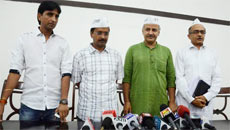
The Aam Admi Party's (AAP's) suicidal tendencies are bound to help the Bharatiya Janata Party (BJP) more than any other party because the saffron outfit is politically better placed to exploit them.
If the AAP hadn't been driven by competitive egos, it might have been able to build on its success in the Delhi elections to spread its wings to, say, Mumbai, Bengaluru and Haryana for a start.
Such inroads by a feisty competitor could not but have unnerved the BJP, under pressure as it is from challenges from traditional rivals like the Congress and the regional parties of the Hindu heartland on the land acquisition law and other issues.
Now, however, the BJP can breathe easy. Since the AAP has ceased to be a major danger, at least for the present, the Narendra Modi government can pursue its agenda at its own pace.
Indeed, the prime minister may well feel that providence is on his side. First, the Congress virtually collapsed to hand him a majority in the Lok Sabha last year. Now, the only party which gave signs of being a formidable rival is imploding.
The BJP's other advantage is that most of the other parties are suffering from leadership problems.
While the Congress will have to contend with the exigencies of dual control at the top posed by Sonia and Rahul Gandhi, it is yet to be seen whether the revamped Janata-2 comprising several parties of the "cow belt" plus Janata-Secular of Karnataka will be able to take off.
It is possible that Janata-2 will present a serious challenge to the BJP in the Bihar elections towards the end of the year with its caste-dominated vote banks. But whether regional heavyweights with inflated egos like Mulayam Singh Yadav, Lalu Prasad Yadav, Sharad Yadav, Nitish Kumar, H.D. Deve Gowda and others will be able to stick together for any length of time is open to question.
It is obvious that compared to these parties, the BJP has in Modi a leader whose political longevity is seemingly assured.
Moreover, there is not much doubt about his durability unlike others who once had an apparently bright future like, say, Indira Gandhi, whose massive 1971 success was blighted, first, by the Navnirman movement against corruption in Gujarat in 1973, the railway strike of 1974 and, finally, the Emergency of 1975-77, which rung the curtains down on her reign.
Similarly, Rajiv Gandhi's 415-seat tally in the 543-member Lok Sabha fell apart like a house of cards in 1989 following his suspected involvement in the Bofors howitzer scandal.
Modi, in contrast, appears to be reasonably secure at the moment with no one in sight who offers a genuine challenge. He even seems to have succeeded in partially curbing those in the saffron brotherhood who had been targeting Muslims and Christians on being emboldened by the BJP's majority in the Lok Sabha.
As a result, the "Godhra moment" - the deaths of Hindu pilgrims in a train fire which sparked off the Gujarat riots of 2002 - for which Mani Shankar Aiyar of the Congress has been waiting hasn't materialized. Aiyar had likened the anticipated "moment" with the Reichstag fire which led to the Nazi crackdown on the Jews in Hitler's Germany.
Modi's only problem at present is the slowness of the reforms process which is negating the pre-election promise of achhey din (good days) via a fast-paced development programme.
The other is the less serious one of the RSS-types imposing their fetishes on the nation by, among other things, banning beef and films like Un-freedom, which depicts "unnatural passion" or homosexuality, and "Fifty Shades of Grey" for depicting excessive passion.
If the censor board chief, Pahlaj Nihalani, is behind the ban on the films, it was Home Minister Rajnath Singh who favoured the ban on the BBC documentary, India's Daughter, on the December 2012 rape victim.
Since then, Singh has been toying with the idea of a countrywide ban on beef even if the beef-eating "festivals" organised in Kerala and West Bengal have shown that not all Indians, including Hindus, share the inhibitions of the RSS.
These issues may be of interest mainly to the chatterati, but social network-savvy BJP cannot be unaware that no segment of society can be ignored in these days of the twitter and YouTube, not to mention the 24/7 news channels with their insatiable thirst for sensationalism.
Not surprisingly, the RSS wants the government to circumvent the judiciary's deletion of Section 66-A of the IT Act, freeing the Internet from official control.
Considering how much emphasis Modi places on his foreign interactions, he must be conscious of the need to retain his "modern" image, which is likely to suffer if he allows too much latitude to the primitives in the Hindutva camp.
One way to counter their localism is extensive globalization - the General Motors want to make India its regional export hub - so that the winds of new technology, new attitudes and new vision sweep away the cobwebs of age-old fads and prejudices.