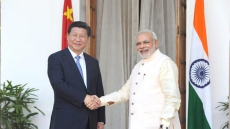
India’s concerns over border incursions by Chinese troops remained at the forefront of talks between Prime Minister Narendra Modi and visiting Chinese President Xi Jinping Thursday even as the two nations charted a new chapter in economic ties with Beijing announcing $20 billion investment over the next five years.
Addressing a joint media briefing after 90 minutes of restricted talks followed by delegation-level talks, Modi was candid in expressing India’s concerns over the latest incident of hundreds of Peoples’ Liberation Army troops entering Chumar in Ladakh sector in Jammu and Kashmir. He said the border row should be resolved soon.
He also suggested that clarifications on the Line of Actual Control (LAC) "would be of use" in solving the festering border question.
Expressing "serious concern over repeated incidents along the border", Modi said: "We agreed that peace and tranquility in the border region constitutes an essential foundation for mutual trust and confidence and for realizing the full potential of our relationship.
"I also suggested that clarification of Line of Actual Control would greatly contribute to our efforts to maintain peace and tranquility and requested President Xi to resume the stalled process of clarifying the LAC. We should also seek an early settlement of the boundary question.
"This is an important understanding, which should be observed diligently," he added.
India and China disagree over demarcation of large chunks of their over-4,000 km-long boundary, especially in the western sector with Chinese troops repeatedly entering Indian territory. The stand-off is resolved through established border mechanisms. The two countries last year inked a special border mechanism to resolve such disputes.
Xi said both sides have agreed to "continue to be sensitive and respectful to each others' sensitivities and concerns and progressively handle the outstanding issues in a positive attitude".
But he reiterated the Chinese position that the boundary question is "left over from history" and both sides have made progress in maintaining peace and tranquillity in the border areas.
Referring to the latest incursion by hundreds of Chinese troops in Chumar, Xi said: "Since the boundary is yet to be demarcated, sometimes there could be instances (of transgressions) and both sides are fully capable to manage to resolve the issues through border-related mechanism so that such incidents have little impact on ties."
He said China would work with "friendly determination" with India to settle the boundary question at an early date and for a peaceful, tranquil border.
Underlining that resolving the border issue is imperative to economic growth, Modi said: "... a climate of mutual trust and confidence; respect for each other's sensitivities and concerns; and, peace and stability in our relations and along our borders are essential for us to realize the enormous potential in our relations.
"If we achieve that, we can reinforce each other's economic growth. We can contribute to peace, stability and prosperity in our region. And, we can give new direction and energy to the global economy. "
"... I would like to say that this is a historic opportunity for the relationship between India and China, filled with vast possibilities. We can start a new era in our relations. If we are sensitive to our opportunities and challenges, then I am confident that we will fulfil our responsibility to make it a great success," Modi added.
India also expressed "concern" over China's contentious visa policy and transborder rivers.
Referring to the border problem during his address at the Indian Council of World Affairs here, Xi said: "Neighbours may encounter problems. What is important is to tackle the boundary question and seek a fair, reasonable solution at an early date. And in the meantime, India and China should not allow the boundary problem to affect their bilateral economic ties."
"We should not just focus on our differences and forget our friendship and cooperation and let it stand in the way of our development, cooperation," he said.
Xi repeated his vision of India and China together becoming a geopolitical force in the world. He said with the rise of the Asian century, “China and India as two vital forces have once again been brought to the forefront of times... Our ties have gone beyond the bilateral scope.”
He suggested that China’s policy of engagement with its neighbourhood to the west could be dovetailed into India’s Look East Policy to tap the common market and become the region's growth engines.
Touching on strategic ties, Xi said Beijing supports "India's aspiration for a bigger role" in the UN Security Council (UNSC). He also said China is willing to support India's full membership in the Shanghai Cooperation Organisation and in return, expects India to help it in building relations in the South Asian Association for Regional Cooperation (SAARC).
Both sides gave a fillip to their economic and trade ties by inking 16 agreements, including one that will see China investing $20 billion in India's infrastructure sector over five years.
China has also assured greater access to Indian goods.
Modi said he had outlined India’s concerns over the trade imbalance and been assured that Beijing would take concrete steps on the issue.