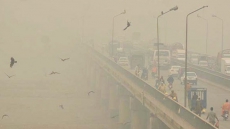
During the past two decades, Delhi's air quality was the "most deadly" in 2016 as it reduced the life expectancy of a resident by more than 10 years, a new study said Monday, asserting that the national capital was the second among 50 most polluted areas of the country.
India is today the world's second most-polluted country, trailing only Nepal, it said and pointed out that loss of life expectancy was the highest in Asia, exceeding six years in many parts of India and China.
According to air quality life index and accompanying report produced by the Energy Policy Institute at the University of Chicago (EPIC), globally particulate pollution reduces average life expectancy by 1.8 years, making it the greatest global threat to human health.
"By comparison, first-hand cigarette smoke leads to a reduction in global average life expectancy of about 1.6 years," it said.
"The impact of particulate pollution on life expectancy is comparable to that of smoking, twice that of alcohol and drug use, three times that of unsafe water, five times that of HIV/AIDS, and more than 25 times that of conflict and terrorism," it said.
The study pointed out that over the past two decades, the concentration of fine particulates increased by 69 per cent on an average across India, reducing the life expectancy of a typical Indian citizen by 4.3 years compared to 2.2 years in 1998.
It said concentrations of particulate pollution in India's northern states of Bihar, Uttar Pradesh, Haryana, Punjab, and the National Capital Territory of Delhi are "substantially higher" and the impact on life expectancy exceeds six years.
It said pollution is the "single greatest threat" to human health globally, with its effect on life expectancy exceeding that of devastating communicable diseases such as tuberculosis and HIV/AIDS, behavioral killers like cigarette smoking, and even war.
Seventy-five per cent of the global population or 5.5 billion people, live in areas where particulate pollution exceeds the WHO guideline.
"The AQLI reveals that India and China, which make up 36 per cent of the world's population, account for 73 per cent of all years of life lost due to particulate pollution," it said.
The study said particulate pollution is "so severe that it shortens the average Indian's life expectancy by more than four years relative to what it would be if WHO air quality guidelines were met".
Among the 50 most-polluted areas in the country, Delhi was second to Bulandshahr.
In Delhi, the PM 2.5 concentration (particles in the air with a diameter of less than 2.5 micrometres) was 114 microgram/m3 in 2016 which is 1.6 times more than 70 microgram/m3 in 1998, the study said.
In Bulandshahr, the PM 2.5 concentration was 124 microgram/m3 in 2016, which is 1.6 times more than 70 microgram/m3 in 1998, it said.
Delhi's air pollution reduced the life expectancy by more than 10 years of a typical resident in 2016 in a span of 18 years between 1998-2016, the study said.
"In 1998, Delhi, Uttar Pradesh, Haryana, and Bihar already suffered from particulate concentrations that exceeded WHO safe levels by factors of 3 to 6 and reduced life expectancy of residents there by between 2 and 5 years," the study said.
"Over the ensuing two decades, pollution in these regions increased to as much as 10 times the WHO safe limit in the case of Uttar Pradesh, where air pollution levels now reduce life expectancy by 8.6 years," it said.
The AQLI is based on a pair of peer-reviewed studies that quantify the causal relationship between long-term human exposure to particulate pollution and life expectancy.
The results from these studies are then combined with hyper-localized, global particulate matter measurements, yielding unprecedented insight into the true cost of air pollution in communities around the world.
In 2016, the added life-years from compliance with the WHO guideline would raise the average life expectancy at birth from 69 to 73 years - a larger gain than from eliminating unsafe water and poor sanitation, perhaps the second-greatest environmental health risk in the country, it said.
Some residents of the United States still lose up to a year of life from pollution, it pointed out.
"Around the world today, people are breathing air that represents a serious risk to their health.
"But the way this risk is communicated is very often opaque and confusing, translating air pollution concentrations into colours, like red, brown, orange, and green. What those colours mean for people's wellbeing has always been unclear," said Michael Greenstone, the Milton Friedman Professor in Economics and director of EPIC.
Greenstone also noted, "My colleagues and I developed the AQLI, where the 'L' stands for 'life' to address these shortcomings. It takes particulate air pollution concentrations and converts them into perhaps the most important metric that exists - life expectancy."