As the nation waits with bated breath for the results of the just concluded mammoth nine-stage election, one clear winner is already on display. And that is the Aam Aadmi Party (AAP) and its radically fresh and welcome electoral strategy. It is of little importance if it can send any member to parliament.
To realize the import of AAP's phenomenal rise, one has to for a moment keep aside the "how many seats" approach to understanding electoral politics. Here are the reasons:
First, whether the two main, established, flushed with funds and state-power-wielding political parties, namely the Congress and the BJP, and the largely pliable media, agree or not, the 2014 elections ended up as a contest where the maverick AAP became the rule-setter in some of the intense battles.
Simply by taking on Narendra Modi in Varanasi, the AAP forced the nation's attention and, in turn, the world's, on Arvind Kejriwal and his greenhorn party. How many political parties in India can claim such a feat and that too within less than 18 months of their birth? And to bolster the same tactic, the AAP fielded a delightfully articulate Kumar Vishwas against the pathetically staid Rahul Gandhi, another media magnet. Thus, the AAP, with its woefully inadequate funds and human resources, made sure that the media attention stayed on it and its two star candidates - even if the attention was mostly laced with cynicism, derision and outright hostility.

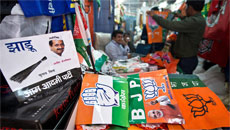
A few quick examples of rule-setting by AAP. Its supporters wore a white cap. Soon BJP supporters started wearing orange caps. When AAP groups started small street-corner meetings and visiting neighbourhoods with singing bards, BJP and Congress cadres tried to emulate that too. When AAP and its leaders wanted to reach Indians directly, they bombarded the social media like Facebook and Twitter with instant updates, BJP and Congress tried the same approach, but miserably stayed far behind in that race. And, above all, the AAP volunteers played the "underdog" role to the hilt, going as far as responding with flowers and songs when attacked by agitated goons of established parties.
Arrayed against helicopters, billions of rupees in party coffers, ferociously loyal RSS and sundry other militant outfits of BJP, and the government-backed ruling Congress and its vast resources, the AAP still stole the march over two heavyweights like Narendra Modi and Rahul Gandhi. Commenting on Kejriwal's rise, sociologist Dipankar Gupta said, "Amazing! No money, no muscle. A great case study for sociology and political science."

Second, just by putting up 434 candidates across India the AAP succeeded in creating an instant outreach across India and thereby laid the foundation to build upon for the next electoral fight. Again, it will be a mistake to try to calculate AAP's sway by the number of seats it wins, against this number. The AAP leadership knew very well that the party was not winning many seats, even if Kejriwal, with uncharacteristic bravado, once said that the party would bag 100 seats. Spreading thin, in retrospect, was clearly a clever move preceding consolidation.
In one fell swoop, AAP made a successful bid to gatecrash into India's political centrestage, outdating narrow, caste- or religion-based slogans of hitherto powerful regional satraps in the process. Witness the panic of a Mayawati or a Mulayam Singh or a Lalu Prasad or a Karunanidhi at the prospect of emasculation!
With a virtually non-existent party apparatus, AAP has instantly become a presence in the pan-Indian consciousness and assumed the role of a viable opposition to the top-down, solely power-seeking Indian political parties. In fact, the real task of AAP starts now to build a party and offer a fresh, bottom-up approach to doing politics, which combines the roles of a watchdog and a mobilizer. The Left parties particularly have much to learn from this experiment to stop their slide to becoming irrelevant.

Third, AAP can't be dismissed any more with epithets like "anarchists" or "the fleers". The party and its cool but vocal leaders have raised extremely important issues like corporate influence over government, rampant corruption by state functionaries, lack of accountability in governance and the widespread malfeasance and bureaucratic callousness that ordinary Indians daily suffer from.
AAP and its campaign have clearly struck a chord with the vast, hitherto silent but now stirred majority, given the admiring response to its innovative campaign style and unblemished personal records of its leadership. For example, even a hard-nosed economist and political analyst like Swaminathan Aiyar made a donation to AAP and praised its economic policy of allowing private business to create wealth in a dispensation where the government simply plays the role of a facilitator.
Thus, it would be a folly to write off or underestimate AAP or Arvind Kejriwal even if he loses the contest against the carefully manufactured neon halo of Narendra Modi.

Assuming it does not win even one seat, AAP's success is evident. Imagine what a dramatic influence it would exert on other members of parliament, if a few of AAP's intelligent, sober and clean candidates win. They would instantly become benchmarks for parliamentary conduct and again force others to behave or lose face in the eyes of an increasingly alert Indian people.
No matter who wins the 2014 race, Kejriwal and his AAP will already have their share of glory. And that is good news for India's democracy.