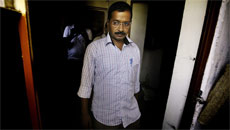
Former Punjab top cop K.P.S. Gill, who is credited with having played a big role in eliminating terrorism from Punjab, died here in a private hospital. He was 82.
Gill, a former Director General of Punjab Police, was suffering from end-stage kidney failure and significant ischemic heart disease.
"He had been recovering from peritonitis but died of sudden cardiac arrest due to cardiac arrhythmia", said a statement from Sir Gangaram Hospital where he was undergoing treatment. He died at 2.55 p.m.
He was admitted to the hospital on May 18.
Gill, who was known as 'supercop', was DGP of Punjab Police between 1988 and 1990 and came back to the post again in 1991 and held it till retirement in 1995.
🙏🏼RIP #KPSGill's contribution in fighting terrorism and restoring peace to Punjab will never be forgotten.My condolences to the family.
— PRIYANKA (@priyankachopra) May 26, 2017
Gill was also president of the Institute for Conflict Management and president of the Indian Hockey Federation (IHF).
He received the Padma Shri in 1989 for his work in civil service.
Sad loss. #KPSGill contribution in fighting terrorism and restoring peace to Punjab cannot be forgotten. My prayers with bereaved family.
— Capt.Amarinder Singh (@capt_amarinder) May 26, 2017
Punjab Chief Minister Capt Amarinder Singh on Friday offered his condolence on the death of former state DGP KPS Gill, recalling his invaluable contribution to bringing peace back to the state from the grip of militancy.
The chief minister said Gill’s role in restoring peace and stability to Punjab cannot be undermined or forgotten, and he continues to be emulated by police and security personnel around the country, as an example of how the most complex of problems can be resolved with grit and determination.
Condolences on the passing away of Former Punjab Police Chief brave KPS Gill at the age of 82 RIP!! pic.twitter.com/9oEKXCBtKd
— Punjab Congress (@punjabpcc) May 26, 2017
Expressing his heartfelt sympathies for the bereaved family, the chief minister said his thoughts and prayers were with them in their hour of grief.
State Health Minister Brahm Mohindra also expressed profound grief and sorrow over the sad demise of KPS Gill.
In a condolence message, Mohindra said KPS Gill was a committed and decorated police officer who served twice as the Director General of Police in Punjab. He termed KPS Gill as an honest, brave, highly efficient and upright officer.
KPS Gill will be remembered for his service to our nation in the fields of policing & security. Pained by his demise. My condolences.
— Narendra Modi (@narendramodi) May 26, 2017
Prime Minister Narendra Modi offered his condolences on Twitter and said Gill would be remembered for his service to the nation.
He was called the super cop for his work in Punjab, where he was the Director General of Police from 1988 to 1990 and then again from 1991 until his retirement from the Indian Police Service in 1995.
When they fail to deliver they divide & distract. But anger and hatred will not convert into jobs or solutions
— Office of RG (@OfficeOfRG) May 26, 2017
I offer my heartfelt condolences to the bereaved family of Shri KPS Gill. May God give them strength to bear this loss. 2/2
— Rajnath Singh (@rajnathsingh) May 26, 2017
My deepest condolences on the passing away of Shri KPS Gill ji. He was an iconic IPS officer who served the nation with honor and pride.
— Amit Shah (@AmitShah) May 26, 2017
INC CONDOLENCE
— INC India (@INCIndia) May 26, 2017
Congress President Smt Sonia Gandhi's condolence message on the passing away of Shri KPS Gill pic.twitter.com/618Rbfn59d
Kanwar Pal Singh Gill: The 'SUPERCOP' Who Led From The Front
India’s best-known cop, Kanwar Pal Singh Gill — credited with crushing insurgency in Punjab — hung up his holster on Friday.
The two-time Director General of Police (DGP) for Punjab, known for dealing with militants with an iron hand, died a quiet death in a Delhi hospital.
He was 82.
Ramrod straight, and with a moustache that defied gravity, KPS Gill was feared in some quarters as much as he was admired in others.

The detractors accused him of violating human rights in Punjab, as it reeled under militant violence in the eighties and early nineties. The supporters said it was the only way he could have tamed armed members of the Khalistan movement, waging a war for secession.
Gill, who succumbed to kidney ailment in the Sir Ganga Ram Hospital on Friday, joined the Indian Police Service in 1958 and was posted in Assam and Meghalaya, where he served for 29 years. He returned to his home state of Punjab in 1984.

His curriculum vitae marked an equal number of highs and lows. In Assam, as in Punjab, he was known for his no-nonsense-style of functioning, stamping out crime and insurgency with a heavy boot.
But while he was credited with rooting out insurgency in Punjab, international rights groups such as Human Rights Watch (HRW) accused him of violating people’s rights.

“Thousands of civilians and suspected militants were summarily executed in staged encounters,” an HRW report said in 1991, accusing the police of using “increasingly brutal methods”.
His finest moment, possibly, was in May 1988, when he commanded ‘Operation Black Thunder’ to flush out militants holed up in the Golden Temple in Amritsar. The police action, and the decision to switch off water and electricity connections, led to the surrender of 67 persons.
A practising Sikh, Gill ensured that during the operation, unlike the controversial Army-led ‘Blue Star’ of 1984, the Sikh shrine was not touched.

No stranger to controversy, Gill was convicted of sexual harassment in 1996 for molesting a civil servant. She had accused him of slapping her bottom at a party in Chandigarh on July 18, 1988.
The 'Supercop' was then the toast of town — rather, of the country.

But the bureaucrat, Rupan Deol Bajaj, surprised Chandigarh’s elite circles when she lodged a police complaint against him. In an FIR on July 28, 1988, she alleged that the slap was the last straw. At one point, she said, he crooked a finger at her and said: “You get up. Come with me.”
But Gill had his legion of friends, too—among them a stream of journalists. Fond of his evening drinks, he knew his Shakespeare and loved Urdu ghazals. An old acquaintance recalls how he could spend an entire night talking about music, while quaffing beer.
An author and seen widely as an expert on counter-terrorism, the Padma Shri awardee was also the president of the Institute for Conflict Management and of the Indian Hockey Federation.
An officer known to lead from the front, he was admired by the rank for his leadership qualities, and the fact that he stood by them.

A Punjab watcher recalls how, once while trying to enter a trench, he refused to crawl into the tunnel.
“Sir, you will be targeted,” a junior officer said.
“A janrail (Punjabi for General) never bends,” he replied.