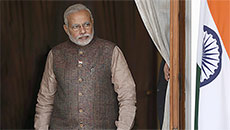
He may have been in the firing line of opposition leaders for his frequent visits abroad but Prime Minister Narendra Modi seems undeterred by the flak - and even the jokes on his foreign visits - to set a new benchmark for India's foreign policy initiatives and make India a global power.
In just over 18 months after becoming prime minister, Modi has already visited 30 countries, three of them - the United States, France and Nepal seeing two visits each. His first visit, within 20 days of assuming office, was to closest neighbour Bhutan in June 2014.
That Modi is not in any foreign holiday mode can be gauged from his hectic schedules in all the countries he has visited so far and the number of summit meetings with top leaders, including US President Barack Obama, British Prime Minister David Cameroon, Chinese President Xi Jinping and the heads of state and government rulers of the other countries.

From the tiny island country Fiji to economic giants like the US and Japan, Modi has ensured that he leads by example on the diplomatic front to engage with other countries for economic and strategic interests. Modi's mission certainly is aimed at catapulting India to a global power in the coming years.
But in doing so, Modi is not trying to usurp the role of the ministry of external affairs (MEA) or for that matter of External Affairs Minister Sushma Swaraj.
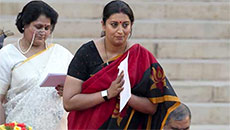
Though Sushma Swaraj is generally not part of Modi's foreign entourage, she certainly should not be feeling left out.
The minister has herself been criss-crossing the globe in the same period - having been to 28 countries as well, clearly indicating the importance the Modi government is attaching to foreign policy matters and getting India the tag of a world power in the future.
Swaraj, like Modi, too is not on any junket and is ensuring India's diplomatic outreach and strategic partnerships in the present and the future.

President Pranab Mukherjee has travelled to 10 countries in six state visits after the Modi government took over. Vice President Hamid Ansari has travelled abroad thrice in the same period.
Modi has addressed lawmakers in various countries - from Australia to the United States - but his penchant seems to be in a rockstar role in addressing biggish gatherings of Indians settled abroad. From his first mega-show at New York's Madison Square Garden to stadia in Sydney and Dubai to the recent show at London's iconic Wembley Stadium (where even British Prime Minister David Cameroon was present), Modi has created an image of being a hit with NRIs.
"Narendra Modi's foreign policy initiatives have realized the true potential and role of the world's largest democracy, India, on the world stage," the website of the Prime Minister's Office (PMO) states, making it clear where he wants to see India in the coming years.
Modi's foreign policy initiatives are not only offshore.
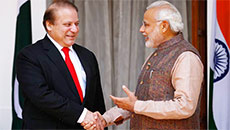
He assumed office with a bang by getting the top leaders of all the SAARC countries, including Pakistani Prime Minister Nawaz Sharif, to attend his swearing-in in New Delhi on May 26, 2014.

"Narendra Modi became the first Indian prime minister to embark on a bilateral visit to Nepal after a long period of 17 years, to Australia after 28 years, to Fiji after 31 years and the Seychelles after 34 years. He became the first PM of India to visit Mongolia.
Modi has attached great importance to strong ties with the Arab world. His visit to the UAE in August 2015, the first by an Indian PM in 34 years, covered tremendous ground in enhancing India's economic partnership with the Gulf," the PMO website states, listing the importance that his government is attaching to engaging with countries which seemed to have been lost on India's foreign policy radar in the last few decades as the emphasis continued on the big western powers.
Modi has addressed the UN General Assembly, actively participated in the India-Africa Forum, BRICS, SAARC and G-20 Summits and attended other international conferences in Paris, Kuala Lumpur and other cities.
On home ground too, Modi has not let off on the diplomatic front.
He invited US President Barack Obama to be the chief guest at the 2015 Republic Day celebrations in New Delhi on January 26 - a first in Indo-US ties - hosted Chinese President Xi Jinping in Ahmedabad and New Delhi, had his Australian counterpart Tony Abbott visiting and hosted President Vladimir Putin of Russia and Chancellor Angela Merkel of Germany.

Though Modi has not yet touched base on the African continent, the historic India-Africa Summit was held in New Delhi in October at which all the 54 African nations were represented - perhaps the first time this has happened outside the continent. Modi also held bilateral meetings with several African leaders during the event.
Modi has, with visits to pricipal central Asian countries like Kazakhstan, Kyrgyzstan, Turkmenistan, Tajikistan and Uzbekistan, as also Mongolia, has indicated his government wanted to secure strategic ties with them.
And, as the year is being closed, it was announced that Modi would be visiting Islamabad next year for the SAARC summit. This, on the back of renewed India-Pakistan ties and the renewal of their composite dialogue.
There perhaps couldn't have been a better way to end the year.