Wednesday, December 31, 2025
ADVT 
India

Greatest Harm Would Happen If Indian Judiciary Doesn't Rectify, Introspect: Narendra Modi

Darpan News Desk IANS, 04 Apr, 2015 11:44 PM
    Prime Minister Narendra Modi said on Sunday there was a need to create good law institutions and capable manpower keeping future in mind.
     
    "People have a lot of faith in the judicial system of India. We need to look at the manpower that is coming in this field in coming years. We have to think how can we create good law institutions, keeping in mind the needs of the future," Modi said, addressing a joint conference of chief justices of high courts and chief ministers here.
     
    The conference was inaugurated by the prime minister.
     
    "There is a great responsibility on the Indian judiciary. In fact, we all are the same kind of individuals carrying out responsibilities as per our potential and capabilities. But this is not the case with people in the judicial system, what they do is divine. God has sent you to carry out this divine responsibility," said Modi.
     
    "The judiciary should be both powerful and perfect. This is the place that is trusted by common people," the prime minister said.
     
    Talking about the pending cases, Modi said people need to think how courts functioned if there was no electricity or there were other complications.
     
    "We all talk about the pendency of cases in courts but have we ever thought the number of hours the judiciary has to spent on them and the problems they go through," Modi asked.
     
    Talking about the usage of technology in the judicial system, Modi said: "The quicker we get technology in this field, the easier it is to bring about a qualitative change." 
     
    "None of the responsibilities is one sided, more we use technology in the judicial system, better it can function," he added.
    MORE India ARTICLES

    How Punjab's Paddy Straw Burning is Impacting Climate and Health

    How Punjab's Paddy Straw Burning is Impacting Climate and Health
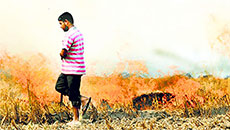
    A study by an international team using satellite and ground-based instruments has shown that crop residue burning, a common practice in northern India and particularly in Punjab, is contributing to atmospheric pollution over the entire Indo-Gangetic Plain (IGP) that may have climate and health implications.

    How Punjab's Paddy Straw Burning is Impacting Climate and Health

    Centre will study Gujarat's housing model

    Centre will study Gujarat's housing model
    The BJP-led NDA government, which has affordable housing for all as one of its objectives, will study the Gujarat model of housing for poor, Union Minister of Housing and Poverty Alleviation M. Venkaiah Naidu said here Tuesday.

    Centre will study Gujarat's housing model

    Delhi Police studies Surat's CCTV system

    Delhi Police studies Surat's CCTV system
    A Delhi Police team Tuesday went to Surat in Gujarat to study the CCTV cameras installed there in the public-private partnership (PPP) model.

    Delhi Police studies Surat's CCTV system

    Dehradun shootout: Life imprisonment for 17 policemen

    Dehradun shootout: Life imprisonment for 17 policemen
    A Delhi court Monday awarded life imprisonment to 17 of the 18 policemen convicted of killing a 22-year-old MBA student in a fake shootout in Dehradun in 2009.

    Dehradun shootout: Life imprisonment for 17 policemen

    Five bodies found in Himachal river, 21 still missing

    Five bodies found in Himachal river, 21 still missing
    The bodies of five engineering students were retrieved Monday from the Beas river in Himachal Pradesh's Mandi district while a search is on for 21 others who were washed away. A court described it as "consequence of utter and callous negligence".

    Five bodies found in Himachal river, 21 still missing

    President lists how Modi's 'acche din' are here to come

    President lists how Modi's 'acche din' are here to come
    If "acche din aane wale hain" or good days are to come was Prime Minister Narendra Modi's vote-pulling election slogan, President Pranab Mukherjee Monday outlined "how" in his 55-minute address to a joint session of parliament, listing the new government's priorities in areas ranging from domestic issues to foreign policy.

    President lists how Modi's 'acche din' are here to come