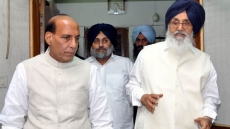
Sikh politics is on the boil in Punjab and Haryana. Punjab Chief Minister Parkash Singh Badal is insisting that Haryana roll back the Haryana Sikh Gurdwaras (Management) Act, 2014, creating a separate body to manage the gurdwaras in the state.
The new body will cut into the clout of the all-powerful Sikh Gurdwara Parbandhak Committee (SGPC) which has managed all gurdwaras in Punjab and in neighouring Haryana and Himachal as well.
This is the first time in 48 years since the reorganisation of Punjab in 1966 - when Haryana and Himachal were carved out of the state - that the control of gurdwaras in Haryana will go out of the SGPC hands.
A troubling fact for Badal and his Shiromani Akali Dal has, over the years, come to control the SGPC. Any loss in the SGPC's influence may also cause his political fortunes to wane.
Backed by the Centre, Badal is contesting the Haryana law on the ground that it was contrary to the Sikh Gurdwara Act, 1925, and Section 72 of the Punjab State Reorganisation Act, 1966, which vested the task of managing all gurdwaras in the three states in the SGPC.
The Sikh Gurdwara Act, 1925, was enacted to better administer gurdwaras. It was enacted after a long struggle for reforms to free them up from the clutches of Mahants. Things have now come a full circle, with political mahants, who abhor any kind of democratization, again gaining charge.
Section 72 of the Reorganisation Act says any corporate body based in Punjab but also serving the needs of the other two states would be an inter-state one and continue to operate in these states until other provisions are made by law.
Sub-section (3) says that the provisions "shall apply also to the Punjab University, the Punjab Agricultural University and the Board constituted under the provisions of Part III of the Sikh Gurdwaras Act, 1925".
Sub-section (1) also makes it clear that such inter-state bodies would continue to operate and Haryana and Himachal would contribute funds to them till their alternates were set up in the newborn states.
In course of time, Haryana set up Kurukshetra University as a substitute to Punjab University and replaced Punjab Agricultural University by the Hissar-based Haryana Agriculture University. Similarly HP University and HP Agricultural University were set up.
There was no clamour when operations of the Punjab University and Punjab Agricultural University were shut down by new bodies both in Haryana and Himachal under the 1966 Act.
So, Section 72 can't bar Haryana from setting up its own body to manage gurdwaras in the state.
There has been a feeling among a sizable section of Sikhs in Haryana that management of gurdwaras in the state was subject to the whims and fancies of the Amritsar-based SGPC.
There was also a growing feeling that they were denied their legitimate representation in the Sikh religious body.
The Haryana Sikhs say that the Sikh Gurdwara Act, 1925, was enacted for the control and management of important gurdwaras in undivided Punjab only. It was a Punjab act for which prior consent was given by the then governor general.
Any such law cannot be extended to Haryana and Himachal, which were carved out of the undivided state to satisfy the Akali clamour for a Punjabi Suba (state).
Neither was there any explicit provision for vesting their control with the SGPC. However, since it is an emotive issue involving Sikhs on both sides, it politically pits the Congress against the Akalis in Punjab.
The Congress is counting every vote that it can garner in the run up to the assembly elections in Haryana a couple of months from now. The Akalis too do not wish to miss any opportunity to check the erosion of their support base, so starkly reflected in the April-May Lok Sabha elections in Punjab.
What's worse, the union home secretary has written to the Haryana chief secretary urging the governor to withdraw his assent to the Haryana Sikh Gurdwaras (Management) Act, 2014, that was granted on July 14, 2014.
Once the governor has given his assent to a bill, it becomes a law. There is no provision under the constitution that the governor, after assenting to a bill, can withdraw that.
A law can be only annulled by bringing a bill in the assembly nullifying it. The governor has to assent to it. Alternately, the court could set aside the law if its validity was challenged.
There is no third option. The governor has no power to suo motu withdraw his consent as under the constitutional scheme he is bound to normally act on the aid and advice of the council of ministers. He can only act otherwise in exceptional circumstances wherein his office is specifically enjoined to act on his own such as sending reports to the president.
So, no direction can be issued to the Haryana government under Article 256 of the constitution to obliterate Haryana's 2014 Gurdwaras Act.
What on the face of it seems to be a battle for votes shouldn't be allowed to get any cloak of constitutional sanctity. Can the centre ignore all long-term ramifications of such a move just to please a political ally?